

22 Marine Macro- and Microalgae: An Overview
regulating capabilities against ocean acidification, deoxygenation, and eutrophication (Chung et al. 2017;
Kang and Chung 2017).
We briefly introduce the Korean project (Chung et al. 2011, 2013) in the present study. For the first
time, we developed a draft of Seaweed CDM-AR-PDD. Hopefully, the work could provide valuable
information for countries preparing the NDCs with seaweeds (Sondak et al. 2017).
Korean initiative
Concept of a Coastal CO 2 Removal Belt (CCRB)
At their annual meeting in 2005, the Korean Society of Phycology decided to recruit a task force to evaluate
algae-related projects for combating the effects of climate change. From those proposals, the Project
‘Greenhouse Gas (GHG) Emissions Reductions using Seaweeds’ was funded by the Korean Ministry of
Maritime Affairs and Fisheries (MOMAF, now Ministry of Oceans and Fisheries) in 2006 (http://agwseaweed.org). The purpose of that project was to develop a seaweed Clean Development Mechanism
(CDM). The objective of the Coastal CO 2 Removal Belt (CCRB; Fig. 2) was to accomplish CO 2 removal
via forests or beds in coastal waters, implementing those tasks along various spatial-temporal scales
(Chung 2007; Chung et al. 2013). The CCRB was to be established and managed by CDM Projects.
To achieve this goal efficiently, the project was conducted in two phases. The first, from 2006 to 2008,
involved selecting suitable species for the CCRB and developing methods for monitoring the baseline of
seaweed communities. The second phase, from 2009 to 2011, focused on conducting a pilot CCRB farm
study to devise a new method for measuring the actual, net removal of GHG by seaweeds.
As a newly developed concept, the CCRB had several facets that required open discussion. Intended
for coastal regions, it was to be a natural and/or man-made community that achieved CO 2 removal in
the manner of a forest, and it was defined according to various spatial-temporal scales. Its operational
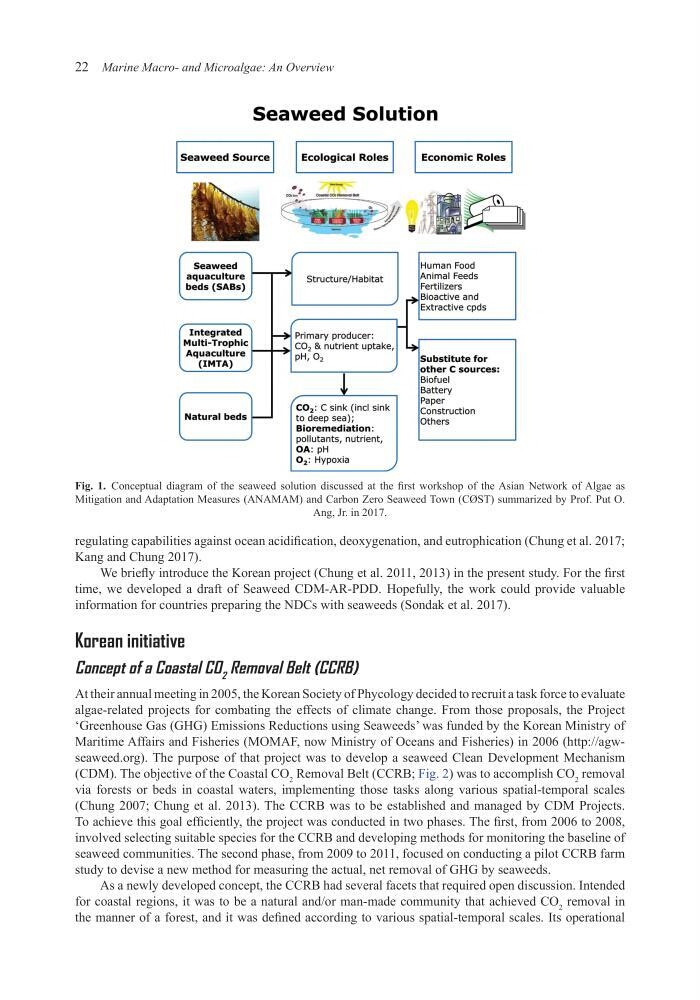
Fig. 1. Conceptual diagram of the seaweed solution discussed at the first workshop of the Asian Network of Algae as
Mitigation and Adaptation Measures (ANAMAM) and Carbon Zero Seaweed Town (CØST) summarized by Prof. Put O.
Ang, Jr. in 2017.
Seaweed Solution
Ecological Roles
Economic Roles
Seaweed
Human Food
aquaculture
Structure/Habitat
Animal Feeds
beds (SABs)
Fertilizers
r+ Bioactive and
Extractive cpds
Integrated
~ Primary producer:
Multi-Trophic 1-- ~
C0 2 & nutrient uptake, ~
Aquaculture
(IMTA)
pH, 0 2
Substitute for
other C sources:
!
Biofuel
Battery
C0 2 : C sink (incl sink
Paper
Construction
Natural beds 1-to deep sea);
Others
Bioremediation :
pollutants, nutrient,
OA : pH
0 2 : Hypoxia
regulating capabilities against ocean acidification, deoxygenation, and eutrophication (Chung et al. 2017;
Kang and Chung 2017).
We briefly introduce the Korean project (Chung et al. 2011, 2013) in the present study. For the first
time, we developed a draft of Seaweed CDM-AR-PDD. Hopefully, the work could provide valuable
information for countries preparing the NDCs with seaweeds (Sondak et al. 2017).
Korean initiative
Concept of a Coastal CO 2 Removal Belt (CCRB)
At their annual meeting in 2005, the Korean Society of Phycology decided to recruit a task force to evaluate
algae-related projects for combating the effects of climate change. From those proposals, the Project
‘Greenhouse Gas (GHG) Emissions Reductions using Seaweeds’ was funded by the Korean Ministry of
Maritime Affairs and Fisheries (MOMAF, now Ministry of Oceans and Fisheries) in 2006 (http://agwseaweed.org). The purpose of that project was to develop a seaweed Clean Development Mechanism
(CDM). The objective of the Coastal CO 2 Removal Belt (CCRB; Fig. 2) was to accomplish CO 2 removal
via forests or beds in coastal waters, implementing those tasks along various spatial-temporal scales
(Chung 2007; Chung et al. 2013). The CCRB was to be established and managed by CDM Projects.
To achieve this goal efficiently, the project was conducted in two phases. The first, from 2006 to 2008,
involved selecting suitable species for the CCRB and developing methods for monitoring the baseline of
seaweed communities. The second phase, from 2009 to 2011, focused on conducting a pilot CCRB farm
study to devise a new method for measuring the actual, net removal of GHG by seaweeds.
As a newly developed concept, the CCRB had several facets that required open discussion. Intended
for coastal regions, it was to be a natural and/or man-made community that achieved CO 2 removal in
the manner of a forest, and it was defined according to various spatial-temporal scales. Its operational
Fig. 1. Conceptual diagram of the seaweed solution discussed at the first workshop of the Asian Network of Algae as
Mitigation and Adaptation Measures (ANAMAM) and Carbon Zero Seaweed Town (CØST) summarized by Prof. Put O.
Ang, Jr. in 2017.
Seaweed Solution
Ecological Roles
Economic Roles
Seaweed
Human Food
aquaculture
Structure/Habitat
Animal Feeds
beds (SABs)
Fertilizers
r+ Bioactive and
Extractive cpds
Integrated
~ Primary producer:
Multi-Trophic 1-- ~
C0 2 & nutrient uptake, ~
Aquaculture
(IMTA)
pH, 0 2
Substitute for
other C sources:
!
Biofuel
Battery
C0 2 : C sink (incl sink
Paper
Construction
Natural beds 1-to deep sea);
Others
Bioremediation :
pollutants, nutrient,
OA : pH
0 2 : Hypoxia