

208 Marine Macro- and Microalgae: An Overview
stabilizes the oil phase in emulsifier-free cosmetics by increasing its viscosity. It is important to note that
alginates are not absorbed into the skin. Propylene glycol alginate, an ester formed from propylene glycol
and alginic acid, has similar properties to alginic acid.
The main use of the alginates are as thermally stable cold setting gelling agents and are prepared by
the addition of calcium ions, with gelling occurring at much lower concentrations than when compared to
gelatin. Such gels can be heat treated without melting, although they may eventually undergo degradation.
The choice of gelling ions has a significant effect on the final gel properties. Low molecular weight alginate
with a low concentration of gelling ions (like Ca
2+
) generally exhibits the highest inhomogeneity (SkjåkBræk et al. 1989). Alginate with high G content produces strong brittle gels with good heat stability, but
prone to water separation on freeze-thaw. Alginate with high M content produces weaker more-elastic gels
with good freeze-thaw behavior. High MGMG content and a high concentration of gelling ions (Ca
2+
ions)
are found to reduce shear (Donati et al. 2005).
The uses of alginates are based on their ability to: (a) increase the viscosity of solutions when dissolved
in water; (b) their ability to form gels, when a calcium salt is added to a solution of sodium alginate in
water; and (c) their ability to form films of sodium or calcium alginate and fibres of calcium alginates. In
contrast to the agar gels, where the water must initially be heated to about 80°C in order to dissolve the
agar and the gel forms when cooled below about 40°C, no heat is required to form an alginate gel. Also,
these gels do not melt when heated.
Alginic acid is also structurally related to hyaluronic acid or hyaluronan, and shows molecular weight
dependent inhibition of hyaluronidase (Asada et al. 1997). Hyaluronidases are a group of enzymes that
degrade hyaluronic acid polymers (Fraser et al. 1997). Hyaluronic acid is a major constituent of the
extracellular matrix (ECM) of most tissues, including skin, synovial fluid, and vitreous humor (Fraser et
al. 1997). Therefore, it is highly compatible and suitable for use in many medical applications. The name
“hyaluronic acid” comes from the Greek “hyalos” (vitreous) and uronic acid (Meyer and Palmer 1934). It
is a high molecular weight linear polysaccharide polymer of the family of glycosaminoglycans, one of the
largest matrix molecules, and is a polymer with a length of 2–25 µm and a molecular weight 106–107 Da.
The apparent size of hyaluronic acid is even greater, because it can incorporate a large volume of water.
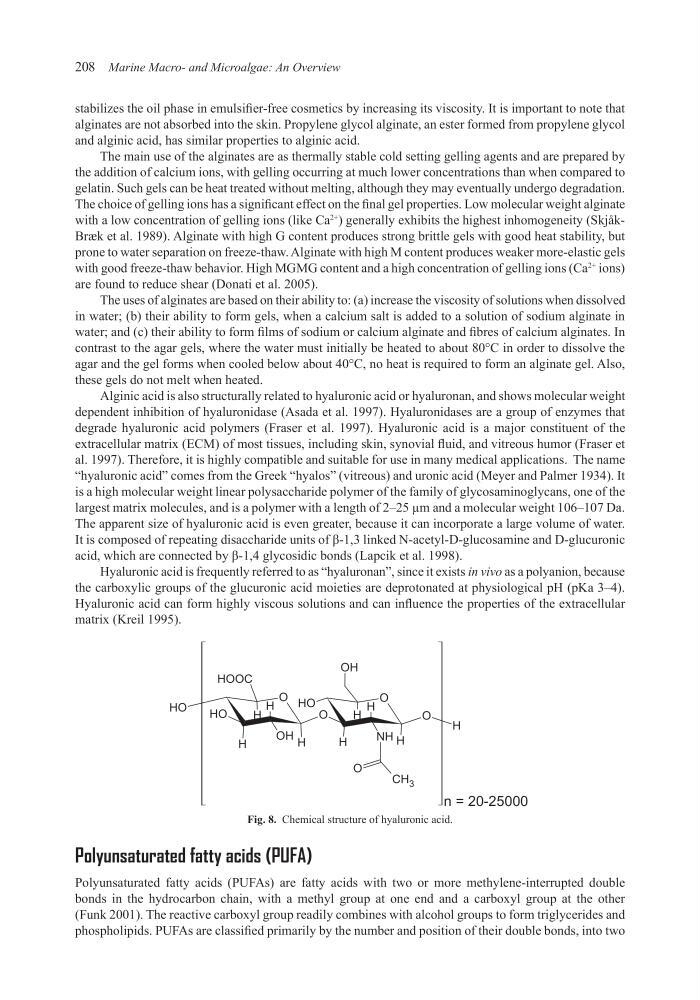
It is composed of repeating disaccharide units of β-1,3 linked N-acetyl-D-glucosamine and D-glucuronic
acid, which are connected by β-1,4 glycosidic bonds (Lapcik et al. 1998).
Hyaluronic acid is frequently referred to as “hyaluronan”, since it exists in vivo as a polyanion, because
the carboxylic groups of the glucuronic acid moieties are deprotonated at physiological pH (pKa 3–4).
Hyaluronic acid can form highly viscous solutions and can influence the properties of the extracellular
matrix (Kreil 1995).
Fig. 8. Chemical structure of hyaluronic acid.
O
H
OH
H
H
H
O
H
O
H
HOOC
O
H
NH
H
H
H
O
O
O
H
OH
H
O
CH 3
n = 20-25000
Polyunsaturated fatty acids (PUFA)
Polyunsaturated fatty acids (PUFAs) are fatty acids with two or more methylene-interrupted double
bonds in the hydrocarbon chain, with a methyl group at one end and a carboxyl group at the other
(Funk 2001). The reactive carboxyl group readily combines with alcohol groups to form triglycerides and
phospholipids. PUFAs are classified primarily by the number and position of their double bonds, into two
stabilizes the oil phase in emulsifier-free cosmetics by increasing its viscosity. It is important to note that
alginates are not absorbed into the skin. Propylene glycol alginate, an ester formed from propylene glycol
and alginic acid, has similar properties to alginic acid.
The main use of the alginates are as thermally stable cold setting gelling agents and are prepared by
the addition of calcium ions, with gelling occurring at much lower concentrations than when compared to
gelatin. Such gels can be heat treated without melting, although they may eventually undergo degradation.
The choice of gelling ions has a significant effect on the final gel properties. Low molecular weight alginate
with a low concentration of gelling ions (like Ca
2+
) generally exhibits the highest inhomogeneity (SkjåkBræk et al. 1989). Alginate with high G content produces strong brittle gels with good heat stability, but
prone to water separation on freeze-thaw. Alginate with high M content produces weaker more-elastic gels
with good freeze-thaw behavior. High MGMG content and a high concentration of gelling ions (Ca
2+
ions)
are found to reduce shear (Donati et al. 2005).
The uses of alginates are based on their ability to: (a) increase the viscosity of solutions when dissolved
in water; (b) their ability to form gels, when a calcium salt is added to a solution of sodium alginate in
water; and (c) their ability to form films of sodium or calcium alginate and fibres of calcium alginates. In
contrast to the agar gels, where the water must initially be heated to about 80°C in order to dissolve the
agar and the gel forms when cooled below about 40°C, no heat is required to form an alginate gel. Also,
these gels do not melt when heated.
Alginic acid is also structurally related to hyaluronic acid or hyaluronan, and shows molecular weight
dependent inhibition of hyaluronidase (Asada et al. 1997). Hyaluronidases are a group of enzymes that
degrade hyaluronic acid polymers (Fraser et al. 1997). Hyaluronic acid is a major constituent of the
extracellular matrix (ECM) of most tissues, including skin, synovial fluid, and vitreous humor (Fraser et
al. 1997). Therefore, it is highly compatible and suitable for use in many medical applications. The name
“hyaluronic acid” comes from the Greek “hyalos” (vitreous) and uronic acid (Meyer and Palmer 1934). It
is a high molecular weight linear polysaccharide polymer of the family of glycosaminoglycans, one of the
largest matrix molecules, and is a polymer with a length of 2–25 µm and a molecular weight 106–107 Da.
The apparent size of hyaluronic acid is even greater, because it can incorporate a large volume of water.
It is composed of repeating disaccharide units of β-1,3 linked N-acetyl-D-glucosamine and D-glucuronic
acid, which are connected by β-1,4 glycosidic bonds (Lapcik et al. 1998).
Hyaluronic acid is frequently referred to as “hyaluronan”, since it exists in vivo as a polyanion, because
the carboxylic groups of the glucuronic acid moieties are deprotonated at physiological pH (pKa 3–4).
Hyaluronic acid can form highly viscous solutions and can influence the properties of the extracellular
matrix (Kreil 1995).
Fig. 8. Chemical structure of hyaluronic acid.
O
H
OH
H
H
H
O
H
O
H
HOOC
O
H
NH
H
H
H
O
O
O
H
OH
H
O
CH 3
n = 20-25000
Polyunsaturated fatty acids (PUFA)
Polyunsaturated fatty acids (PUFAs) are fatty acids with two or more methylene-interrupted double
bonds in the hydrocarbon chain, with a methyl group at one end and a carboxyl group at the other
(Funk 2001). The reactive carboxyl group readily combines with alcohol groups to form triglycerides and
phospholipids. PUFAs are classified primarily by the number and position of their double bonds, into two