

The Cosmeceutical Properties of Compounds Derived from Marine Algae 207
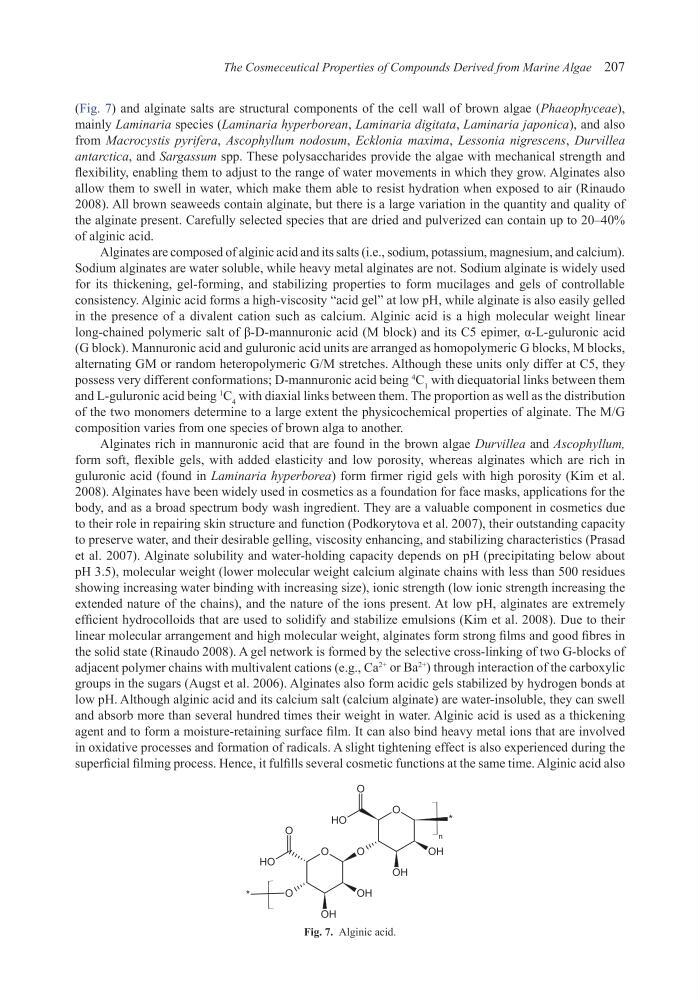
(Fig. 7) and alginate salts are structural components of the cell wall of brown algae (Phaeophyceae),
mainly Laminaria species (Laminaria hyperborean, Laminaria digitata, Laminaria japonica), and also
from Macrocystis pyrifera, Ascophyllum nodosum, Ecklonia maxima, Lessonia nigrescens, Durvillea
antarctica, and Sargassum spp. These polysaccharides provide the algae with mechanical strength and
flexibility, enabling them to adjust to the range of water movements in which they grow. Alginates also
allow them to swell in water, which make them able to resist hydration when exposed to air (Rinaudo
2008). All brown seaweeds contain alginate, but there is a large variation in the quantity and quality of
the alginate present. Carefully selected species that are dried and pulverized can contain up to 20–40%
of alginic acid.
Alginates are composed of alginic acid and its salts (i.e., sodium, potassium, magnesium, and calcium).
Sodium alginates are water soluble, while heavy metal alginates are not. Sodium alginate is widely used
for its thickening, gel-forming, and stabilizing properties to form mucilages and gels of controllable
consistency. Alginic acid forms a high-viscosity “acid gel” at low pH, while alginate is also easily gelled
in the presence of a divalent cation such as calcium. Alginic acid is a high molecular weight linear
long-chained polymeric salt of β-D-mannuronic acid (M block) and its C5 epimer, α-L-guluronic acid
(G block). Mannuronic acid and guluronic acid units are arranged as homopolymeric G blocks, M blocks,
alternating GM or random heteropolymeric G/M stretches. Although these units only differ at C5, they
possess very different conformations; D-mannuronic acid being
4
C 1 with diequatorial links between them
and L-guluronic acid being
1
C 4 with diaxial links between them. The proportion as well as the distribution
of the two monomers determine to a large extent the physicochemical properties of alginate. The M/G
composition varies from one species of brown alga to another.
Alginates rich in mannuronic acid that are found in the brown algae Durvillea and Ascophyllum,
form soft, flexible gels, with added elasticity and low porosity, whereas alginates which are rich in
guluronic acid (found in Laminaria hyperborea) form firmer rigid gels with high porosity (Kim et al.
2008). Alginates have been widely used in cosmetics as a foundation for face masks, applications for the
body, and as a broad spectrum body wash ingredient. They are a valuable component in cosmetics due
to their role in repairing skin structure and function (Podkorytova et al. 2007), their outstanding capacity
to preserve water, and their desirable gelling, viscosity enhancing, and stabilizing characteristics (Prasad
et al. 2007). Alginate solubility and water-holding capacity depends on pH (precipitating below about
pH 3.5), molecular weight (lower molecular weight calcium alginate chains with less than 500 residues
showing increasing water binding with increasing size), ionic strength (low ionic strength increasing the
extended nature of the chains), and the nature of the ions present. At low pH, alginates are extremely
efficient hydrocolloids that are used to solidify and stabilize emulsions (Kim et al. 2008). Due to their
linear molecular arrangement and high molecular weight, alginates form strong films and good fibres in
the solid state (Rinaudo 2008). A gel network is formed by the selective cross-linking of two G-blocks of
adjacent polymer chains with multivalent cations (e.g., Ca
2+
or Ba
2+
) through interaction of the carboxylic
groups in the sugars (Augst et al. 2006). Alginates also form acidic gels stabilized by hydrogen bonds at
low pH. Although alginic acid and its calcium salt (calcium alginate) are water-insoluble, they can swell
and absorb more than several hundred times their weight in water. Alginic acid is used as a thickening
agent and to form a moisture-retaining surface film. It can also bind heavy metal ions that are involved
in oxidative processes and formation of radicals. A slight tightening effect is also experienced during the
superficial filming process. Hence, it fulfills several cosmetic functions at the same time. Alginic acid also
Fig. 7. Alginic acid.
n
O
*
OH
OH
O
O
H
O
O
OH
OH
O
O
H
O
*
(Fig. 7) and alginate salts are structural components of the cell wall of brown algae (Phaeophyceae),
mainly Laminaria species (Laminaria hyperborean, Laminaria digitata, Laminaria japonica), and also
from Macrocystis pyrifera, Ascophyllum nodosum, Ecklonia maxima, Lessonia nigrescens, Durvillea
antarctica, and Sargassum spp. These polysaccharides provide the algae with mechanical strength and
flexibility, enabling them to adjust to the range of water movements in which they grow. Alginates also
allow them to swell in water, which make them able to resist hydration when exposed to air (Rinaudo
2008). All brown seaweeds contain alginate, but there is a large variation in the quantity and quality of
the alginate present. Carefully selected species that are dried and pulverized can contain up to 20–40%
of alginic acid.
Alginates are composed of alginic acid and its salts (i.e., sodium, potassium, magnesium, and calcium).
Sodium alginates are water soluble, while heavy metal alginates are not. Sodium alginate is widely used
for its thickening, gel-forming, and stabilizing properties to form mucilages and gels of controllable
consistency. Alginic acid forms a high-viscosity “acid gel” at low pH, while alginate is also easily gelled
in the presence of a divalent cation such as calcium. Alginic acid is a high molecular weight linear
long-chained polymeric salt of β-D-mannuronic acid (M block) and its C5 epimer, α-L-guluronic acid
(G block). Mannuronic acid and guluronic acid units are arranged as homopolymeric G blocks, M blocks,
alternating GM or random heteropolymeric G/M stretches. Although these units only differ at C5, they
possess very different conformations; D-mannuronic acid being
4
C 1 with diequatorial links between them
and L-guluronic acid being
1
C 4 with diaxial links between them. The proportion as well as the distribution
of the two monomers determine to a large extent the physicochemical properties of alginate. The M/G
composition varies from one species of brown alga to another.
Alginates rich in mannuronic acid that are found in the brown algae Durvillea and Ascophyllum,
form soft, flexible gels, with added elasticity and low porosity, whereas alginates which are rich in
guluronic acid (found in Laminaria hyperborea) form firmer rigid gels with high porosity (Kim et al.
2008). Alginates have been widely used in cosmetics as a foundation for face masks, applications for the
body, and as a broad spectrum body wash ingredient. They are a valuable component in cosmetics due
to their role in repairing skin structure and function (Podkorytova et al. 2007), their outstanding capacity
to preserve water, and their desirable gelling, viscosity enhancing, and stabilizing characteristics (Prasad
et al. 2007). Alginate solubility and water-holding capacity depends on pH (precipitating below about
pH 3.5), molecular weight (lower molecular weight calcium alginate chains with less than 500 residues
showing increasing water binding with increasing size), ionic strength (low ionic strength increasing the
extended nature of the chains), and the nature of the ions present. At low pH, alginates are extremely
efficient hydrocolloids that are used to solidify and stabilize emulsions (Kim et al. 2008). Due to their
linear molecular arrangement and high molecular weight, alginates form strong films and good fibres in
the solid state (Rinaudo 2008). A gel network is formed by the selective cross-linking of two G-blocks of
adjacent polymer chains with multivalent cations (e.g., Ca
2+
or Ba
2+
) through interaction of the carboxylic
groups in the sugars (Augst et al. 2006). Alginates also form acidic gels stabilized by hydrogen bonds at
low pH. Although alginic acid and its calcium salt (calcium alginate) are water-insoluble, they can swell
and absorb more than several hundred times their weight in water. Alginic acid is used as a thickening
agent and to form a moisture-retaining surface film. It can also bind heavy metal ions that are involved
in oxidative processes and formation of radicals. A slight tightening effect is also experienced during the
superficial filming process. Hence, it fulfills several cosmetic functions at the same time. Alginic acid also
Fig. 7. Alginic acid.
n
O
*
OH
OH
O
O
H
O
O
OH
OH
O
O
H
O
*