

204 Marine Macro- and Microalgae: An Overview
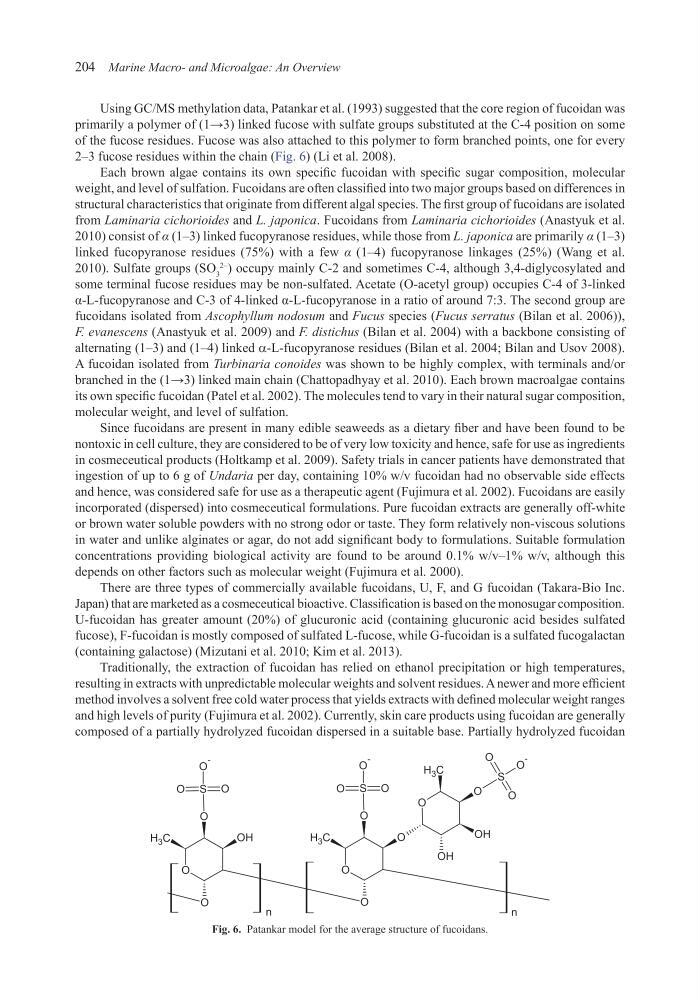
Using GC/MS methylation data, Patankar et al. (1993) suggested that the core region of fucoidan was
primarily a polymer of (1→3) linked fucose with sulfate groups substituted at the C-4 position on some
of the fucose residues. Fucose was also attached to this polymer to form branched points, one for every
2–3 fucose residues within the chain (Fig. 6) (Li et al. 2008).
Each brown algae contains its own specific fucoidan with specific sugar composition, molecular
weight, and level of sulfation. Fucoidans are often classified into two major groups based on differences in
structural characteristics that originate from different algal species. The first group of fucoidans are isolated
from Laminaria cichorioides and L. japonica. Fucoidans from Laminaria cichorioides (Anastyuk et al.
2010) consist of α (1–3) linked fucopyranose residues, while those from L. japonica are primarily α (1–3)
linked fucopyranose residues (75%) with a few α (1–4) fucopyranose linkages (25%) (Wang et al.
2010). Sulfate groups (SO 3
2–
) occupy mainly C-2 and sometimes C-4, although 3,4-diglycosylated and
some terminal fucose residues may be non-sulfated. Acetate (O-acetyl group) occupies C-4 of 3-linked
α-L-fucopyranose and C-3 of 4-linked α-L-fucopyranose in a ratio of around 7:3. The second group are
fucoidans isolated from Ascophyllum nodosum and Fucus species (Fucus serratus (Bilan et al. 2006)),
F. evanescens (Anastyuk et al. 2009) and F. distichus (Bilan et al. 2004) with a backbone consisting of
alternating (1–3) and (1–4) linked α-L-fucopyranose residues (Bilan et al. 2004; Bilan and Usov 2008).
A fucoidan isolated from Turbinaria conoides was shown to be highly complex, with terminals and/or
branched in the (1→3) linked main chain (Chattopadhyay et al. 2010). Each brown macroalgae contains
its own specific fucoidan (Patel et al. 2002). The molecules tend to vary in their natural sugar com position,
molecular weight, and level of sulfation.
Since fucoidans are present in many edible seaweeds as a dietary fiber and have been found to be
nontoxic in cell culture, they are considered to be of very low toxicity and hence, safe for use as ingredients
in cosmeceutical products (Holtkamp et al. 2009). Safety trials in cancer patients have demonstrated that
ingestion of up to 6 g of Undaria per day, containing 10% w/v fucoidan had no observable side effects
and hence, was considered safe for use as a therapeutic agent (Fujimura et al. 2002). Fucoidans are easily
incorporated (dispersed) into cosmeceutical formulations. Pure fucoidan extracts are generally off-white
or brown water soluble powders with no strong odor or taste. They form relatively non-viscous solutions
in water and unlike alginates or agar, do not add significant body to formulations. Suitable formulation
concentrations providing biological activity are found to be around 0.1% w/v–1% w/v, although this
depends on other factors such as molecular weight (Fujimura et al. 2000).
There are three types of commercially available fucoidans, U, F, and G fucoidan (Takara-Bio Inc.
Japan) that are marketed as a cosmeceutical bioactive. Classification is based on the monosugar composition.
U-fucoidan has greater amount (20%) of glucuronic acid (containing glucuronic acid besides sulfated
fucose), F-fucoidan is mostly composed of sulfated L-fucose, while G-fucoidan is a sulfated fucogalactan
(containing galactose) (Mizutani et al. 2010; Kim et al. 2013).
Traditionally, the extraction of fucoidan has relied on ethanol precipitation or high temperatures,
resulting in extracts with unpredictable molecular weights and solvent residues. A newer and more efficient
method involves a solvent free cold water process that yields extracts with defined molecular weight ranges
and high levels of purity (Fujimura et al. 2002). Currently, skin care products using fucoidan are generally
composed of a partially hydrolyzed fucoidan dispersed in a suitable base. Partially hydrolyzed fucoidan
Fig. 6. Patankar model for the average structure of fucoidans.
O
O
O
C
H 3
S
O
O
O
O
O
-
OH
OH
C
H 3
O
S
O
O
O
-
O
OH
O
C
H 3
S O
O
O
-
O
n
n
Using GC/MS methylation data, Patankar et al. (1993) suggested that the core region of fucoidan was
primarily a polymer of (1→3) linked fucose with sulfate groups substituted at the C-4 position on some
of the fucose residues. Fucose was also attached to this polymer to form branched points, one for every
2–3 fucose residues within the chain (Fig. 6) (Li et al. 2008).
Each brown algae contains its own specific fucoidan with specific sugar composition, molecular
weight, and level of sulfation. Fucoidans are often classified into two major groups based on differences in
structural characteristics that originate from different algal species. The first group of fucoidans are isolated
from Laminaria cichorioides and L. japonica. Fucoidans from Laminaria cichorioides (Anastyuk et al.
2010) consist of α (1–3) linked fucopyranose residues, while those from L. japonica are primarily α (1–3)
linked fucopyranose residues (75%) with a few α (1–4) fucopyranose linkages (25%) (Wang et al.
2010). Sulfate groups (SO 3
2–
) occupy mainly C-2 and sometimes C-4, although 3,4-diglycosylated and
some terminal fucose residues may be non-sulfated. Acetate (O-acetyl group) occupies C-4 of 3-linked
α-L-fucopyranose and C-3 of 4-linked α-L-fucopyranose in a ratio of around 7:3. The second group are
fucoidans isolated from Ascophyllum nodosum and Fucus species (Fucus serratus (Bilan et al. 2006)),
F. evanescens (Anastyuk et al. 2009) and F. distichus (Bilan et al. 2004) with a backbone consisting of
alternating (1–3) and (1–4) linked α-L-fucopyranose residues (Bilan et al. 2004; Bilan and Usov 2008).
A fucoidan isolated from Turbinaria conoides was shown to be highly complex, with terminals and/or
branched in the (1→3) linked main chain (Chattopadhyay et al. 2010). Each brown macroalgae contains
its own specific fucoidan (Patel et al. 2002). The molecules tend to vary in their natural sugar com position,
molecular weight, and level of sulfation.
Since fucoidans are present in many edible seaweeds as a dietary fiber and have been found to be
nontoxic in cell culture, they are considered to be of very low toxicity and hence, safe for use as ingredients
in cosmeceutical products (Holtkamp et al. 2009). Safety trials in cancer patients have demonstrated that
ingestion of up to 6 g of Undaria per day, containing 10% w/v fucoidan had no observable side effects
and hence, was considered safe for use as a therapeutic agent (Fujimura et al. 2002). Fucoidans are easily
incorporated (dispersed) into cosmeceutical formulations. Pure fucoidan extracts are generally off-white
or brown water soluble powders with no strong odor or taste. They form relatively non-viscous solutions
in water and unlike alginates or agar, do not add significant body to formulations. Suitable formulation
concentrations providing biological activity are found to be around 0.1% w/v–1% w/v, although this
depends on other factors such as molecular weight (Fujimura et al. 2000).
There are three types of commercially available fucoidans, U, F, and G fucoidan (Takara-Bio Inc.
Japan) that are marketed as a cosmeceutical bioactive. Classification is based on the monosugar composition.
U-fucoidan has greater amount (20%) of glucuronic acid (containing glucuronic acid besides sulfated
fucose), F-fucoidan is mostly composed of sulfated L-fucose, while G-fucoidan is a sulfated fucogalactan
(containing galactose) (Mizutani et al. 2010; Kim et al. 2013).
Traditionally, the extraction of fucoidan has relied on ethanol precipitation or high temperatures,
resulting in extracts with unpredictable molecular weights and solvent residues. A newer and more efficient
method involves a solvent free cold water process that yields extracts with defined molecular weight ranges
and high levels of purity (Fujimura et al. 2002). Currently, skin care products using fucoidan are generally
composed of a partially hydrolyzed fucoidan dispersed in a suitable base. Partially hydrolyzed fucoidan
Fig. 6. Patankar model for the average structure of fucoidans.
O
O
O
C
H 3
S
O
O
O
O
O
-
OH
OH
C
H 3
O
S
O
O
O
-
O
OH
O
C
H 3
S O
O
O
-
O
n
n