

200 Marine Macro- and Microalgae: An Overview
phloroglucinols isolated from marine algae have been found to have enzyme inhibitory properties against
hyaluronidase, heparanases, phospholipase A2, tyrosine kinase, and collagenase expression (Wessels et
al. 1999; Shibata et al. 2003; Joe et al. 2006). Sulfated polysaccharides found in macroalgae also show
significant anti-viral activity against coated viruses, such as herpes and HIV (Schaeffer and Krylov 2000;
Thompson and Dragar 2004).
Terpenoids
Terpenoids (isoprenoids) are the largest and most widespread class of secondary metabolites found in
abundance in higher plants, including marine algae. They are also found in insects and microorganisms.
Although, terpenoids and isoprenoids are sometimes referred to as terpenes, chemically terpenes are
hydrocarbons (composed only of carbon and hydrogen), while terpenoids and isoprenoids are oxygencontaining analogs of terpenes. Recent research into marine natural products has shown marine algae
are a rich source of terpenoids with unique and unusual structures. Many substituents rarely found in
terrestrial terpenoids occur in marine terpenoids (for example, bromo- and chloro-substituents are found
in algal terpenoids).
Novel marine terpenoids show great promise as a source for new antioxidant agents in cosmetic
preparations (Kang et al. 2004; Paduch et al. 2007), due to their good skin penetration enhancing abilities,
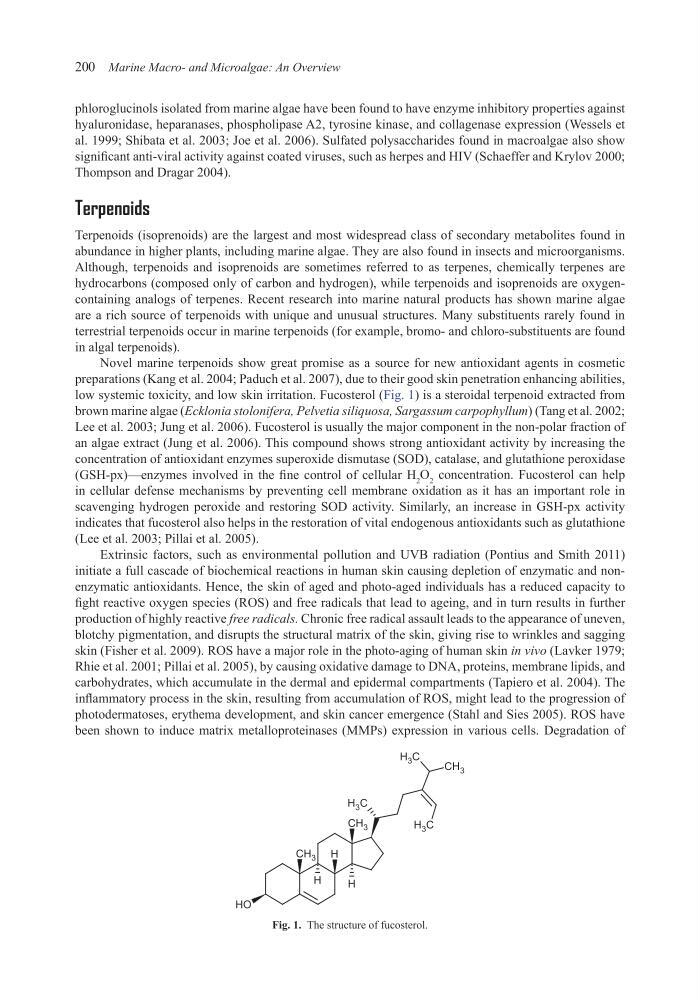
low systemic toxicity, and low skin irritation. Fucosterol (Fig. 1) is a steroidal terpenoid extracted from
brown marine algae (Ecklonia stolonifera, Pelvetia siliquosa, Sargassum carpophyllum) (Tang et al. 2002;
Lee et al. 2003; Jung et al. 2006). Fucosterol is usually the major component in the non-polar fraction of
an algae extract (Jung et al. 2006). This compound shows strong antioxidant activity by increasing the
concentration of antioxidant enzymes superoxide dismutase (SOD), catalase, and glutathione peroxidase
(GSH-px)—enzymes involved in the fine control of cellular H 2 O 2 concentration. Fucosterol can help
in cellular defense mechanisms by preventing cell membrane oxidation as it has an important role in
scavenging hydrogen peroxide and restoring SOD activity. Similarly, an increase in GSH-px activity
indicates that fucosterol also helps in the restoration of vital endogenous antioxidants such as glutathione
(Lee et al. 2003; Pillai et al. 2005).
Extrinsic factors, such as environmental pollution and UVB radiation (Pontius and Smith 2011)
initiate a full cascade of biochemical reactions in human skin causing depletion of enzymatic and nonenzymatic antioxidants. Hence, the skin of aged and photo-aged individuals has a reduced capacity to
fight reactive oxygen species (ROS) and free radicals that lead to ageing, and in turn results in further
production of highly reactive free radicals. Chronic free radical assault leads to the appearance of uneven,
blotchy pigmentation, and disrupts the structural matrix of the skin, giving rise to wrinkles and sagging
skin (Fisher et al. 2009). ROS have a major role in the photo-aging of human skin in vivo (Lavker 1979;
Rhie et al. 2001; Pillai et al. 2005), by causing oxidative damage to DNA, proteins, membrane lipids, and
carbohydrates, which accumulate in the dermal and epidermal compartments (Tapiero et al. 2004). The
inflammatory process in the skin, resulting from accumulation of ROS, might lead to the progression of
photodermatoses, erythema development, and skin cancer emergence (Stahl and Sies 2005). ROS have
been shown to induce matrix metalloproteinases (MMPs) expression in various cells. Degradation of
CH 3
C
H 3
CH 3
C
H 3
CH 3
O
H
H
H
H
C
H 3
Fig. 1. The structure of fucosterol.
phloroglucinols isolated from marine algae have been found to have enzyme inhibitory properties against
hyaluronidase, heparanases, phospholipase A2, tyrosine kinase, and collagenase expression (Wessels et
al. 1999; Shibata et al. 2003; Joe et al. 2006). Sulfated polysaccharides found in macroalgae also show
significant anti-viral activity against coated viruses, such as herpes and HIV (Schaeffer and Krylov 2000;
Thompson and Dragar 2004).
Terpenoids
Terpenoids (isoprenoids) are the largest and most widespread class of secondary metabolites found in
abundance in higher plants, including marine algae. They are also found in insects and microorganisms.
Although, terpenoids and isoprenoids are sometimes referred to as terpenes, chemically terpenes are
hydrocarbons (composed only of carbon and hydrogen), while terpenoids and isoprenoids are oxygencontaining analogs of terpenes. Recent research into marine natural products has shown marine algae
are a rich source of terpenoids with unique and unusual structures. Many substituents rarely found in
terrestrial terpenoids occur in marine terpenoids (for example, bromo- and chloro-substituents are found
in algal terpenoids).
Novel marine terpenoids show great promise as a source for new antioxidant agents in cosmetic
preparations (Kang et al. 2004; Paduch et al. 2007), due to their good skin penetration enhancing abilities,
low systemic toxicity, and low skin irritation. Fucosterol (Fig. 1) is a steroidal terpenoid extracted from
brown marine algae (Ecklonia stolonifera, Pelvetia siliquosa, Sargassum carpophyllum) (Tang et al. 2002;
Lee et al. 2003; Jung et al. 2006). Fucosterol is usually the major component in the non-polar fraction of
an algae extract (Jung et al. 2006). This compound shows strong antioxidant activity by increasing the
concentration of antioxidant enzymes superoxide dismutase (SOD), catalase, and glutathione peroxidase
(GSH-px)—enzymes involved in the fine control of cellular H 2 O 2 concentration. Fucosterol can help
in cellular defense mechanisms by preventing cell membrane oxidation as it has an important role in
scavenging hydrogen peroxide and restoring SOD activity. Similarly, an increase in GSH-px activity
indicates that fucosterol also helps in the restoration of vital endogenous antioxidants such as glutathione
(Lee et al. 2003; Pillai et al. 2005).
Extrinsic factors, such as environmental pollution and UVB radiation (Pontius and Smith 2011)
initiate a full cascade of biochemical reactions in human skin causing depletion of enzymatic and nonenzymatic antioxidants. Hence, the skin of aged and photo-aged individuals has a reduced capacity to
fight reactive oxygen species (ROS) and free radicals that lead to ageing, and in turn results in further
production of highly reactive free radicals. Chronic free radical assault leads to the appearance of uneven,
blotchy pigmentation, and disrupts the structural matrix of the skin, giving rise to wrinkles and sagging
skin (Fisher et al. 2009). ROS have a major role in the photo-aging of human skin in vivo (Lavker 1979;
Rhie et al. 2001; Pillai et al. 2005), by causing oxidative damage to DNA, proteins, membrane lipids, and
carbohydrates, which accumulate in the dermal and epidermal compartments (Tapiero et al. 2004). The
inflammatory process in the skin, resulting from accumulation of ROS, might lead to the progression of
photodermatoses, erythema development, and skin cancer emergence (Stahl and Sies 2005). ROS have
been shown to induce matrix metalloproteinases (MMPs) expression in various cells. Degradation of
CH 3
C
H 3
CH 3
C
H 3
CH 3
O
H
H
H
H
C
H 3
Fig. 1. The structure of fucosterol.