

The Cosmeceutical Properties of Compounds Derived from Marine Algae 201
fibrillar collagen that occurs in photo damaged skin is a consequence of upregulation of MMPs (Klein
and Bischoff 2011). MMPs are major enzymes involved in the remodeling of the extracellular matrix, by
proteolytic degradation of collagen and elastic fibres, and loss of the skin’s ability to resist stretching. In
normal skin, MMPs are expressed in very low levels and are kept inactive (Pillai et al. 2005).
In recent years, experimental research has led to the discovery of a new type of carotenoid from seaweed
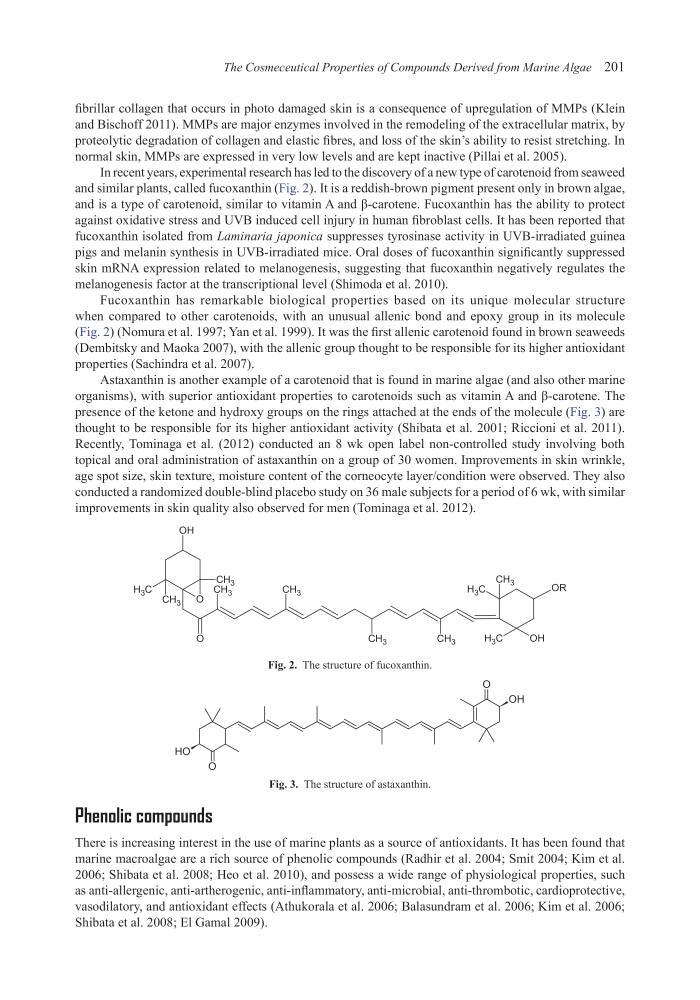
and similar plants, called fucoxanthin (Fig. 2). It is a reddish-brown pigment present only in brown algae,
and is a type of carotenoid, similar to vitamin A and β-carotene. Fucoxanthin has the ability to protect
against oxidative stress and UVB induced cell injury in human fibroblast cells. It has been reported that
fucoxanthin isolated from Laminaria japonica suppresses tyrosinase activity in UVB-irradiated guinea
pigs and melanin synthesis in UVB-irradiated mice. Oral doses of fucoxanthin significantly suppressed
skin mRNA expression related to melanogenesis, suggesting that fucoxanthin negatively regulates the
melanogenesis factor at the transcriptional level (Shimoda et al. 2010).
Fucoxanthin has remarkable biological properties based on its unique molecular structure
when compared to other carotenoids, with an unusual allenic bond and epoxy group in its molecule
(Fig. 2) (Nomura et al. 1997; Yan et al. 1999). It was the first allenic carotenoid found in brown seaweeds
(Dembitsky and Maoka 2007), with the allenic group thought to be responsible for its higher antioxidant
properties (Sachindra et al. 2007).
Astaxanthin is another example of a carotenoid that is found in marine algae (and also other marine
organisms), with superior antioxidant properties to carotenoids such as vitamin A and β-carotene. The
presence of the ketone and hydroxy groups on the rings attached at the ends of the molecule (Fig. 3) are
thought to be responsible for its higher antioxidant activity (Shibata et al. 2001; Riccioni et al. 2011).
Recently, Tominaga et al. (2012) conducted an 8 wk open label non-controlled study involving both
topical and oral administration of astaxanthin on a group of 30 women. Improvements in skin wrinkle,
age spot size, skin texture, moisture content of the corneocyte layer/condition were observed. They also
conducted a randomized double-blind placebo study on 36 male subjects for a period of 6 wk, with similar
improvements in skin quality also observed for men (Tominaga et al. 2012).
Fig. 2. The structure of fucoxanthin.
CH 3
CH 3
O
CH 3
CH 3
OH
C
H 3
C
H 3
CH 3
OR
O
C
H 3
CH 3
OH
CH 3
Fig. 3. The structure of astaxanthin.
O
O
H
OH
O
Phenolic compounds
There is increasing interest in the use of marine plants as a source of antioxidants. It has been found that
marine macroalgae are a rich source of phenolic compounds (Radhir et al. 2004; Smit 2004; Kim et al.
2006; Shibata et al. 2008; Heo et al. 2010), and possess a wide range of physiological properties, such
as anti-allergenic, anti-artherogenic, anti-inflammatory, anti-microbial, anti-thrombotic, cardioprotective,
vasodilatory, and antioxidant effects (Athukorala et al. 2006; Balasundram et al. 2006; Kim et al. 2006;
Shibata et al. 2008; El Gamal 2009).
fibrillar collagen that occurs in photo damaged skin is a consequence of upregulation of MMPs (Klein
and Bischoff 2011). MMPs are major enzymes involved in the remodeling of the extracellular matrix, by
proteolytic degradation of collagen and elastic fibres, and loss of the skin’s ability to resist stretching. In
normal skin, MMPs are expressed in very low levels and are kept inactive (Pillai et al. 2005).
In recent years, experimental research has led to the discovery of a new type of carotenoid from seaweed
and similar plants, called fucoxanthin (Fig. 2). It is a reddish-brown pigment present only in brown algae,
and is a type of carotenoid, similar to vitamin A and β-carotene. Fucoxanthin has the ability to protect
against oxidative stress and UVB induced cell injury in human fibroblast cells. It has been reported that
fucoxanthin isolated from Laminaria japonica suppresses tyrosinase activity in UVB-irradiated guinea
pigs and melanin synthesis in UVB-irradiated mice. Oral doses of fucoxanthin significantly suppressed
skin mRNA expression related to melanogenesis, suggesting that fucoxanthin negatively regulates the
melanogenesis factor at the transcriptional level (Shimoda et al. 2010).
Fucoxanthin has remarkable biological properties based on its unique molecular structure
when compared to other carotenoids, with an unusual allenic bond and epoxy group in its molecule
(Fig. 2) (Nomura et al. 1997; Yan et al. 1999). It was the first allenic carotenoid found in brown seaweeds
(Dembitsky and Maoka 2007), with the allenic group thought to be responsible for its higher antioxidant
properties (Sachindra et al. 2007).
Astaxanthin is another example of a carotenoid that is found in marine algae (and also other marine
organisms), with superior antioxidant properties to carotenoids such as vitamin A and β-carotene. The
presence of the ketone and hydroxy groups on the rings attached at the ends of the molecule (Fig. 3) are
thought to be responsible for its higher antioxidant activity (Shibata et al. 2001; Riccioni et al. 2011).
Recently, Tominaga et al. (2012) conducted an 8 wk open label non-controlled study involving both
topical and oral administration of astaxanthin on a group of 30 women. Improvements in skin wrinkle,
age spot size, skin texture, moisture content of the corneocyte layer/condition were observed. They also
conducted a randomized double-blind placebo study on 36 male subjects for a period of 6 wk, with similar
improvements in skin quality also observed for men (Tominaga et al. 2012).
Fig. 2. The structure of fucoxanthin.
CH 3
CH 3
O
CH 3
CH 3
OH
C
H 3
C
H 3
CH 3
OR
O
C
H 3
CH 3
OH
CH 3
Fig. 3. The structure of astaxanthin.
O
O
H
OH
O
Phenolic compounds
There is increasing interest in the use of marine plants as a source of antioxidants. It has been found that
marine macroalgae are a rich source of phenolic compounds (Radhir et al. 2004; Smit 2004; Kim et al.
2006; Shibata et al. 2008; Heo et al. 2010), and possess a wide range of physiological properties, such
as anti-allergenic, anti-artherogenic, anti-inflammatory, anti-microbial, anti-thrombotic, cardioprotective,
vasodilatory, and antioxidant effects (Athukorala et al. 2006; Balasundram et al. 2006; Kim et al. 2006;
Shibata et al. 2008; El Gamal 2009).