

166 Marine Macro- and Microalgae: An Overview
other amino acids, resulting in adverse effects on livestock. Generally, proteins of cereal grains and most
other plant protein concentrates fail to supply the complete amino acid needs of poultry, due to a shortage
of methionine and/or lysine. Soybean meal, which is widely used in poultry diets, is a good source
of lysine and tryptophan, but it is low in the sulfur-containing amino acids methionine and cysteine.
Fishmeal is an excellent source of all of these amino acids.
Standard fishmeal typically contains 64% to 67% crude protein, although it may reach 72% in
special fish products. High quality fishmeal provides a balanced amount of all essential amino acids,
minerals, phospholipids, and fatty acids (e.g., docosahexaenoic and eicosapentaenoic acids) for optimum
development, growth, and reproduction. Nutrients in fishmeal also aid in disease resistance by boosting
and helping to maintain a healthy functional immune system.
Interest in algae as protein source arose with the realization that many species are extremely rich in
such nutrient. In fact, reported protein values vary with algal species, from 28–39% protein such as in
Porphyridium cruentum, to 60–70% protein as in Spirulina maxima (Becker 2004), with an interesting
amino acid profile.
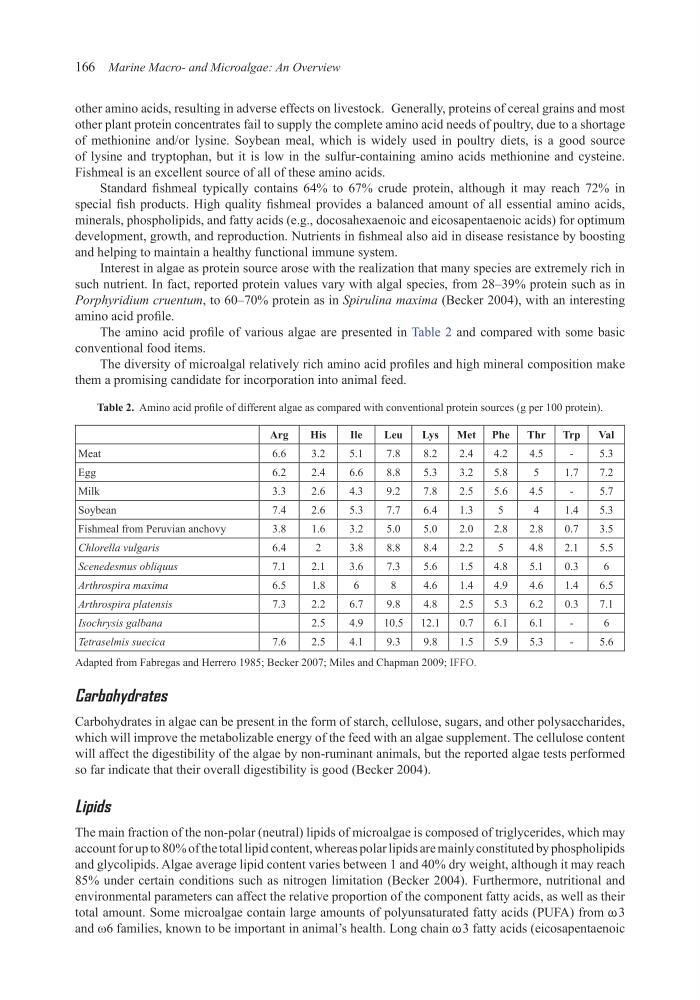
The amino acid profile of various algae are presented in Table 2 and compared with some basic
conventional food items.
The diversity of microalgal relatively rich amino acid profiles and high mineral composition make
them a promising candidate for incorporation into animal feed.
Table 2. Amino acid profile of different algae as compared with conventional protein sources (g per 100 protein).
Arg
His
Ile
Leu
Lys
Met Phe
Thr
Trp
Val
Meat
6.6
3.2
5.1
7.8
8.2
2.4
4.2
4.5
-
5.3
Egg
6.2
2.4
6.6
8.8
5.3
3.2
5.8
5
1.7
7.2
Milk
3.3
2.6
4.3
9.2
7.8
2.5
5.6
4.5
-
5.7
Soybean
7.4
2.6
5.3
7.7
6.4
1.3
5
4
1.4
5.3
Fishmeal from Peruvian anchovy
3.8
1.6
3.2
5.0
5.0
2.0
2.8
2.8
0.7
3.5
Chlorella vulgaris
6.4
2
3.8
8.8
8.4
2.2
5
4.8
2.1
5.5
Scenedesmus obliquus
7.1
2.1
3.6
7.3
5.6
1.5
4.8
5.1
0.3
6
Arthrospira maxima
6.5
1.8
6
8
4.6
1.4
4.9
4.6
1.4
6.5
Arthrospira platensis
7.3
2.2
6.7
9.8
4.8
2.5
5.3
6.2
0.3
7.1
Isochrysis galbana
2.5
4.9
10.5
12.1
0.7
6.1
6.1
-
6
Tetraselmis suecica
7.6
2.5
4.1
9.3
9.8
1.5
5.9
5.3
-
5.6
Adapted from Fabregas and Herrero 1985; Becker 2007; Miles and Chapman 2009; IFFO.
Carbohydrates
Carbohydrates in algae can be present in the form of starch, cellulose, sugars, and other polysaccharides,
which will improve the metabolizable energy of the feed with an algae supplement. The cellulose content
will affect the digestibility of the algae by non-ruminant animals, but the reported algae tests performed
so far indicate that their overall digestibility is good (Becker 2004).
Lipids
The main fraction of the non-polar (neutral) lipids of microalgae is composed of triglycerides, which may
account for up to 80% of the total lipid content, whereas polar lipids are mainly constituted by phospholipids
and glycolipids. Algae average lipid content varies between 1 and 40% dry weight, although it may reach
85% under certain conditions such as nitrogen limitation (Becker 2004). Furthermore, nutritional and
environmental parameters can affect the relative proportion of the component fatty acids, as well as their
total amount. Some microalgae contain large amounts of polyunsaturated fatty acids (PUFA) from w3
and ω6 families, known to be important in animal’s health. Long chain w3 fatty acids (eicosapentaenoic
other amino acids, resulting in adverse effects on livestock. Generally, proteins of cereal grains and most
other plant protein concentrates fail to supply the complete amino acid needs of poultry, due to a shortage
of methionine and/or lysine. Soybean meal, which is widely used in poultry diets, is a good source
of lysine and tryptophan, but it is low in the sulfur-containing amino acids methionine and cysteine.
Fishmeal is an excellent source of all of these amino acids.
Standard fishmeal typically contains 64% to 67% crude protein, although it may reach 72% in
special fish products. High quality fishmeal provides a balanced amount of all essential amino acids,
minerals, phospholipids, and fatty acids (e.g., docosahexaenoic and eicosapentaenoic acids) for optimum
development, growth, and reproduction. Nutrients in fishmeal also aid in disease resistance by boosting
and helping to maintain a healthy functional immune system.
Interest in algae as protein source arose with the realization that many species are extremely rich in
such nutrient. In fact, reported protein values vary with algal species, from 28–39% protein such as in
Porphyridium cruentum, to 60–70% protein as in Spirulina maxima (Becker 2004), with an interesting
amino acid profile.
The amino acid profile of various algae are presented in Table 2 and compared with some basic
conventional food items.
The diversity of microalgal relatively rich amino acid profiles and high mineral composition make
them a promising candidate for incorporation into animal feed.
Table 2. Amino acid profile of different algae as compared with conventional protein sources (g per 100 protein).
Arg
His
Ile
Leu
Lys
Met Phe
Thr
Trp
Val
Meat
6.6
3.2
5.1
7.8
8.2
2.4
4.2
4.5
-
5.3
Egg
6.2
2.4
6.6
8.8
5.3
3.2
5.8
5
1.7
7.2
Milk
3.3
2.6
4.3
9.2
7.8
2.5
5.6
4.5
-
5.7
Soybean
7.4
2.6
5.3
7.7
6.4
1.3
5
4
1.4
5.3
Fishmeal from Peruvian anchovy
3.8
1.6
3.2
5.0
5.0
2.0
2.8
2.8
0.7
3.5
Chlorella vulgaris
6.4
2
3.8
8.8
8.4
2.2
5
4.8
2.1
5.5
Scenedesmus obliquus
7.1
2.1
3.6
7.3
5.6
1.5
4.8
5.1
0.3
6
Arthrospira maxima
6.5
1.8
6
8
4.6
1.4
4.9
4.6
1.4
6.5
Arthrospira platensis
7.3
2.2
6.7
9.8
4.8
2.5
5.3
6.2
0.3
7.1
Isochrysis galbana
2.5
4.9
10.5
12.1
0.7
6.1
6.1
-
6
Tetraselmis suecica
7.6
2.5
4.1
9.3
9.8
1.5
5.9
5.3
-
5.6
Adapted from Fabregas and Herrero 1985; Becker 2007; Miles and Chapman 2009; IFFO.
Carbohydrates
Carbohydrates in algae can be present in the form of starch, cellulose, sugars, and other polysaccharides,
which will improve the metabolizable energy of the feed with an algae supplement. The cellulose content
will affect the digestibility of the algae by non-ruminant animals, but the reported algae tests performed
so far indicate that their overall digestibility is good (Becker 2004).
Lipids
The main fraction of the non-polar (neutral) lipids of microalgae is composed of triglycerides, which may
account for up to 80% of the total lipid content, whereas polar lipids are mainly constituted by phospholipids
and glycolipids. Algae average lipid content varies between 1 and 40% dry weight, although it may reach
85% under certain conditions such as nitrogen limitation (Becker 2004). Furthermore, nutritional and
environmental parameters can affect the relative proportion of the component fatty acids, as well as their
total amount. Some microalgae contain large amounts of polyunsaturated fatty acids (PUFA) from w3
and ω6 families, known to be important in animal’s health. Long chain w3 fatty acids (eicosapentaenoic