

Microalgae for Feed 167
and docosahexaenoic acids) are known to possess anti-inflammatory action, whereas the quality of ω6
fatty acids influences the production of sebum responsible for the shiny coat.
Vitamins, minerals, and pigments
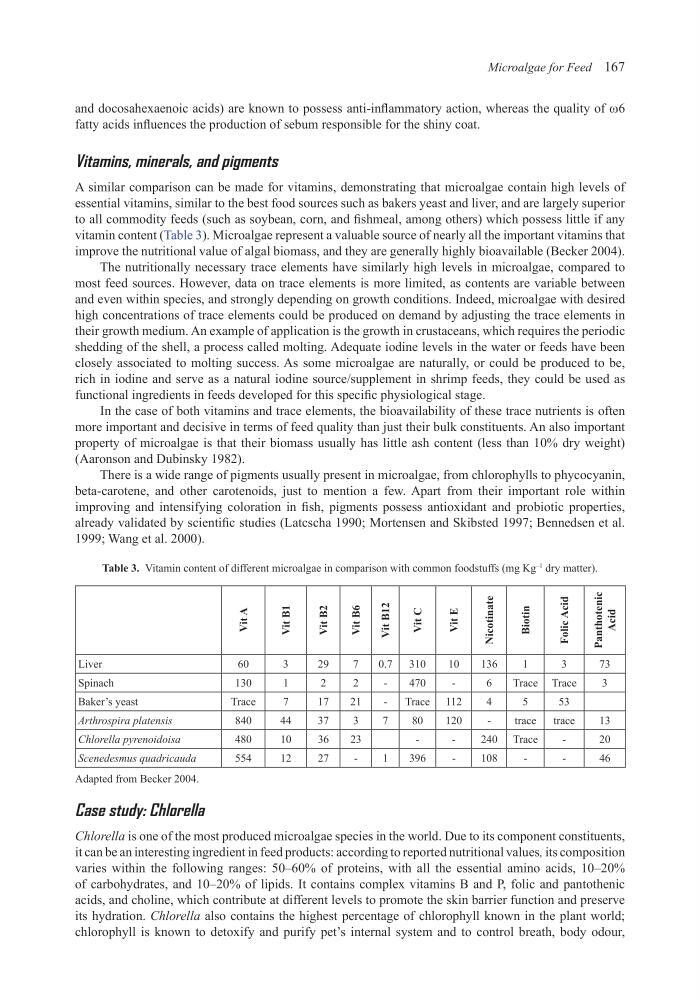
A similar comparison can be made for vitamins, demonstrating that microalgae contain high levels of
essential vitamins, similar to the best food sources such as bakers yeast and liver, and are largely superior
to all commodity feeds (such as soybean, corn, and fishmeal, among others) which possess little if any
vitamin content (Table 3). Microalgae represent a valuable source of nearly all the important vitamins that
improve the nutritional value of algal biomass, and they are generally highly bioavailable (Becker 2004).
The nutritionally necessary trace elements have similarly high levels in microalgae, compared to
most feed sources. However, data on trace elements is more limited, as contents are variable between
and even within species, and strongly depending on growth conditions. Indeed, microalgae with desired
high concentrations of trace elements could be produced on demand by adjusting the trace elements in
their growth medium. An example of application is the growth in crustaceans, which requires the periodic
shedding of the shell, a process called molting. Adequate iodine levels in the water or feeds have been
closely associated to molting success. As some microalgae are naturally, or could be produced to be,
rich in iodine and serve as a natural iodine source/supplement in shrimp feeds, they could be used as
functional ingredients in feeds developed for this specific physiological stage.
In the case of both vitamins and trace elements, the bioavailability of these trace nutrients is often
more important and decisive in terms of feed quality than just their bulk constituents. An also important
property of microalgae is that their biomass usually has little ash content (less than 10% dry weight)
(Aaronson and Dubinsky 1982).
There is a wide range of pigments usually present in microalgae, from chlorophylls to phycocyanin,
beta-carotene, and other carotenoids, just to mention a few. Apart from their important role within
improving and intensifying coloration in fish, pigments possess antioxidant and probiotic properties,
already validated by scientific studies (Latcscha 1990; Mortensen and Skibsted 1997; Bennedsen et al.
1999; Wang et al. 2000).
Table 3. Vitamin content of different microalgae in comparison with common foodstuffs (mg Kg
–1
dry matter).
Vit A
Vit B1
Vit B2
Vit B6
Vit B12
Vit C
Vit E
Nicotinate
Biotin
Folic Acid
Panthotenic
Acid
Liver
60
3
29
7
0.7
310
10
136
1
3
73
Spinach
130
1
2
2
-
470
-
6
Trace Trace
3
Baker’s yeast
Trace
7
17
21
-
Trace 112
4
5
53
Arthrospira platensis
840
44
37
3
7
80
120
-
trace
trace
13
Chlorella pyrenoidoisa
480
10
36
23
-
-
240 Trace
-
20
Scenedesmus quadricauda
554
12
27
-
1
396
-
108
-
-
46
Adapted from Becker 2004.
Case study: Chlorella
Chlorella is one of the most produced microalgae species in the world. Due to its component constituents,
it can be an interesting ingredient in feed products: according to reported nutritional values, its composition
varies within the following ranges: 50–60% of proteins, with all the essential amino acids, 10–20%
of carbohydrates, and 10–20% of lipids. It contains complex vitamins B and P, folic and pantothenic
acids, and choline, which contribute at different levels to promote the skin barrier function and preserve
its hydration. Chlorella also contains the highest percentage of chlorophyll known in the plant world;
chlorophyll is known to detoxify and purify pet’s internal system and to control breath, body odour,
and docosahexaenoic acids) are known to possess anti-inflammatory action, whereas the quality of ω6
fatty acids influences the production of sebum responsible for the shiny coat.
Vitamins, minerals, and pigments
A similar comparison can be made for vitamins, demonstrating that microalgae contain high levels of
essential vitamins, similar to the best food sources such as bakers yeast and liver, and are largely superior
to all commodity feeds (such as soybean, corn, and fishmeal, among others) which possess little if any
vitamin content (Table 3). Microalgae represent a valuable source of nearly all the important vitamins that
improve the nutritional value of algal biomass, and they are generally highly bioavailable (Becker 2004).
The nutritionally necessary trace elements have similarly high levels in microalgae, compared to
most feed sources. However, data on trace elements is more limited, as contents are variable between
and even within species, and strongly depending on growth conditions. Indeed, microalgae with desired
high concentrations of trace elements could be produced on demand by adjusting the trace elements in
their growth medium. An example of application is the growth in crustaceans, which requires the periodic
shedding of the shell, a process called molting. Adequate iodine levels in the water or feeds have been
closely associated to molting success. As some microalgae are naturally, or could be produced to be,
rich in iodine and serve as a natural iodine source/supplement in shrimp feeds, they could be used as
functional ingredients in feeds developed for this specific physiological stage.
In the case of both vitamins and trace elements, the bioavailability of these trace nutrients is often
more important and decisive in terms of feed quality than just their bulk constituents. An also important
property of microalgae is that their biomass usually has little ash content (less than 10% dry weight)
(Aaronson and Dubinsky 1982).
There is a wide range of pigments usually present in microalgae, from chlorophylls to phycocyanin,
beta-carotene, and other carotenoids, just to mention a few. Apart from their important role within
improving and intensifying coloration in fish, pigments possess antioxidant and probiotic properties,
already validated by scientific studies (Latcscha 1990; Mortensen and Skibsted 1997; Bennedsen et al.
1999; Wang et al. 2000).
Table 3. Vitamin content of different microalgae in comparison with common foodstuffs (mg Kg
–1
dry matter).
Vit A
Vit B1
Vit B2
Vit B6
Vit B12
Vit C
Vit E
Nicotinate
Biotin
Folic Acid
Panthotenic
Acid
Liver
60
3
29
7
0.7
310
10
136
1
3
73
Spinach
130
1
2
2
-
470
-
6
Trace Trace
3
Baker’s yeast
Trace
7
17
21
-
Trace 112
4
5
53
Arthrospira platensis
840
44
37
3
7
80
120
-
trace
trace
13
Chlorella pyrenoidoisa
480
10
36
23
-
-
240 Trace
-
20
Scenedesmus quadricauda
554
12
27
-
1
396
-
108
-
-
46
Adapted from Becker 2004.
Case study: Chlorella
Chlorella is one of the most produced microalgae species in the world. Due to its component constituents,
it can be an interesting ingredient in feed products: according to reported nutritional values, its composition
varies within the following ranges: 50–60% of proteins, with all the essential amino acids, 10–20%
of carbohydrates, and 10–20% of lipids. It contains complex vitamins B and P, folic and pantothenic
acids, and choline, which contribute at different levels to promote the skin barrier function and preserve
its hydration. Chlorella also contains the highest percentage of chlorophyll known in the plant world;
chlorophyll is known to detoxify and purify pet’s internal system and to control breath, body odour,