

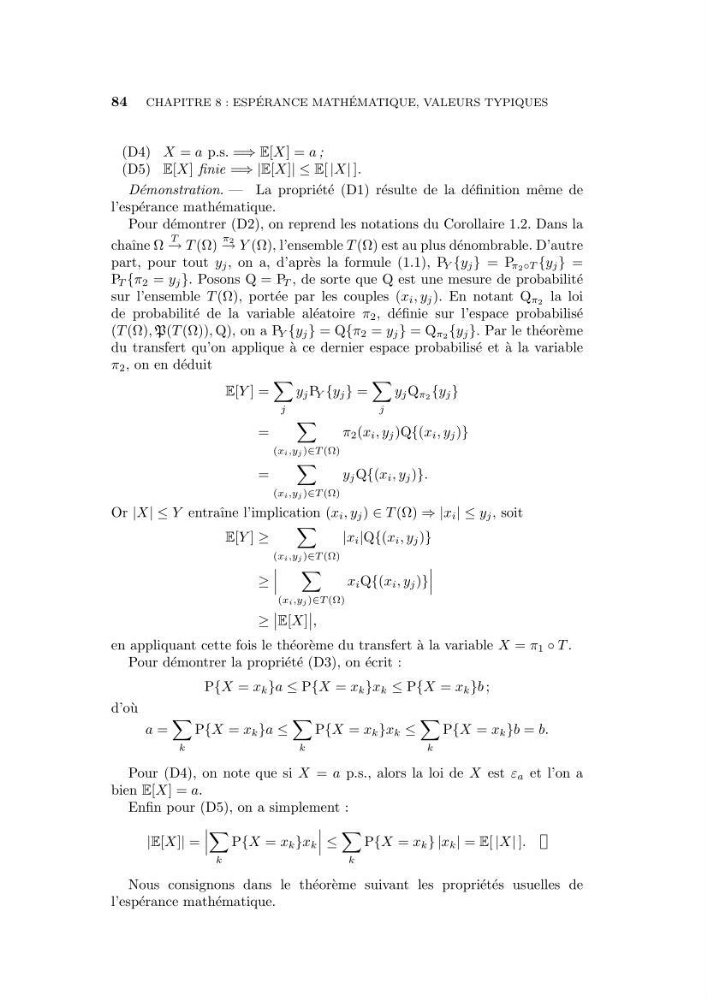
84 CHAPITRE 8 : ESP ´
ERANCE MATH ´
EMATIQUE, VALEURS TYPIQUES
(D4) X = a p.s. =⇒ E[X] = a ;
(D5) E[X] finie =⇒ |E[X]| ≤ E[ |X| ].
D´ emonstration. — La propri´ et´ e (D1) r´ esulte de la d´ efinition mˆ eme de
l’esp´ erance math´ ematique.
Pour d´ emontrer (D2), on reprend les notations du Corollaire 1.2. Dans la
chaˆ ıne Ω
T
→ T (Ω)
π 2
→ Y (Ω), l’ensemble T (Ω) est au plus d´ enombrable. D’autre
part, pour tout y j , on a, d’apr` es la formule (1.1), P Y {y j } = P π 2 ◦T {y j } =
P T {π 2 = y j }. Posons Q = P T , de sorte que Q est une mesure de probabilit´ e
sur l’ensemble T (Ω), port´ ee par les couples (x i , y j ). En notant Q π 2 la loi
de probabilit´ e de la variable al´ eatoire π 2 , d´ efinie sur l’espace probabilis´ e
(T (Ω), P(T (Ω)), Q), on a P Y {y j } = Q{π 2 = y j } = Q π 2 {y j }. Par le th´ eor` eme
du transfert qu’on applique `
a ce dernier espace probabilis´ e et ` a la variable
π 2 , on en d´ eduit
E[Y ] =
j
y j P Y {y j } =
j
y j Q π 2 {y j }
=
(x i ,y j )∈T (Ω)
π 2 (x i , y j )Q{(x i , y j )}
=
(x i ,y j )∈T (Ω)
y j Q{(x i , y j )}.
Or |X| ≤ Y entraˆ ıne l’implication (x i , y j ) ∈ T (Ω) ⇒ |x i | ≤ y j , soit
E[Y ] ≥
(x i ,y j )∈T (Ω)
|x i |Q{(x i , y j )}
≥
(x i ,y j )∈T (Ω)
x i Q{(x i , y j )}
≥
E[X]
,
en appliquant cette fois le th´ eor` eme du transfert `
a la variable X = π 1 ◦ T .
Pour d´ emontrer la propri´ et´ e (D3), on ´ ecrit :
P{X = x k }a ≤ P{X = x k }x k ≤ P{X = x k }b ;
d’o` u
a =
k
P{X = x k }a ≤
k
P{X = x k }x k ≤
k
P{X = x k }b = b.
Pour (D4), on note que si X = a p.s., alors la loi de X est ε a et l’on a
bien E[X] = a.
Enfin pour (D5), on a simplement :
|E[X]| =
k
P{X = x k }x k
≤
k
P{X = x k } |x k | = E[ |X| ].
Nous consignons dans le th´ eor` eme suivant les propri´ et´ es usuelles de
l’esp´ erance math´ ematique.
ERANCE MATH ´
EMATIQUE, VALEURS TYPIQUES
(D4) X = a p.s. =⇒ E[X] = a ;
(D5) E[X] finie =⇒ |E[X]| ≤ E[ |X| ].
D´ emonstration. — La propri´ et´ e (D1) r´ esulte de la d´ efinition mˆ eme de
l’esp´ erance math´ ematique.
Pour d´ emontrer (D2), on reprend les notations du Corollaire 1.2. Dans la
chaˆ ıne Ω
T
→ T (Ω)
π 2
→ Y (Ω), l’ensemble T (Ω) est au plus d´ enombrable. D’autre
part, pour tout y j , on a, d’apr` es la formule (1.1), P Y {y j } = P π 2 ◦T {y j } =
P T {π 2 = y j }. Posons Q = P T , de sorte que Q est une mesure de probabilit´ e
sur l’ensemble T (Ω), port´ ee par les couples (x i , y j ). En notant Q π 2 la loi
de probabilit´ e de la variable al´ eatoire π 2 , d´ efinie sur l’espace probabilis´ e
(T (Ω), P(T (Ω)), Q), on a P Y {y j } = Q{π 2 = y j } = Q π 2 {y j }. Par le th´ eor` eme
du transfert qu’on applique `
a ce dernier espace probabilis´ e et ` a la variable
π 2 , on en d´ eduit
E[Y ] =
j
y j P Y {y j } =
j
y j Q π 2 {y j }
=
(x i ,y j )∈T (Ω)
π 2 (x i , y j )Q{(x i , y j )}
=
(x i ,y j )∈T (Ω)
y j Q{(x i , y j )}.
Or |X| ≤ Y entraˆ ıne l’implication (x i , y j ) ∈ T (Ω) ⇒ |x i | ≤ y j , soit
E[Y ] ≥
(x i ,y j )∈T (Ω)
|x i |Q{(x i , y j )}
≥
(x i ,y j )∈T (Ω)
x i Q{(x i , y j )}
≥
E[X]
,
en appliquant cette fois le th´ eor` eme du transfert `
a la variable X = π 1 ◦ T .
Pour d´ emontrer la propri´ et´ e (D3), on ´ ecrit :
P{X = x k }a ≤ P{X = x k }x k ≤ P{X = x k }b ;
d’o` u
a =
k
P{X = x k }a ≤
k
P{X = x k }x k ≤
k
P{X = x k }b = b.
Pour (D4), on note que si X = a p.s., alors la loi de X est ε a et l’on a
bien E[X] = a.
Enfin pour (D5), on a simplement :
|E[X]| =
k
P{X = x k }x k
≤
k
P{X = x k } |x k | = E[ |X| ].
Nous consignons dans le th´ eor` eme suivant les propri´ et´ es usuelles de
l’esp´ erance math´ ematique.