

4. R `
EGLES DE CALCUL
149
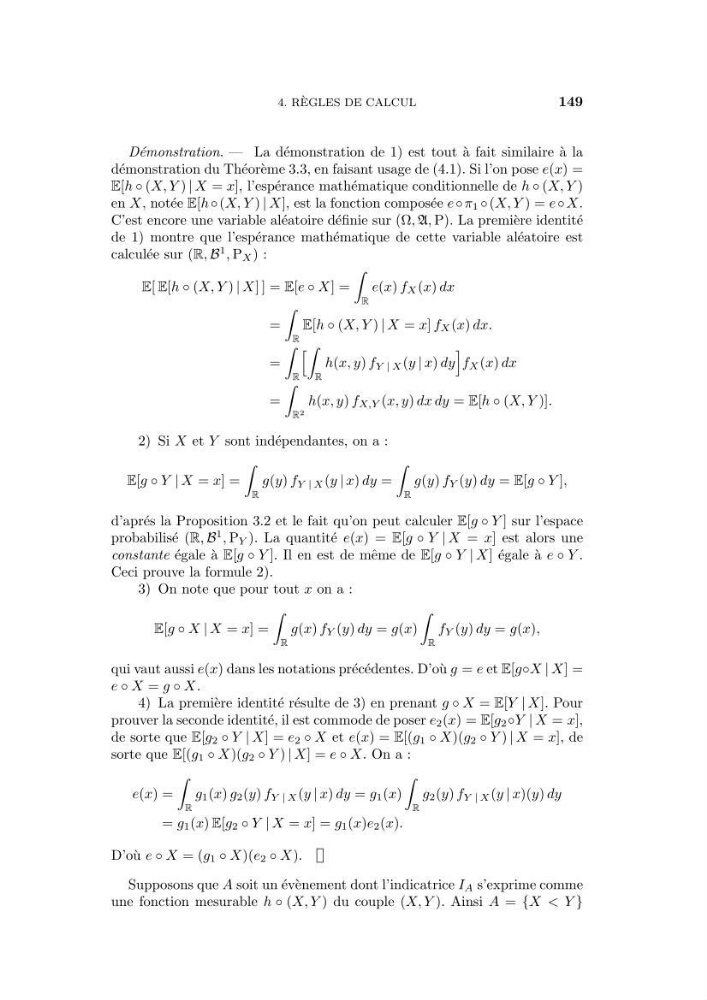
D´ emonstration. — La d´ emonstration de 1) est tout `
a fait similaire `
a la
d´ emonstration du Th´ eor` eme 3.3, en faisant usage de (4.1). Si l’on pose e(x) =
E[h ◦ (X, Y ) | X = x], l’esp´ erance math´ ematique conditionnelle de h ◦ (X, Y )
en X, not´ ee E[h ◦ (X, Y ) | X], est la fonction compos´ ee e ◦ π 1 ◦ (X, Y ) = e ◦ X.
C’est encore une variable al´ eatoire d´ efinie sur (Ω, A, P). La premi` ere identit´ e
de 1) montre que l’esp´ erance math´ ematique de cette variable al´ eatoire est
calcul´ ee sur (R, B
1 , P X ) :
E[ E[h ◦ (X, Y ) | X] ] = E[e ◦ X] =
R
e(x) f X (x) dx
=
R
E[h ◦ (X, Y ) | X = x] f X (x) dx.
=
R
R
h(x, y) f Y | X (y | x) dy
f X (x) dx
=
R 2
h(x, y) f X,Y (x, y) dx dy = E[h ◦ (X, Y )].
2) Si X et Y sont ind´ ependantes, on a :
E[g ◦ Y | X = x] =
R
g(y) f Y | X (y | x) dy =
R
g(y) f Y (y) dy = E[g ◦ Y ],
d’apr´ es la Proposition 3.2 et le fait qu’on peut calculer E[g ◦ Y ] sur l’espace
probabilis´ e (R, B
1 , P Y ). La quantit´ e e(x) = E[g ◦ Y | X = x] est alors une
constante ´ egale ` a E[g ◦ Y ]. Il en est de mˆ eme de E[g ◦ Y | X] ´ egale ` a e ◦ Y .
Ceci prouve la formule 2).
3) On note que pour tout x on a :
E[g ◦ X | X = x] =
R
g(x) f Y (y) dy = g(x)
R
f Y (y) dy = g(x),
qui vaut aussi e(x) dans les notations pr´ ec´ edentes. D’o` u g = e et E[g◦X | X] =
e ◦ X = g ◦ X.
4) La premi` ere identit´ e r´ esulte de 3) en prenant g ◦ X = E[Y | X]. Pour
prouver la seconde identit´ e, il est commode de poser e 2 (x) = E[g 2 ◦Y | X = x],
de sorte que E[g 2 ◦ Y | X] = e 2 ◦ X et e(x) = E[(g 1 ◦ X)(g 2 ◦ Y ) | X = x], de
sorte que E[(g 1 ◦ X)(g 2 ◦ Y ) | X] = e ◦ X. On a :
e(x) =
R
g 1 (x) g 2 (y) f Y | X (y | x) dy = g 1 (x)
R
g 2 (y) f Y | X (y | x)(y) dy
= g 1 (x) E[g 2 ◦ Y | X = x] = g 1 (x)e 2 (x).
D’o` u e ◦ X = (g 1 ◦ X)(e 2 ◦ X).
Supposons que A soit un ´ ev` enement dont l’indicatrice I A s’exprime comme
une fonction mesurable h ◦ (X, Y ) du couple (X, Y ). Ainsi A = {X < Y }
EGLES DE CALCUL
149
D´ emonstration. — La d´ emonstration de 1) est tout `
a fait similaire `
a la
d´ emonstration du Th´ eor` eme 3.3, en faisant usage de (4.1). Si l’on pose e(x) =
E[h ◦ (X, Y ) | X = x], l’esp´ erance math´ ematique conditionnelle de h ◦ (X, Y )
en X, not´ ee E[h ◦ (X, Y ) | X], est la fonction compos´ ee e ◦ π 1 ◦ (X, Y ) = e ◦ X.
C’est encore une variable al´ eatoire d´ efinie sur (Ω, A, P). La premi` ere identit´ e
de 1) montre que l’esp´ erance math´ ematique de cette variable al´ eatoire est
calcul´ ee sur (R, B
1 , P X ) :
E[ E[h ◦ (X, Y ) | X] ] = E[e ◦ X] =
R
e(x) f X (x) dx
=
R
E[h ◦ (X, Y ) | X = x] f X (x) dx.
=
R
R
h(x, y) f Y | X (y | x) dy
f X (x) dx
=
R 2
h(x, y) f X,Y (x, y) dx dy = E[h ◦ (X, Y )].
2) Si X et Y sont ind´ ependantes, on a :
E[g ◦ Y | X = x] =
R
g(y) f Y | X (y | x) dy =
R
g(y) f Y (y) dy = E[g ◦ Y ],
d’apr´ es la Proposition 3.2 et le fait qu’on peut calculer E[g ◦ Y ] sur l’espace
probabilis´ e (R, B
1 , P Y ). La quantit´ e e(x) = E[g ◦ Y | X = x] est alors une
constante ´ egale ` a E[g ◦ Y ]. Il en est de mˆ eme de E[g ◦ Y | X] ´ egale ` a e ◦ Y .
Ceci prouve la formule 2).
3) On note que pour tout x on a :
E[g ◦ X | X = x] =
R
g(x) f Y (y) dy = g(x)
R
f Y (y) dy = g(x),
qui vaut aussi e(x) dans les notations pr´ ec´ edentes. D’o` u g = e et E[g◦X | X] =
e ◦ X = g ◦ X.
4) La premi` ere identit´ e r´ esulte de 3) en prenant g ◦ X = E[Y | X]. Pour
prouver la seconde identit´ e, il est commode de poser e 2 (x) = E[g 2 ◦Y | X = x],
de sorte que E[g 2 ◦ Y | X] = e 2 ◦ X et e(x) = E[(g 1 ◦ X)(g 2 ◦ Y ) | X = x], de
sorte que E[(g 1 ◦ X)(g 2 ◦ Y ) | X] = e ◦ X. On a :
e(x) =
R
g 1 (x) g 2 (y) f Y | X (y | x) dy = g 1 (x)
R
g 2 (y) f Y | X (y | x)(y) dy
= g 1 (x) E[g 2 ◦ Y | X = x] = g 1 (x)e 2 (x).
D’o` u e ◦ X = (g 1 ◦ X)(e 2 ◦ X).
Supposons que A soit un ´ ev` enement dont l’indicatrice I A s’exprime comme
une fonction mesurable h ◦ (X, Y ) du couple (X, Y ). Ainsi A = {X < Y }