

Amphibians (Frogs)
263
Amino Acids (g/100 g Protein or
g/16 g N)
Lysine
5.91
Histidine
2.33
Arginine
8.19
Aspartic acid
9.65
Threonine
3.03
Serine
3.14
Glutamic acid
14.76
Proline
3.15
Glycine
5.13
Alanine
3.15
Cystine
1.52
Valine
4.82
Methionine
3.51
Isoleucine
5.48
Leucine
8.11
Tyrosine
3.17
Phenylalanine
4.62
Source: Data from Onadeko et al.
(2011).
FAMILY: RANIDAE
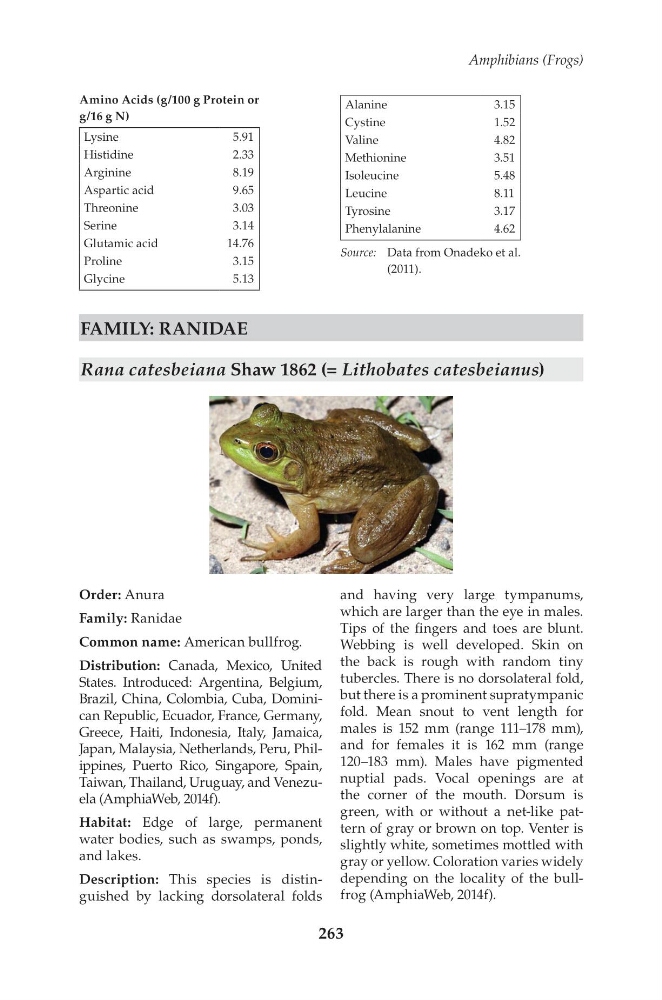
Rana catesbeiana Shaw 1862 (= Lithobates catesbeianus)
Order: Anura
Family: Ranidae
Common name: American bullfrog.
Distribution: Canada, Mexico, United
States. Introduced: Argentina, Belgium,
Brazil, China, Colombia, Cuba, Dominican Republic, Ecuador, France, Germany,
Greece, Haiti, Indonesia, Italy, Jamaica,
Japan, Malaysia, Netherlands, Peru, Philippines, Puerto Rico, Singapore, Spain,
Taiwan, Thailand, Uruguay, and Venezuela (AmphiaWeb, 2014f).
Habitat: Edge of large, permanent
water bodies, such as swamps, ponds,
and lakes.
Description: This species is distinguished by lacking dorsolateral folds
and having very large tympanums,
which are larger than the eye in males.
Tips of the fingers and toes are blunt.
Webbing is well developed. Skin on
the back is rough with random tiny
tubercles. There is no dorsolateral fold,
but there is a prominent supratympanic
fold. Mean snout to vent length for
males is 152 mm (range 111–178 mm),
and for females it is 162 mm (range
120–183 mm). Males have pigmented
nuptial pads. Vocal openings are at
the corner of the mouth. Dorsum is
green, with or without a net-like pattern of gray or brown on top. Venter is
slightly white, sometimes mottled with
gray or yellow. Coloration varies widely
depending on the locality of the bullfrog (AmphiaWeb, 2014f).
263
Amino Acids (g/100 g Protein or
g/16 g N)
Lysine
5.91
Histidine
2.33
Arginine
8.19
Aspartic acid
9.65
Threonine
3.03
Serine
3.14
Glutamic acid
14.76
Proline
3.15
Glycine
5.13
Alanine
3.15
Cystine
1.52
Valine
4.82
Methionine
3.51
Isoleucine
5.48
Leucine
8.11
Tyrosine
3.17
Phenylalanine
4.62
Source: Data from Onadeko et al.
(2011).
FAMILY: RANIDAE
Rana catesbeiana Shaw 1862 (= Lithobates catesbeianus)
Order: Anura
Family: Ranidae
Common name: American bullfrog.
Distribution: Canada, Mexico, United
States. Introduced: Argentina, Belgium,
Brazil, China, Colombia, Cuba, Dominican Republic, Ecuador, France, Germany,
Greece, Haiti, Indonesia, Italy, Jamaica,
Japan, Malaysia, Netherlands, Peru, Philippines, Puerto Rico, Singapore, Spain,
Taiwan, Thailand, Uruguay, and Venezuela (AmphiaWeb, 2014f).
Habitat: Edge of large, permanent
water bodies, such as swamps, ponds,
and lakes.
Description: This species is distinguished by lacking dorsolateral folds
and having very large tympanums,
which are larger than the eye in males.
Tips of the fingers and toes are blunt.
Webbing is well developed. Skin on
the back is rough with random tiny
tubercles. There is no dorsolateral fold,
but there is a prominent supratympanic
fold. Mean snout to vent length for
males is 152 mm (range 111–178 mm),
and for females it is 162 mm (range
120–183 mm). Males have pigmented
nuptial pads. Vocal openings are at
the corner of the mouth. Dorsum is
green, with or without a net-like pattern of gray or brown on top. Venter is
slightly white, sometimes mottled with
gray or yellow. Coloration varies widely
depending on the locality of the bullfrog (AmphiaWeb, 2014f).