

Nutritional Freshwater Life
262
FAMILY: PTYCHADENIDAE
Ptychadena pumilio Boulenger 1920
Order: Anura
Family: Ptychadenidae
Common name: Medine grassland
frog, dwarf grass frog, spotted-throated
ridged frog, dwarf rana, little rocket
frog.
Distribution: Angola, Benin, Botswana,
Cameroon, Central African Republic,
Congo, the Democratic Republic of
the Congo, Ethiopia, Gabon, Malawi,
Mali, Mozambique, Namibia, Nigeria,
Senegal, Sierra Leone, South Africa,
United Republic of Tanzania, Zambia,
Zimbabwe (Amphibia Web, 2014e).
Habitat: Close to water, and especially
on the banks of rivers and pools.
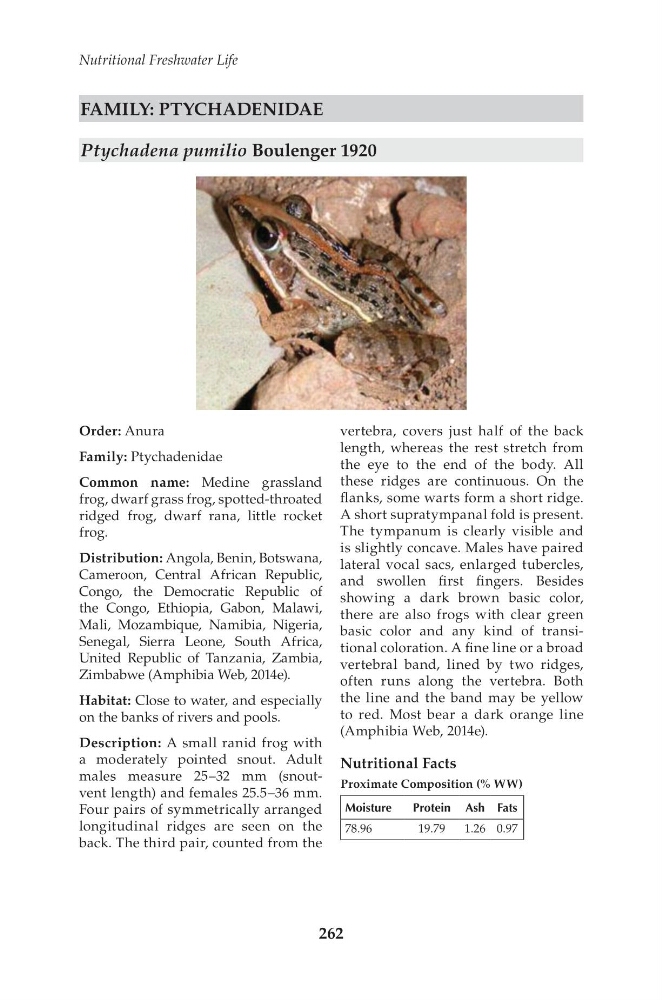
Description: A small ranid frog with
a moderately pointed snout. Adult
males measure 25–32 mm (snoutvent length) and females 25.5–36 mm.
Four pairs of symmetrically arranged
longitudinal ridges are seen on the
back. The third pair, counted from the
vertebra, covers just half of the back
length, whereas the rest stretch from
the eye to the end of the body. All
these ridges are continuous. On the
flanks, some warts form a short ridge.
A short supratympanal fold is present.
The tympanum is clearly visible and
is slightly concave. Males have paired
lateral vocal sacs, enlarged tubercles,
and swollen first fingers. Besides
showing a dark brown basic color,
there are also frogs with clear green
basic color and any kind of transitional coloration. A fine line or a broad
vertebral band, lined by two ridges,
often runs along the vertebra. Both
the line and the band may be yellow
to red. Most bear a dark orange line
(Amphibia Web, 2014e).
Nutritional Facts
Proximate Composition (% WW)
Moisture
Protein Ash Fats
78.96
19.79
1.26 0.97
262
FAMILY: PTYCHADENIDAE
Ptychadena pumilio Boulenger 1920
Order: Anura
Family: Ptychadenidae
Common name: Medine grassland
frog, dwarf grass frog, spotted-throated
ridged frog, dwarf rana, little rocket
frog.
Distribution: Angola, Benin, Botswana,
Cameroon, Central African Republic,
Congo, the Democratic Republic of
the Congo, Ethiopia, Gabon, Malawi,
Mali, Mozambique, Namibia, Nigeria,
Senegal, Sierra Leone, South Africa,
United Republic of Tanzania, Zambia,
Zimbabwe (Amphibia Web, 2014e).
Habitat: Close to water, and especially
on the banks of rivers and pools.
Description: A small ranid frog with
a moderately pointed snout. Adult
males measure 25–32 mm (snoutvent length) and females 25.5–36 mm.
Four pairs of symmetrically arranged
longitudinal ridges are seen on the
back. The third pair, counted from the
vertebra, covers just half of the back
length, whereas the rest stretch from
the eye to the end of the body. All
these ridges are continuous. On the
flanks, some warts form a short ridge.
A short supratympanal fold is present.
The tympanum is clearly visible and
is slightly concave. Males have paired
lateral vocal sacs, enlarged tubercles,
and swollen first fingers. Besides
showing a dark brown basic color,
there are also frogs with clear green
basic color and any kind of transitional coloration. A fine line or a broad
vertebral band, lined by two ridges,
often runs along the vertebra. Both
the line and the band may be yellow
to red. Most bear a dark orange line
(Amphibia Web, 2014e).
Nutritional Facts
Proximate Composition (% WW)
Moisture
Protein Ash Fats
78.96
19.79
1.26 0.97