

Fishes
255
Anguilla anguilla Linnaeus 1758 (= Muraena anguilla)
Common name: European eel.
Distribution: From North Cape in
northern Norway, southward along
the coast of Europe, all coasts of the
Mediterranean, and on the North
African coast (Jacoby and Gollock, 2014).
Habitat: From small streams to large
rivers and lakes, and in estuaries,
lagoons, and coastal waters.
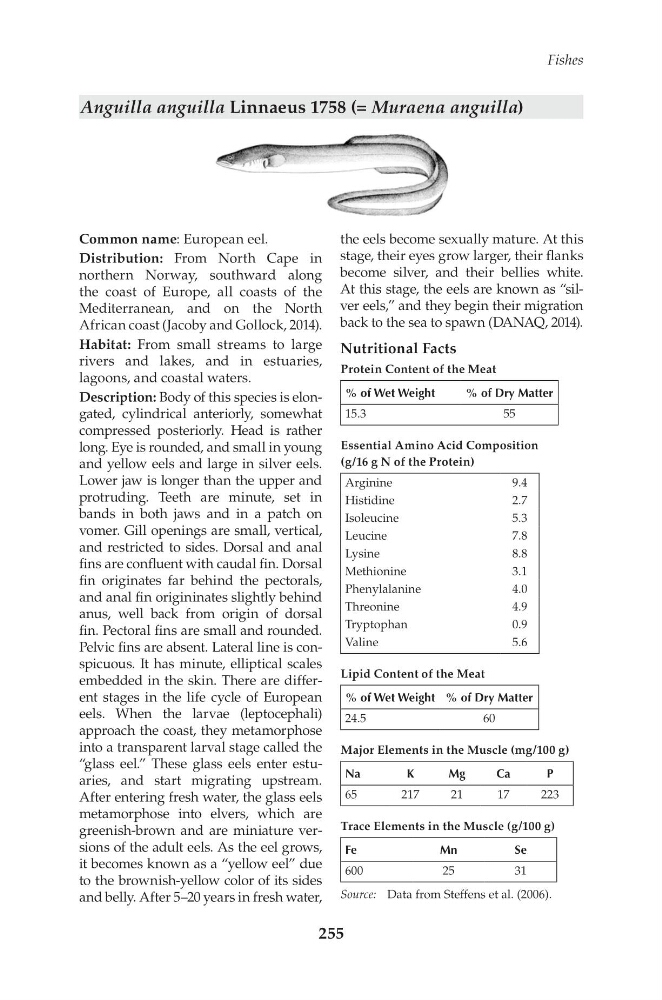
Description: Body of this species is elongated, cylindrical anteriorly, somewhat
compressed posteriorly. Head is rather
long. Eye is rounded, and small in young
and yellow eels and large in silver eels.
Lower jaw is longer than the upper and
protruding. Teeth are minute, set in
bands in both jaws and in a patch on
vomer. Gill openings are small, vertical,
and restricted to sides. Dorsal and anal
fins are confluent with caudal fin. Dorsal
fin originates far behind the pectorals,
and anal fin origininates slightly behind
anus, well back from origin of dorsal
fin. Pectoral fins are small and rounded.
Pelvic fins are absent. Lateral line is conspicuous. It has minute, elliptical scales
embedded in the skin. There are different stages in the life cycle of European
eels. When the larvae (leptocephali)
approach the coast, they metamorphose
into a transparent larval stage called the
“glass eel.” These glass eels enter estuaries, and start migrating upstream.
After entering fresh water, the glass eels
metamorphose into elvers, which are
greenish-brown and are miniature versions of the adult eels. As the eel grows,
it becomes known as a “yellow eel” due
to the brownish-yellow color of its sides
and belly. After 5–20 years in fresh water,
the eels become sexually mature. At this
stage, their eyes grow larger, their flanks
become silver, and their bellies white.
At this stage, the eels are known as “silver eels,” and they begin their migration
back to the sea to spawn (DANAQ, 2014).
Nutritional Facts
Protein Content of the Meat
% of Wet Weight
% of Dry Matter
15.3
55
Essential Amino Acid Composition
(g/16 g N of the Protein)
Arginine
9.4
Histidine
2.7
Isoleucine
5.3
Leucine
7.8
Lysine
8.8
Methionine
3.1
Phenylalanine
4.0
Threonine
4.9
Tryptophan
0.9
Valine
5.6
Lipid Content of the Meat
% of Wet Weight % of Dry Matter
24.5
60
Major Elements in the Muscle (mg/100 g)
Na
K
Mg
Ca
P
65
217
21
17
223
Trace Elements in the Muscle (g/100 g)
Fe
Mn
Se
600
25
31
Source: Data from Steffens et al. (2006).
255
Anguilla anguilla Linnaeus 1758 (= Muraena anguilla)
Common name: European eel.
Distribution: From North Cape in
northern Norway, southward along
the coast of Europe, all coasts of the
Mediterranean, and on the North
African coast (Jacoby and Gollock, 2014).
Habitat: From small streams to large
rivers and lakes, and in estuaries,
lagoons, and coastal waters.
Description: Body of this species is elongated, cylindrical anteriorly, somewhat
compressed posteriorly. Head is rather
long. Eye is rounded, and small in young
and yellow eels and large in silver eels.
Lower jaw is longer than the upper and
protruding. Teeth are minute, set in
bands in both jaws and in a patch on
vomer. Gill openings are small, vertical,
and restricted to sides. Dorsal and anal
fins are confluent with caudal fin. Dorsal
fin originates far behind the pectorals,
and anal fin origininates slightly behind
anus, well back from origin of dorsal
fin. Pectoral fins are small and rounded.
Pelvic fins are absent. Lateral line is conspicuous. It has minute, elliptical scales
embedded in the skin. There are different stages in the life cycle of European
eels. When the larvae (leptocephali)
approach the coast, they metamorphose
into a transparent larval stage called the
“glass eel.” These glass eels enter estuaries, and start migrating upstream.
After entering fresh water, the glass eels
metamorphose into elvers, which are
greenish-brown and are miniature versions of the adult eels. As the eel grows,
it becomes known as a “yellow eel” due
to the brownish-yellow color of its sides
and belly. After 5–20 years in fresh water,
the eels become sexually mature. At this
stage, their eyes grow larger, their flanks
become silver, and their bellies white.
At this stage, the eels are known as “silver eels,” and they begin their migration
back to the sea to spawn (DANAQ, 2014).
Nutritional Facts
Protein Content of the Meat
% of Wet Weight
% of Dry Matter
15.3
55
Essential Amino Acid Composition
(g/16 g N of the Protein)
Arginine
9.4
Histidine
2.7
Isoleucine
5.3
Leucine
7.8
Lysine
8.8
Methionine
3.1
Phenylalanine
4.0
Threonine
4.9
Tryptophan
0.9
Valine
5.6
Lipid Content of the Meat
% of Wet Weight % of Dry Matter
24.5
60
Major Elements in the Muscle (mg/100 g)
Na
K
Mg
Ca
P
65
217
21
17
223
Trace Elements in the Muscle (g/100 g)
Fe
Mn
Se
600
25
31
Source: Data from Steffens et al. (2006).