

Nutritional Freshwater Life
254
ORDER: ANGUILLIFORMES (EELS)
FaMiLy: anGuiLLidae (FreShwater eeLS)
Anguilla japonica Temminck & Schlegel 1846
Phylum: Chordata
Class: Actinopterygii
Class: Anguilliformes
Family: Anguillidae
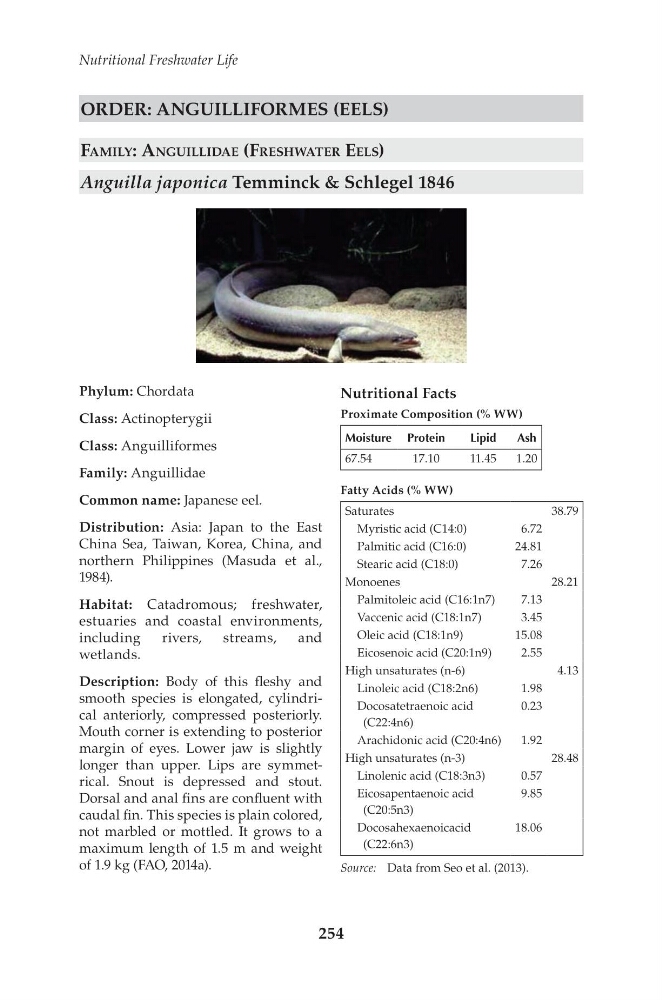
Common name: Japanese eel.
Distribution: Asia: Japan to the East
China Sea, Taiwan, Korea, China, and
northern Philippines (Masuda et al.,
1984).
Habitat: Catadromous; freshwater,
estuaries and coastal environments,
including
rivers,
streams,
and
wetlands.
Description: Body of this fleshy and
smooth species is elongated, cylindrical anteriorly, compressed posteriorly.
Mouth corner is extending to posterior
margin of eyes. Lower jaw is slightly
longer than upper. Lips are symmetrical. Snout is depressed and stout.
Dorsal and anal fins are confluent with
caudal fin. This species is plain colored,
not marbled or mottled. It grows to a
maximum length of 1.5 m and weight
of 1.9 kg (FAO, 2014a).
Nutritional Facts
Proximate Composition (% WW)
Moisture Protein
Lipid
Ash
67.54
17.10
11.45
1.20
Fatty Acids (% WW)
Saturates
38.79
Myristic acid (C14:0)
6.72
Palmitic acid (C16:0)
24.81
Stearic acid (C18:0)
7.26
Monoenes
28.21
Palmitoleic acid (C16:1n7)
7.13
Vaccenic acid (C18:1n7)
3.45
Oleic acid (C18:1n9)
15.08
Eicosenoic acid (C20:1n9)
2.55
High unsaturates (n-6)
4.13
Linoleic acid (C18:2n6)
1.98
Docosatetraenoic acid
(C22:4n6)
0.23
Arachidonic acid (C20:4n6)
1.92
High unsaturates (n-3)
28.48
Linolenic acid (C18:3n3)
0.57
Eicosapentaenoic acid
(C20:5n3)
9.85
Docosahexaenoicacid
(C22:6n3)
18.06
Source: Data from Seo et al. (2013).
254
ORDER: ANGUILLIFORMES (EELS)
FaMiLy: anGuiLLidae (FreShwater eeLS)
Anguilla japonica Temminck & Schlegel 1846
Phylum: Chordata
Class: Actinopterygii
Class: Anguilliformes
Family: Anguillidae
Common name: Japanese eel.
Distribution: Asia: Japan to the East
China Sea, Taiwan, Korea, China, and
northern Philippines (Masuda et al.,
1984).
Habitat: Catadromous; freshwater,
estuaries and coastal environments,
including
rivers,
streams,
and
wetlands.
Description: Body of this fleshy and
smooth species is elongated, cylindrical anteriorly, compressed posteriorly.
Mouth corner is extending to posterior
margin of eyes. Lower jaw is slightly
longer than upper. Lips are symmetrical. Snout is depressed and stout.
Dorsal and anal fins are confluent with
caudal fin. This species is plain colored,
not marbled or mottled. It grows to a
maximum length of 1.5 m and weight
of 1.9 kg (FAO, 2014a).
Nutritional Facts
Proximate Composition (% WW)
Moisture Protein
Lipid
Ash
67.54
17.10
11.45
1.20
Fatty Acids (% WW)
Saturates
38.79
Myristic acid (C14:0)
6.72
Palmitic acid (C16:0)
24.81
Stearic acid (C18:0)
7.26
Monoenes
28.21
Palmitoleic acid (C16:1n7)
7.13
Vaccenic acid (C18:1n7)
3.45
Oleic acid (C18:1n9)
15.08
Eicosenoic acid (C20:1n9)
2.55
High unsaturates (n-6)
4.13
Linoleic acid (C18:2n6)
1.98
Docosatetraenoic acid
(C22:4n6)
0.23
Arachidonic acid (C20:4n6)
1.92
High unsaturates (n-3)
28.48
Linolenic acid (C18:3n3)
0.57
Eicosapentaenoic acid
(C20:5n3)
9.85
Docosahexaenoicacid
(C22:6n3)
18.06
Source: Data from Seo et al. (2013).