

Nutritional Freshwater Life
242
Caudal peduncle is slender. Tip of upper
jaw reaches to hind margin of eye, but
not beyond. Jaws in adult males become
greatly hooked just before and during
breeding. A staggered line of teeth is
seen on the shaft of the vomer, but none
on the head of the vomer. Caudal fin is
fairly deeply forked. Scales are small.
Color of body is brown or green-blue
at back. Flanks are silvery and belly is
white back. Flanks above the lateral line
(rarely below it) have X-shaped black
spots. In freshwater, flanks are greenish
or brown, mottled with red or orange,
and with large dark spots with lighter
edges. This species grows to a maximum size of 150 cm and 39 kg (Jones,
2014).
Nutritional Facts
Proximate Composition (% WW)
Moisture
Ash
Protein Fat
75–82
NA
13–17 NA
NA, not available.
Source: Sarma et al. (2011).
Salmo trutta Linnaeus 1758
Order: Salmoniformes
Family: Salmonidae
Common name: Brown trout, sea trout.
Distribution: Throughout Europe;
North Sea and the Baltic Sea (Fishbase 2003); Italy, Romania, France,
the United Kingdom, Germany, Denmark, and Bosnia and Herzegovina
(Vandeputte and Labbé, 2012).
Habitat: Cold streams, rivers, and lakes.
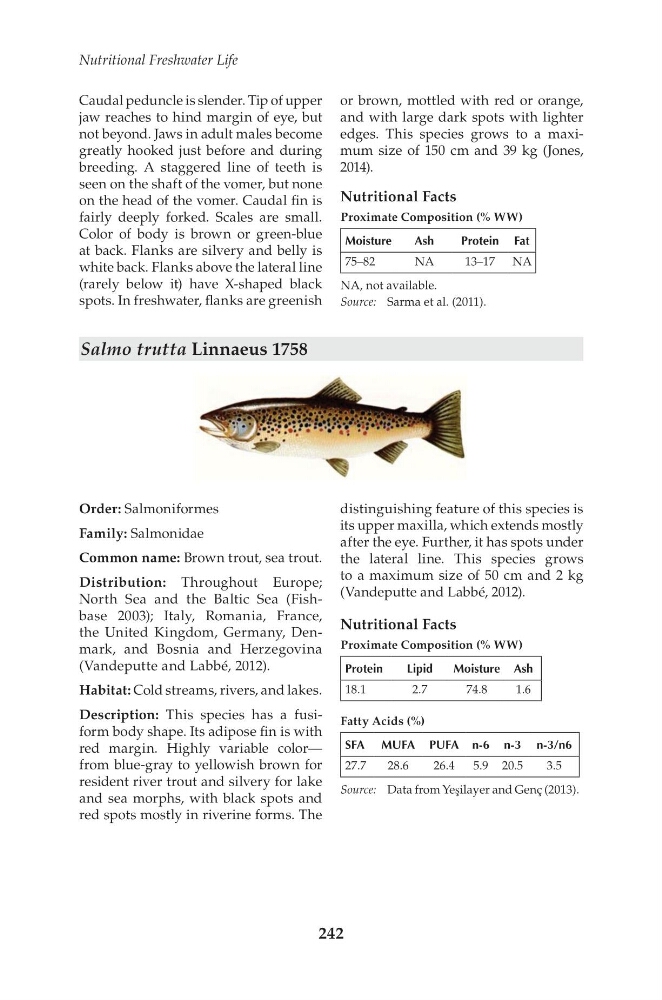
Description: This species has a fusiform body shape. Its adipose fin is with
red margin. Highly variable color—
from blue-gray to yellowish brown for
resident river trout and silvery for lake
and sea morphs, with black spots and
red spots mostly in riverine forms. The
distinguishing feature of this species is
its upper maxilla, which extends mostly
after the eye. Further, it has spots under
the lateral line. This species grows
to a maximum size of 50 cm and 2 kg
(Vandeputte and Labbé, 2012).
Nutritional Facts
Proximate Composition (% WW)
Protein
Lipid
Moisture Ash
18.1
2.7
74.8
1.6
Fatty Acids (%)
SFA MUFA PUFA n-6 n-3 n-3/n6
27.7
28.6
26.4
5.9 20.5
3.5
Source: Data from Yeşilayer and Genç (2013).
242
Caudal peduncle is slender. Tip of upper
jaw reaches to hind margin of eye, but
not beyond. Jaws in adult males become
greatly hooked just before and during
breeding. A staggered line of teeth is
seen on the shaft of the vomer, but none
on the head of the vomer. Caudal fin is
fairly deeply forked. Scales are small.
Color of body is brown or green-blue
at back. Flanks are silvery and belly is
white back. Flanks above the lateral line
(rarely below it) have X-shaped black
spots. In freshwater, flanks are greenish
or brown, mottled with red or orange,
and with large dark spots with lighter
edges. This species grows to a maximum size of 150 cm and 39 kg (Jones,
2014).
Nutritional Facts
Proximate Composition (% WW)
Moisture
Ash
Protein Fat
75–82
NA
13–17 NA
NA, not available.
Source: Sarma et al. (2011).
Salmo trutta Linnaeus 1758
Order: Salmoniformes
Family: Salmonidae
Common name: Brown trout, sea trout.
Distribution: Throughout Europe;
North Sea and the Baltic Sea (Fishbase 2003); Italy, Romania, France,
the United Kingdom, Germany, Denmark, and Bosnia and Herzegovina
(Vandeputte and Labbé, 2012).
Habitat: Cold streams, rivers, and lakes.
Description: This species has a fusiform body shape. Its adipose fin is with
red margin. Highly variable color—
from blue-gray to yellowish brown for
resident river trout and silvery for lake
and sea morphs, with black spots and
red spots mostly in riverine forms. The
distinguishing feature of this species is
its upper maxilla, which extends mostly
after the eye. Further, it has spots under
the lateral line. This species grows
to a maximum size of 50 cm and 2 kg
(Vandeputte and Labbé, 2012).
Nutritional Facts
Proximate Composition (% WW)
Protein
Lipid
Moisture Ash
18.1
2.7
74.8
1.6
Fatty Acids (%)
SFA MUFA PUFA n-6 n-3 n-3/n6
27.7
28.6
26.4
5.9 20.5
3.5
Source: Data from Yeşilayer and Genç (2013).