

Fishes
241
Oncorhynchus nerka Walbaum 1792
Order: Salmoniformes
Family: Salmonidae
Common name: Sockeye salmon.
Distribution: North Pacific: Northern
Japan to Bering Sea and to Los Angeles,
California; Alaska, Yukon Territory,
and British Columbia in Canada, and
Washington and Oregon in United
States (Kesner-Reyes, 2002a).
Habitat: Lakes, streams.
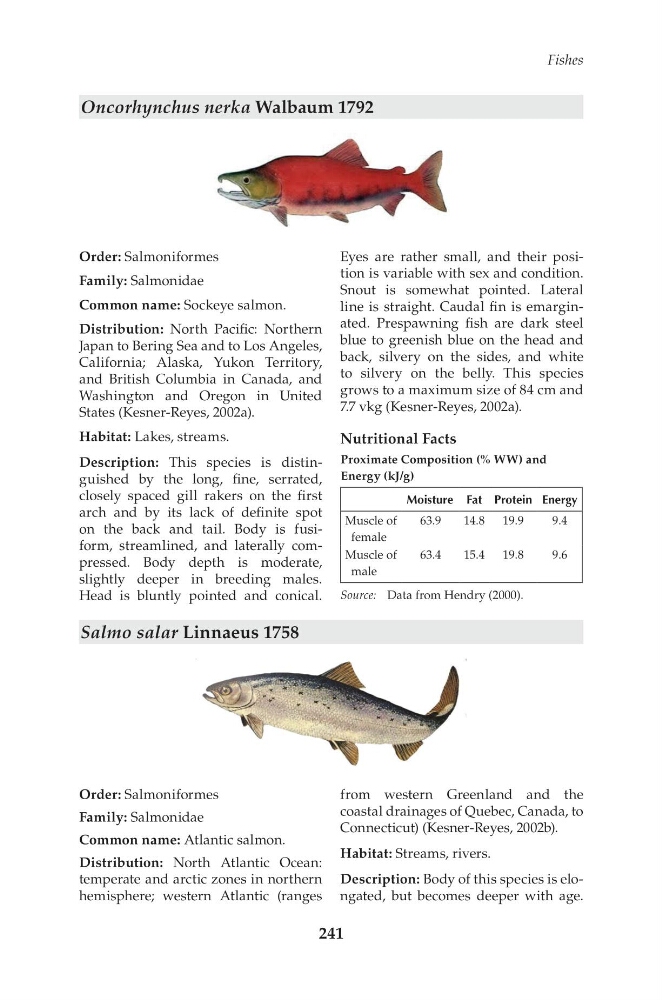
Description: This species is distinguished by the long, fine, serrated,
closely spaced gill rakers on the first
arch and by its lack of definite spot
on the back and tail. Body is fusiform, streamlined, and laterally compressed. Body depth is moderate,
slightly deeper in breeding males.
Head is bluntly pointed and conical.
Eyes are rather small, and their position is variable with sex and condition.
Snout is somewhat pointed. Lateral
line is straight. Caudal fin is emarginated. Prespawning fish are dark steel
blue to greenish blue on the head and
back, silvery on the sides, and white
to silvery on the belly. This species
grows to a maximum size of 84 cm and
7.7 vkg (Kesner-Reyes, 2002a).
Nutritional Facts
Proximate Composition (% WW) and
Energy (kJ/g)
Moisture Fat Protein Energy
Muscle of
female
63.9
14.8 19.9
9.4
Muscle of
male
63.4
15.4 19.8
9.6
Source: Data from Hendry (2000).
Salmo salar Linnaeus 1758
Order: Salmoniformes
Family: Salmonidae
Common name: Atlantic salmon.
Distribution: North Atlantic Ocean:
temperate and arctic zones in northern
hemisphere; western Atlantic (ranges
from western Greenland and the
coastal drainages of Quebec, Canada, to
Connecticut) (Kesner-Reyes, 2002b).
Habitat: Streams, rivers.
Description: Body of this species is elongated, but becomes deeper with age.
241
Oncorhynchus nerka Walbaum 1792
Order: Salmoniformes
Family: Salmonidae
Common name: Sockeye salmon.
Distribution: North Pacific: Northern
Japan to Bering Sea and to Los Angeles,
California; Alaska, Yukon Territory,
and British Columbia in Canada, and
Washington and Oregon in United
States (Kesner-Reyes, 2002a).
Habitat: Lakes, streams.
Description: This species is distinguished by the long, fine, serrated,
closely spaced gill rakers on the first
arch and by its lack of definite spot
on the back and tail. Body is fusiform, streamlined, and laterally compressed. Body depth is moderate,
slightly deeper in breeding males.
Head is bluntly pointed and conical.
Eyes are rather small, and their position is variable with sex and condition.
Snout is somewhat pointed. Lateral
line is straight. Caudal fin is emarginated. Prespawning fish are dark steel
blue to greenish blue on the head and
back, silvery on the sides, and white
to silvery on the belly. This species
grows to a maximum size of 84 cm and
7.7 vkg (Kesner-Reyes, 2002a).
Nutritional Facts
Proximate Composition (% WW) and
Energy (kJ/g)
Moisture Fat Protein Energy
Muscle of
female
63.9
14.8 19.9
9.4
Muscle of
male
63.4
15.4 19.8
9.6
Source: Data from Hendry (2000).
Salmo salar Linnaeus 1758
Order: Salmoniformes
Family: Salmonidae
Common name: Atlantic salmon.
Distribution: North Atlantic Ocean:
temperate and arctic zones in northern
hemisphere; western Atlantic (ranges
from western Greenland and the
coastal drainages of Quebec, Canada, to
Connecticut) (Kesner-Reyes, 2002b).
Habitat: Streams, rivers.
Description: Body of this species is elongated, but becomes deeper with age.