

Nutritional Freshwater Life
236
Order: Gadiformes
Family: Lotidae
Common name: Burbot.
Distribution: Europe (Luna, 1988l).
Habitat: Flowing waters and large,
deep lakes, as well as large rivers with
slow-moving current; estuaries of large
lowland rivers and small mountain
streams.
Description: In this species, its long
second dorsal fin is at least six times
as long as the first, and a single barbel is seen on the chin. Gill rakers are
short. First dorsal is short and second
dorsal and anal fins are joined to the
caudal. Pectorals are short and rounded
and caudal is rounded. Color is yellow, light tan to brown, with a pattern
of dark brown or black on the body,
head, and fins. Pelvic fins are pale
and others are dark and mottled. This
species grows to a maximum size of
152 cm (Luna, 1988l).
Nutritional Facts
Proximate Composition (% WW)
Moisture
Ash
Protein Fat
64.5
1.4
16.2
9.4
Source: Data from Sarma et al. (2011).
ORDER: SALMONIFORMES (SALMON)
FaMiLy: SaLMonidae (SaLMon)
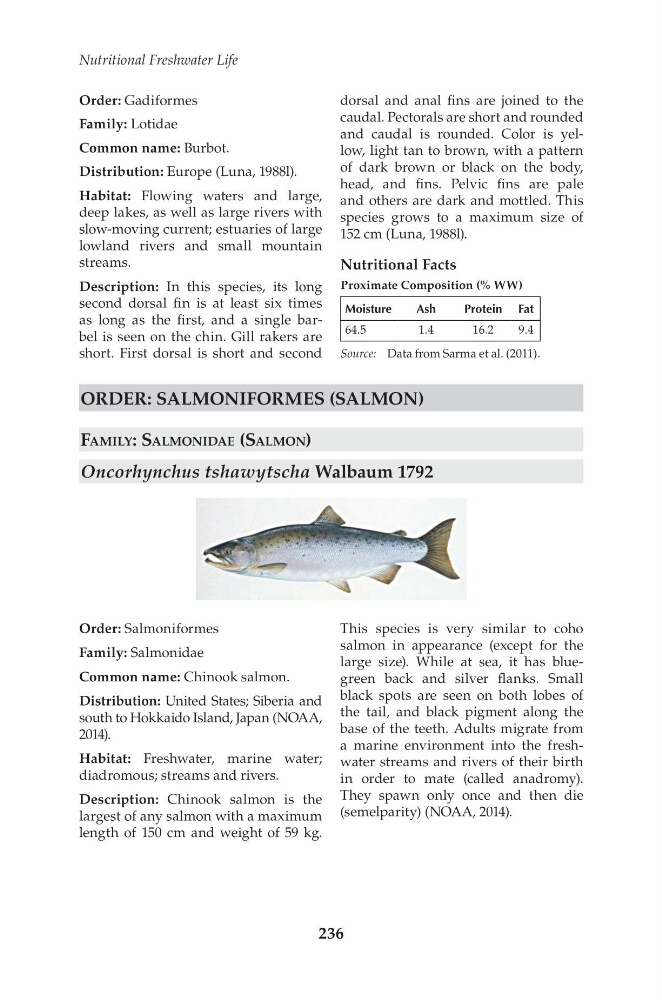
Oncorhynchus tshawytscha Walbaum 1792
Order: Salmoniformes
Family: Salmonidae
Common name: Chinook salmon.
Distribution: United States; Siberia and
south to Hokkaido Island, Japan (NOAA,
2014).
Habitat: Freshwater, marine water;
diadromous; streams and rivers.
Description: Chinook salmon is the
largest of any salmon with a maximum
length of 150 cm and weight of 59 kg.
This species is very similar to coho
salmon in appearance (except for the
large size). While at sea, it has bluegreen back and silver flanks. Small
black spots are seen on both lobes of
the tail, and black pigment along the
base of the teeth. Adults migrate from
a marine environment into the freshwater streams and rivers of their birth
in order to mate (called anadromy).
They spawn only once and then die
(semelparity) (NOAA, 2014).
236
Order: Gadiformes
Family: Lotidae
Common name: Burbot.
Distribution: Europe (Luna, 1988l).
Habitat: Flowing waters and large,
deep lakes, as well as large rivers with
slow-moving current; estuaries of large
lowland rivers and small mountain
streams.
Description: In this species, its long
second dorsal fin is at least six times
as long as the first, and a single barbel is seen on the chin. Gill rakers are
short. First dorsal is short and second
dorsal and anal fins are joined to the
caudal. Pectorals are short and rounded
and caudal is rounded. Color is yellow, light tan to brown, with a pattern
of dark brown or black on the body,
head, and fins. Pelvic fins are pale
and others are dark and mottled. This
species grows to a maximum size of
152 cm (Luna, 1988l).
Nutritional Facts
Proximate Composition (% WW)
Moisture
Ash
Protein Fat
64.5
1.4
16.2
9.4
Source: Data from Sarma et al. (2011).
ORDER: SALMONIFORMES (SALMON)
FaMiLy: SaLMonidae (SaLMon)
Oncorhynchus tshawytscha Walbaum 1792
Order: Salmoniformes
Family: Salmonidae
Common name: Chinook salmon.
Distribution: United States; Siberia and
south to Hokkaido Island, Japan (NOAA,
2014).
Habitat: Freshwater, marine water;
diadromous; streams and rivers.
Description: Chinook salmon is the
largest of any salmon with a maximum
length of 150 cm and weight of 59 kg.
This species is very similar to coho
salmon in appearance (except for the
large size). While at sea, it has bluegreen back and silver flanks. Small
black spots are seen on both lobes of
the tail, and black pigment along the
base of the teeth. Adults migrate from
a marine environment into the freshwater streams and rivers of their birth
in order to mate (called anadromy).
They spawn only once and then die
(semelparity) (NOAA, 2014).