

Fishes
233
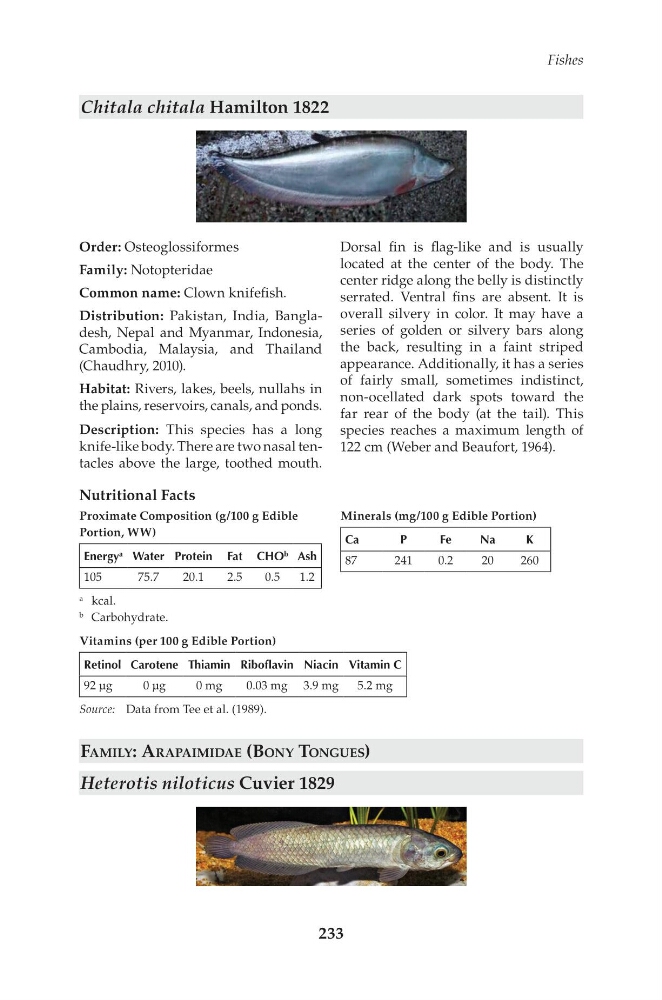
Chitala chitala Hamilton 1822
Order: Osteoglossiformes
Family: Notopteridae
Common name: Clown knifefish.
Distribution: Pakistan, India, Bangladesh, Nepal and Myanmar, Indonesia,
Cambodia, Malaysia, and Thailand
(Chaudhry, 2010).
Habitat: Rivers, lakes, beels, nullahs in
the plains, reservoirs, canals, and ponds.
Description: This species has a long
knife-like body. There are two nasal tentacles above the large, toothed mouth.
Dorsal fin is flag-like and is usually
located at the center of the body. The
center ridge along the belly is distinctly
serrated. Ventral fins are absent. It is
overall silvery in color. It may have a
series of golden or silvery bars along
the back, resulting in a faint striped
appearance. Additionally, it has a series
of fairly small, sometimes indistinct,
non-ocellated dark spots toward the
far rear of the body (at the tail). This
species reaches a maximum length of
122 cm (Weber and Beaufort, 1964).
Nutritional Facts
Proximate Composition (g/100 g Edible
Portion, WW)
Energy a Water Protein Fat CHO b Ash
105
75.7
20.1
2.5
0.5
1.2
a kcal.
b Carbohydrate.
Minerals (mg/100 g Edible Portion)
Ca
P
Fe
Na
K
87
241
0.2
20
260
Vitamins (per 100 g Edible Portion)
Retinol Carotene Thiamin Riboflavin Niacin Vitamin C
92 μg
0 μg
0 mg
0.03 mg 3.9 mg
5.2 mg
Source: Data from Tee et al. (1989).
FaMiLy: araPaiMidae (Bony tonGueS)
Heterotis niloticus Cuvier 1829
233
Chitala chitala Hamilton 1822
Order: Osteoglossiformes
Family: Notopteridae
Common name: Clown knifefish.
Distribution: Pakistan, India, Bangladesh, Nepal and Myanmar, Indonesia,
Cambodia, Malaysia, and Thailand
(Chaudhry, 2010).
Habitat: Rivers, lakes, beels, nullahs in
the plains, reservoirs, canals, and ponds.
Description: This species has a long
knife-like body. There are two nasal tentacles above the large, toothed mouth.
Dorsal fin is flag-like and is usually
located at the center of the body. The
center ridge along the belly is distinctly
serrated. Ventral fins are absent. It is
overall silvery in color. It may have a
series of golden or silvery bars along
the back, resulting in a faint striped
appearance. Additionally, it has a series
of fairly small, sometimes indistinct,
non-ocellated dark spots toward the
far rear of the body (at the tail). This
species reaches a maximum length of
122 cm (Weber and Beaufort, 1964).
Nutritional Facts
Proximate Composition (g/100 g Edible
Portion, WW)
Energy a Water Protein Fat CHO b Ash
105
75.7
20.1
2.5
0.5
1.2
a kcal.
b Carbohydrate.
Minerals (mg/100 g Edible Portion)
Ca
P
Fe
Na
K
87
241
0.2
20
260
Vitamins (per 100 g Edible Portion)
Retinol Carotene Thiamin Riboflavin Niacin Vitamin C
92 μg
0 μg
0 mg
0.03 mg 3.9 mg
5.2 mg
Source: Data from Tee et al. (1989).
FaMiLy: araPaiMidae (Bony tonGueS)
Heterotis niloticus Cuvier 1829