

Fishes
227
Order: Siluriformes
Family: Pangasiidae
Common name: Pangas catfish.
Distribution: Asia: Indian subcontinent and Myanmar (Sampang, 1999b).
Habitat: Freshwater, brackish water;
large rivers and estuaries.
Description: Body is elongated and
laterally compressed. Snout is obtusely
rounded. Upper jaw is longer than
lower jaw and mouth gap is moderate.
Two pairs of barbels are present.
Dorsal spine is serrated anteriorly.
Pectoral spine is comparatively stronger than dorsal spine and serrated
internally. Caudal fin is deeply forked
and lateral line is complete. Abdomen
is silvery and yellowish green/dark
on back. This species reaches a maximum size of 3 m. This species reaches
a maximum size of 3 m (Sampang,
1999b).
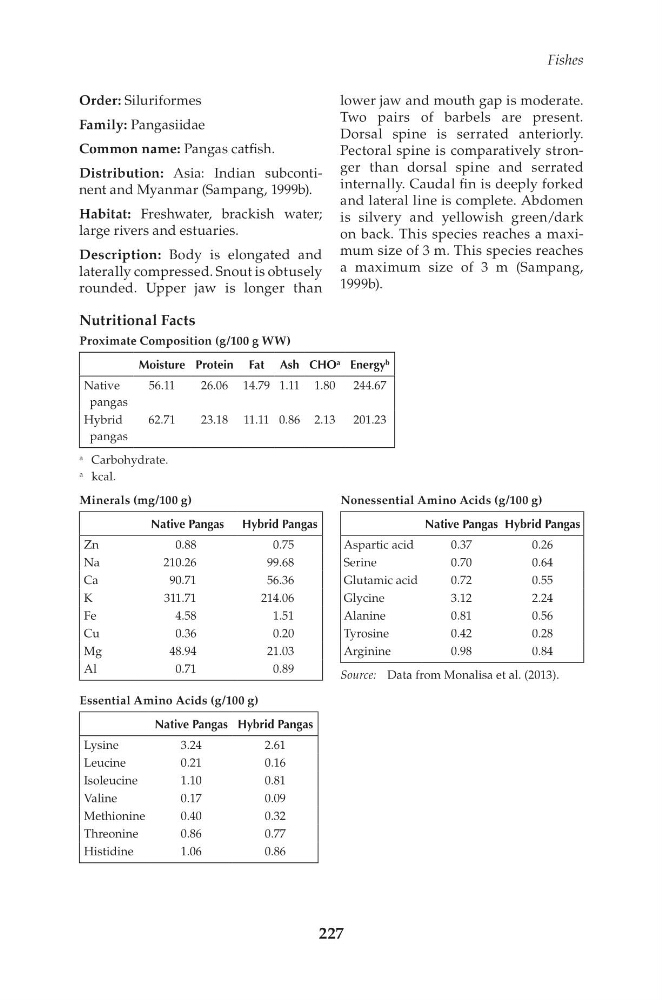
Nutritional Facts
Proximate Composition (g/100 g WW)
Moisture Protein Fat Ash CHO a Energy b
Native
pangas
56.11
26.06 14.79 1.11 1.80 244.67
Hybrid
pangas
62.71
23.18 11.11 0.86 2.13 201.23
a Carbohydrate.
a kcal.
Minerals (mg/100 g)
Native Pangas Hybrid Pangas
Zn
0.88
0.75
Na
210.26
99.68
Ca
90.71
56.36
K
311.71
214.06
Fe
4.58
1.51
Cu
0.36
0.20
Mg
48.94
21.03
Al
0.71
0.89
Essential Amino Acids (g/100 g)
Native Pangas Hybrid Pangas
Lysine
3.24
2.61
Leucine
0.21
0.16
Isoleucine
1.10
0.81
Valine
0.17
0.09
Methionine
0.40
0.32
Threonine
0.86
0.77
Histidine
1.06
0.86
Nonessential Amino Acids (g/100 g)
Native Pangas Hybrid Pangas
Aspartic acid
0.37
0.26
Serine
0.70
0.64
Glutamic acid
0.72
0.55
Glycine
3.12
2.24
Alanine
0.81
0.56
Tyrosine
0.42
0.28
Arginine
0.98
0.84
Source: Data from Monalisa et al. (2013).
227
Order: Siluriformes
Family: Pangasiidae
Common name: Pangas catfish.
Distribution: Asia: Indian subcontinent and Myanmar (Sampang, 1999b).
Habitat: Freshwater, brackish water;
large rivers and estuaries.
Description: Body is elongated and
laterally compressed. Snout is obtusely
rounded. Upper jaw is longer than
lower jaw and mouth gap is moderate.
Two pairs of barbels are present.
Dorsal spine is serrated anteriorly.
Pectoral spine is comparatively stronger than dorsal spine and serrated
internally. Caudal fin is deeply forked
and lateral line is complete. Abdomen
is silvery and yellowish green/dark
on back. This species reaches a maximum size of 3 m. This species reaches
a maximum size of 3 m (Sampang,
1999b).
Nutritional Facts
Proximate Composition (g/100 g WW)
Moisture Protein Fat Ash CHO a Energy b
Native
pangas
56.11
26.06 14.79 1.11 1.80 244.67
Hybrid
pangas
62.71
23.18 11.11 0.86 2.13 201.23
a Carbohydrate.
a kcal.
Minerals (mg/100 g)
Native Pangas Hybrid Pangas
Zn
0.88
0.75
Na
210.26
99.68
Ca
90.71
56.36
K
311.71
214.06
Fe
4.58
1.51
Cu
0.36
0.20
Mg
48.94
21.03
Al
0.71
0.89
Essential Amino Acids (g/100 g)
Native Pangas Hybrid Pangas
Lysine
3.24
2.61
Leucine
0.21
0.16
Isoleucine
1.10
0.81
Valine
0.17
0.09
Methionine
0.40
0.32
Threonine
0.86
0.77
Histidine
1.06
0.86
Nonessential Amino Acids (g/100 g)
Native Pangas Hybrid Pangas
Aspartic acid
0.37
0.26
Serine
0.70
0.64
Glutamic acid
0.72
0.55
Glycine
3.12
2.24
Alanine
0.81
0.56
Tyrosine
0.42
0.28
Arginine
0.98
0.84
Source: Data from Monalisa et al. (2013).