

Nutritional Freshwater Life
224
FaMiLy: iCtaLuridae (north aMeriCan FreShwater CatFiSheS)
Ictalurus punctatus Rafinesque 1818
Order: Siluriformes
Family: Ictaluridae
Common name: Channel catfish.
Distribution: Europe, Russian Federation, Cuba, and portions of Latin
America (Stickney, 2014).
Habitat: Flowing waters; large streams
with low or moderate current.
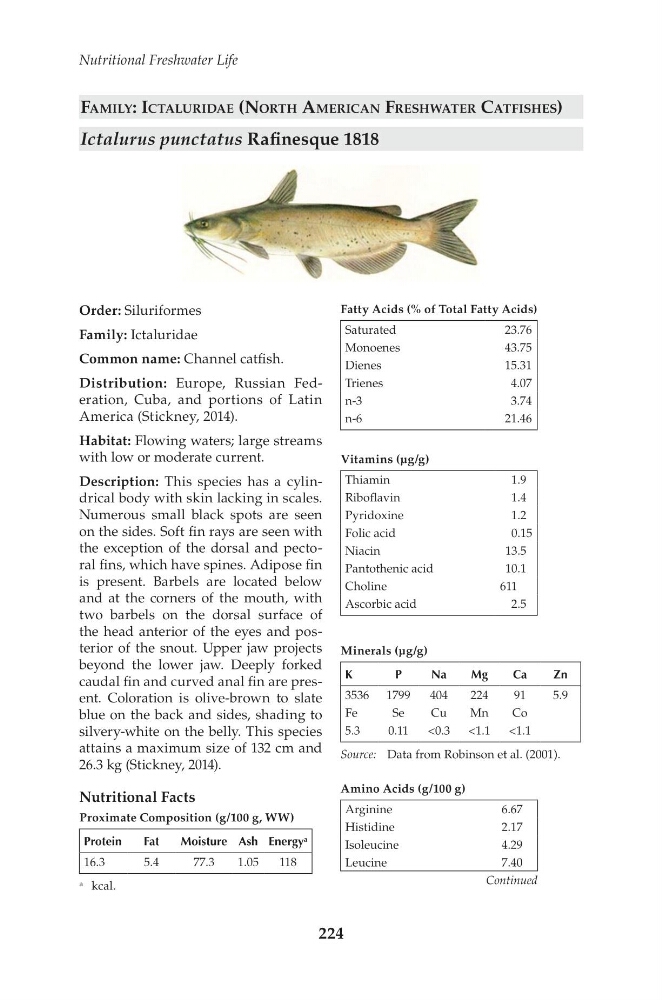
Description: This species has a cylindrical body with skin lacking in scales.
Numerous small black spots are seen
on the sides. Soft fin rays are seen with
the exception of the dorsal and pectoral fins, which have spines. Adipose fin
is present. Barbels are located below
and at the corners of the mouth, with
two barbels on the dorsal surface of
the head anterior of the eyes and posterior of the snout. Upper jaw projects
beyond the lower jaw. Deeply forked
caudal fin and curved anal fin are present. Coloration is olive-brown to slate
blue on the back and sides, shading to
silvery-white on the belly. This species
attains a maximum size of 132 cm and
26.3 kg (Stickney, 2014).
Nutritional Facts
Proximate Composition (g/100 g, WW)
Protein
Fat
Moisture Ash Energy a
16.3
5.4
77.3
1.05
118
a kcal.
Fatty Acids (% of Total Fatty Acids)
Saturated
23.76
Monoenes
43.75
Dienes
15.31
Trienes
4.07
n-3
3.74
n-6
21.46
Vitamins (µg/g)
Thiamin
1.9
Riboflavin
1.4
Pyridoxine
1.2
Folic acid
0.15
Niacin
13.5
Pantothenic acid
10.1
Choline
611
Ascorbic acid
2.5
Minerals (µg/g)
K
P
Na
Mg
Ca
Zn
3536 1799
404
224
91
5.9
Fe
Se
Cu
Mn
Co
5.3
0.11
<0.3
<1.1
<1.1
Source: Data from Robinson et al. (2001).
Amino Acids (g/100 g)
Arginine
6.67
Histidine
2.17
Isoleucine
4.29
Leucine
7.40
Continued
224
FaMiLy: iCtaLuridae (north aMeriCan FreShwater CatFiSheS)
Ictalurus punctatus Rafinesque 1818
Order: Siluriformes
Family: Ictaluridae
Common name: Channel catfish.
Distribution: Europe, Russian Federation, Cuba, and portions of Latin
America (Stickney, 2014).
Habitat: Flowing waters; large streams
with low or moderate current.
Description: This species has a cylindrical body with skin lacking in scales.
Numerous small black spots are seen
on the sides. Soft fin rays are seen with
the exception of the dorsal and pectoral fins, which have spines. Adipose fin
is present. Barbels are located below
and at the corners of the mouth, with
two barbels on the dorsal surface of
the head anterior of the eyes and posterior of the snout. Upper jaw projects
beyond the lower jaw. Deeply forked
caudal fin and curved anal fin are present. Coloration is olive-brown to slate
blue on the back and sides, shading to
silvery-white on the belly. This species
attains a maximum size of 132 cm and
26.3 kg (Stickney, 2014).
Nutritional Facts
Proximate Composition (g/100 g, WW)
Protein
Fat
Moisture Ash Energy a
16.3
5.4
77.3
1.05
118
a kcal.
Fatty Acids (% of Total Fatty Acids)
Saturated
23.76
Monoenes
43.75
Dienes
15.31
Trienes
4.07
n-3
3.74
n-6
21.46
Vitamins (µg/g)
Thiamin
1.9
Riboflavin
1.4
Pyridoxine
1.2
Folic acid
0.15
Niacin
13.5
Pantothenic acid
10.1
Choline
611
Ascorbic acid
2.5
Minerals (µg/g)
K
P
Na
Mg
Ca
Zn
3536 1799
404
224
91
5.9
Fe
Se
Cu
Mn
Co
5.3
0.11
<0.3
<1.1
<1.1
Source: Data from Robinson et al. (2001).
Amino Acids (g/100 g)
Arginine
6.67
Histidine
2.17
Isoleucine
4.29
Leucine
7.40
Continued