

Nutritional Freshwater Life
216
Order: Siluriformes
Family: Bagridae
Common name: Golden catfish, Guinea
catfish, Pyjama catfish.
Distribution: Asia: Pakistan, India,
Nepal and Bangladesh, Afghanistan
(Reyes, 1993h).
Habitat: Flowing and standing waters;
rivers and ponds in plains and submontane regions.
Description: Dorsal profile of this species is rising evenly from tip of snout
to origin of dorsal fin. Ventral profile
is roughly straight up to the end of the
anal fin base. Eyes are rounded and
located entirely in the dorsal half of the
head. Mouth is subterminal. Barbels are
in four pairs. Dorsal fin has spinelet,
spine, and seven branched rays. The
spine is serrated anteriorly near the distal tip. Adipose fin is long. Pectoral fin
has a backwardly curved stout spine.
Caudal fin is deeply forked. Body has a
distinct oval dark brown tympanic spot
and four brown stripes (a middorsal
and three lateral stripes), and all the
stripes are separated by pale longitudinal lines of equal width. This species
grows to a maximum size of only 18 cm
(Darshan et al., 2013).
Proximate Composition (% WW)
Moisture
Ash
Protein Lipid
77.17
1.48
17.86
3.48
Source: Data from Ahmed et al. (2012).
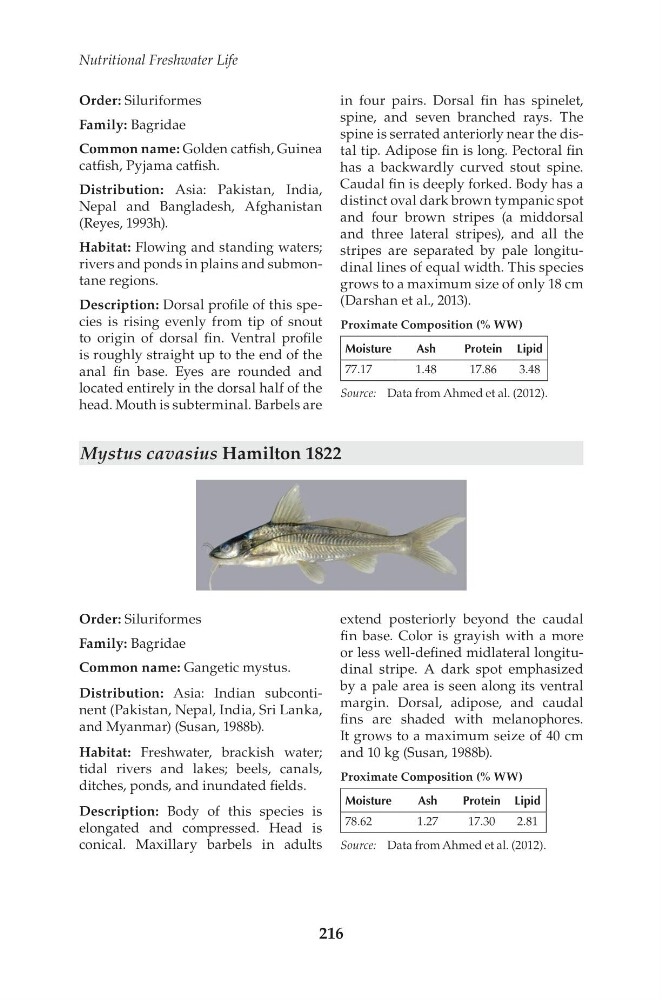
Mystus cavasius Hamilton 1822
Order: Siluriformes
Family: Bagridae
Common name: Gangetic mystus.
Distribution: Asia: Indian subcontinent (Pakistan, Nepal, India, Sri Lanka,
and Myanmar) (Susan, 1988b).
Habitat: Freshwater, brackish water;
tidal rivers and lakes; beels, canals,
ditches, ponds, and inundated fields.
Description: Body of this species is
elongated and compressed. Head is
conical. Maxillary barbels in adults
extend posteriorly beyond the caudal
fin base. Color is grayish with a more
or less well-defined midlateral longitudinal stripe. A dark spot emphasized
by a pale area is seen along its ventral
margin. Dorsal, adipose, and caudal
fins are shaded with melanophores.
It grows to a maximum seize of 40 cm
and 10 kg (Susan, 1988b).
Proximate Composition (% WW)
Moisture
Ash
Protein Lipid
78.62
1.27
17.30
2.81
Source: Data from Ahmed et al. (2012).
216
Order: Siluriformes
Family: Bagridae
Common name: Golden catfish, Guinea
catfish, Pyjama catfish.
Distribution: Asia: Pakistan, India,
Nepal and Bangladesh, Afghanistan
(Reyes, 1993h).
Habitat: Flowing and standing waters;
rivers and ponds in plains and submontane regions.
Description: Dorsal profile of this species is rising evenly from tip of snout
to origin of dorsal fin. Ventral profile
is roughly straight up to the end of the
anal fin base. Eyes are rounded and
located entirely in the dorsal half of the
head. Mouth is subterminal. Barbels are
in four pairs. Dorsal fin has spinelet,
spine, and seven branched rays. The
spine is serrated anteriorly near the distal tip. Adipose fin is long. Pectoral fin
has a backwardly curved stout spine.
Caudal fin is deeply forked. Body has a
distinct oval dark brown tympanic spot
and four brown stripes (a middorsal
and three lateral stripes), and all the
stripes are separated by pale longitudinal lines of equal width. This species
grows to a maximum size of only 18 cm
(Darshan et al., 2013).
Proximate Composition (% WW)
Moisture
Ash
Protein Lipid
77.17
1.48
17.86
3.48
Source: Data from Ahmed et al. (2012).
Mystus cavasius Hamilton 1822
Order: Siluriformes
Family: Bagridae
Common name: Gangetic mystus.
Distribution: Asia: Indian subcontinent (Pakistan, Nepal, India, Sri Lanka,
and Myanmar) (Susan, 1988b).
Habitat: Freshwater, brackish water;
tidal rivers and lakes; beels, canals,
ditches, ponds, and inundated fields.
Description: Body of this species is
elongated and compressed. Head is
conical. Maxillary barbels in adults
extend posteriorly beyond the caudal
fin base. Color is grayish with a more
or less well-defined midlateral longitudinal stripe. A dark spot emphasized
by a pale area is seen along its ventral
margin. Dorsal, adipose, and caudal
fins are shaded with melanophores.
It grows to a maximum seize of 40 cm
and 10 kg (Susan, 1988b).
Proximate Composition (% WW)
Moisture
Ash
Protein Lipid
78.62
1.27
17.30
2.81
Source: Data from Ahmed et al. (2012).