

Nutritional Freshwater Life
196
Description: Body of this species is
deep and strongly compressed laterally.
Long-based dorsal and anal fins mirror
each other in length and frame the body.
The posterior-most soft rays of each of
these fins are slightly elongated to create
a trailing margin. Foremost rays of the
jugular pelvic fins are also slightly elongated. Pectoral fins are large, rounded,
and low-slung. Caudal fin is rounded to
concave. Lateral line is divided in two,
with the posterior portion starting below
the end of the other. There are three
color variations of this fish, viz., a pink
or flesh-colored form, a silver-green, and
a mottled variey. It grows to a maximum
size of 30 cm (Froese and Pauly, 2007b).
Nutritional Facts
Proximate Composition (g/100 g edible
portion, WW)
Energy a Water Protein Fat CHO b Ash
85
78.3
19.8
0.6
0
1.3
a kcal.
b Carbohydrate.
Minerals (mg/100 g edible portion)
Ca
P
Fe
Na
K
77
241
0.8
18
303
Vitamins (per 100 g edible portion)
Retinol Carotene Thiamin Riboflavin Niacin Vitamin C
38 μg
0 μg
0.03 mg 0.46 mg 3.0 mg
3.1 mg
Source: Data from Tee et al. (1989).
FaMiLy: oSPhroneMidae (GouraMieS)
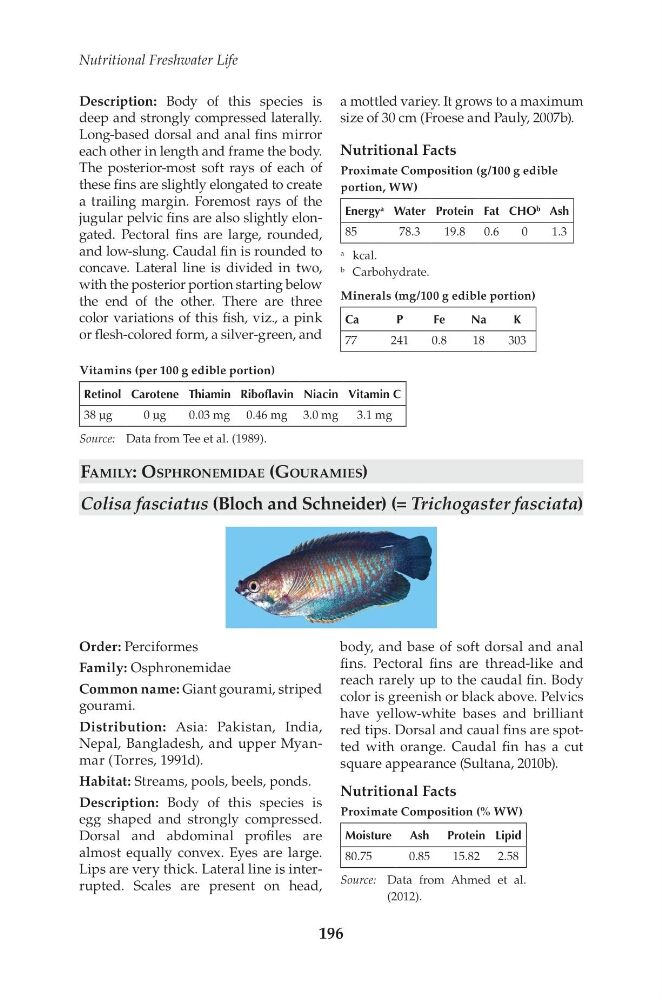
Colisa fasciatus (Bloch and Schneider) (= Trichogaster fasciata)
Order: Perciformes
Family: Osphronemidae
Common name: Giant gourami, striped
gourami.
Distribution: Asia: Pakistan, India,
Nepal, Bangladesh, and upper Myanmar (Torres, 1991d).
Habitat: Streams, pools, beels, ponds.
Description: Body of this species is
egg shaped and strongly compressed.
Dorsal and abdominal profiles are
almost equally convex. Eyes are large.
Lips are very thick. Lateral line is interrupted. Scales are present on head,
body, and base of soft dorsal and anal
fins. Pectoral fins are thread-like and
reach rarely up to the caudal fin. Body
color is greenish or black above. Pelvics
have yellow-white bases and brilliant
red tips. Dorsal and caual fins are spotted with orange. Caudal fin has a cut
square appearance (Sultana, 2010b).
Nutritional Facts
Proximate Composition (% WW)
Moisture
Ash
Protein Lipid
80.75
0.85
15.82 2.58
Source: Data from Ahmed et al.
(2012).
196
Description: Body of this species is
deep and strongly compressed laterally.
Long-based dorsal and anal fins mirror
each other in length and frame the body.
The posterior-most soft rays of each of
these fins are slightly elongated to create
a trailing margin. Foremost rays of the
jugular pelvic fins are also slightly elongated. Pectoral fins are large, rounded,
and low-slung. Caudal fin is rounded to
concave. Lateral line is divided in two,
with the posterior portion starting below
the end of the other. There are three
color variations of this fish, viz., a pink
or flesh-colored form, a silver-green, and
a mottled variey. It grows to a maximum
size of 30 cm (Froese and Pauly, 2007b).
Nutritional Facts
Proximate Composition (g/100 g edible
portion, WW)
Energy a Water Protein Fat CHO b Ash
85
78.3
19.8
0.6
0
1.3
a kcal.
b Carbohydrate.
Minerals (mg/100 g edible portion)
Ca
P
Fe
Na
K
77
241
0.8
18
303
Vitamins (per 100 g edible portion)
Retinol Carotene Thiamin Riboflavin Niacin Vitamin C
38 μg
0 μg
0.03 mg 0.46 mg 3.0 mg
3.1 mg
Source: Data from Tee et al. (1989).
FaMiLy: oSPhroneMidae (GouraMieS)
Colisa fasciatus (Bloch and Schneider) (= Trichogaster fasciata)
Order: Perciformes
Family: Osphronemidae
Common name: Giant gourami, striped
gourami.
Distribution: Asia: Pakistan, India,
Nepal, Bangladesh, and upper Myanmar (Torres, 1991d).
Habitat: Streams, pools, beels, ponds.
Description: Body of this species is
egg shaped and strongly compressed.
Dorsal and abdominal profiles are
almost equally convex. Eyes are large.
Lips are very thick. Lateral line is interrupted. Scales are present on head,
body, and base of soft dorsal and anal
fins. Pectoral fins are thread-like and
reach rarely up to the caudal fin. Body
color is greenish or black above. Pelvics
have yellow-white bases and brilliant
red tips. Dorsal and caual fins are spotted with orange. Caudal fin has a cut
square appearance (Sultana, 2010b).
Nutritional Facts
Proximate Composition (% WW)
Moisture
Ash
Protein Lipid
80.75
0.85
15.82 2.58
Source: Data from Ahmed et al.
(2012).