

Fishes
197
Osphronemus goramy Lacepède 1801
Order: Perciformes
Family: Osphronemidae
Common name: Giant gourami, common gourami, true gourami.
Distribution: Native to Southeast Asia;
Asia: probably limited to Sumatra,
Borneo, Java, the Malay Peninsula,
Thailand, and Indochina (Mekong
Basin) (Torres, 1991k).
Habitat: Freshwater or brackish water;
slow-moving areas such as swamps,
lakes, and large rivers.
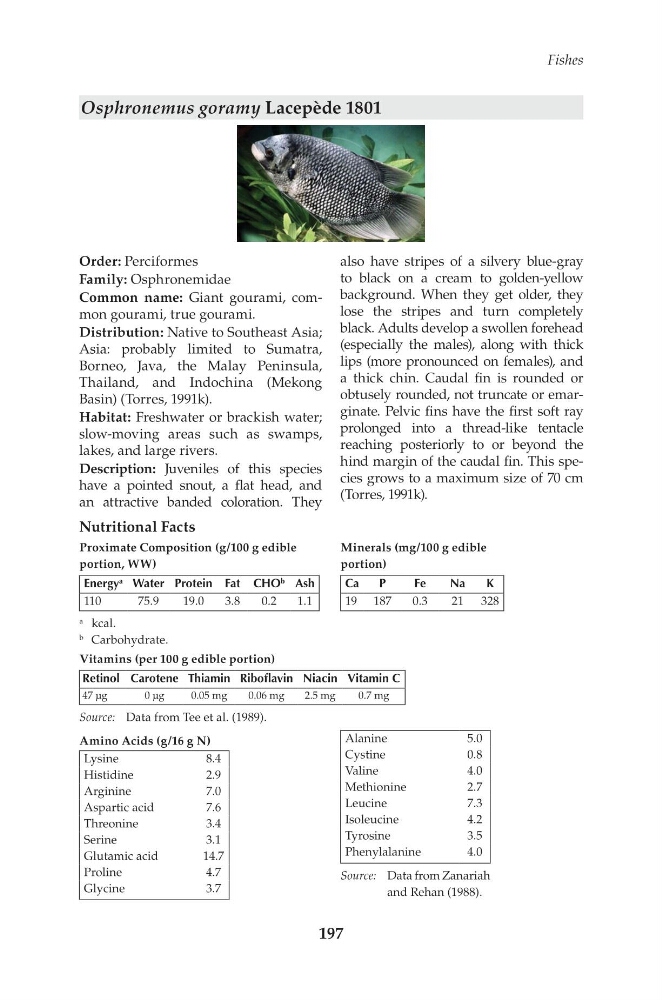
Description: Juveniles of this species
have a pointed snout, a flat head, and
an attractive banded coloration. They
also have stripes of a silvery blue-gray
to black on a cream to golden-yellow
background. When they get older, they
lose the stripes and turn completely
black. Adults develop a swollen forehead
(especially the males), along with thick
lips (more pronounced on females), and
a thick chin. Caudal fin is rounded or
obtusely rounded, not truncate or emarginate. Pelvic fins have the first soft ray
prolonged into a thread-like tentacle
reaching posteriorly to or beyond the
hind margin of the caudal fin. This species grows to a maximum size of 70 cm
(Torres, 1991k).
Nutritional Facts
Proximate Composition (g/100 g edible
portion, WW)
Energy a Water Protein Fat CHO b Ash
110
75.9
19.0
3.8
0.2
1.1
a kcal.
b Carbohydrate.
Minerals (mg/100 g edible
portion)
Ca
P
Fe
Na
K
19 187
0.3
21 328
Vitamins (per 100 g edible portion)
Retinol Carotene Thiamin Riboflavin Niacin Vitamin C
47 μg
0 μg
0.05 mg
0.06 mg
2.5 mg
0.7 mg
Source: Data from Tee et al. (1989).
Amino Acids (g/16 g N)
Lysine
8.4
Histidine
2.9
Arginine
7.0
Aspartic acid
7.6
Threonine
3.4
Serine
3.1
Glutamic acid
14.7
Proline
4.7
Glycine
3.7
Alanine
5.0
Cystine
0.8
Valine
4.0
Methionine
2.7
Leucine
7.3
Isoleucine
4.2
Tyrosine
3.5
Phenylalanine
4.0
Source: Data from Zanariah
and Rehan (1988).
197
Osphronemus goramy Lacepède 1801
Order: Perciformes
Family: Osphronemidae
Common name: Giant gourami, common gourami, true gourami.
Distribution: Native to Southeast Asia;
Asia: probably limited to Sumatra,
Borneo, Java, the Malay Peninsula,
Thailand, and Indochina (Mekong
Basin) (Torres, 1991k).
Habitat: Freshwater or brackish water;
slow-moving areas such as swamps,
lakes, and large rivers.
Description: Juveniles of this species
have a pointed snout, a flat head, and
an attractive banded coloration. They
also have stripes of a silvery blue-gray
to black on a cream to golden-yellow
background. When they get older, they
lose the stripes and turn completely
black. Adults develop a swollen forehead
(especially the males), along with thick
lips (more pronounced on females), and
a thick chin. Caudal fin is rounded or
obtusely rounded, not truncate or emarginate. Pelvic fins have the first soft ray
prolonged into a thread-like tentacle
reaching posteriorly to or beyond the
hind margin of the caudal fin. This species grows to a maximum size of 70 cm
(Torres, 1991k).
Nutritional Facts
Proximate Composition (g/100 g edible
portion, WW)
Energy a Water Protein Fat CHO b Ash
110
75.9
19.0
3.8
0.2
1.1
a kcal.
b Carbohydrate.
Minerals (mg/100 g edible
portion)
Ca
P
Fe
Na
K
19 187
0.3
21 328
Vitamins (per 100 g edible portion)
Retinol Carotene Thiamin Riboflavin Niacin Vitamin C
47 μg
0 μg
0.05 mg
0.06 mg
2.5 mg
0.7 mg
Source: Data from Tee et al. (1989).
Amino Acids (g/16 g N)
Lysine
8.4
Histidine
2.9
Arginine
7.0
Aspartic acid
7.6
Threonine
3.4
Serine
3.1
Glutamic acid
14.7
Proline
4.7
Glycine
3.7
Alanine
5.0
Cystine
0.8
Valine
4.0
Methionine
2.7
Leucine
7.3
Isoleucine
4.2
Tyrosine
3.5
Phenylalanine
4.0
Source: Data from Zanariah
and Rehan (1988).