

Nutritional Freshwater Life
164
Common name: Nile minnow.
Distribution: From Senegal to Ethiopia,
and north as far as the Nile delta
(Geelhand, 2013c).
Habitat: Running waters, especially on
sandy shores and in irrigation canals.
Description: This species has a body
depth of 3.8–5.7 times and head length
3.7–4.5 times the SL (standard length).
Eye diameter is 2.8–3.6 times the head
length. There are 12 scales around the
caudal peduncle, 9–12 anal fin branched
rays, and 8–9 dorsal fin branched
rays. Sides are plain or with irregular
markings and back is dark. This species
reaches a maximum size of 9.5 cm and
only 10 g (Geelhand, 2013c).
Nutritional Facts
Proximate Composition (% DM)
Protein Fiber Ash Moisture Energy a
37.1
0.42 5.0
8.0
370.12
a kcal/100 g.
Minerals (mg/g)
Fe
Cu
Ni
Na
K
Zn
Pb
0.086 0.042 0.02 3.7 8.4 0.082 0.017
Source: Data from Onyia et al. (2010).
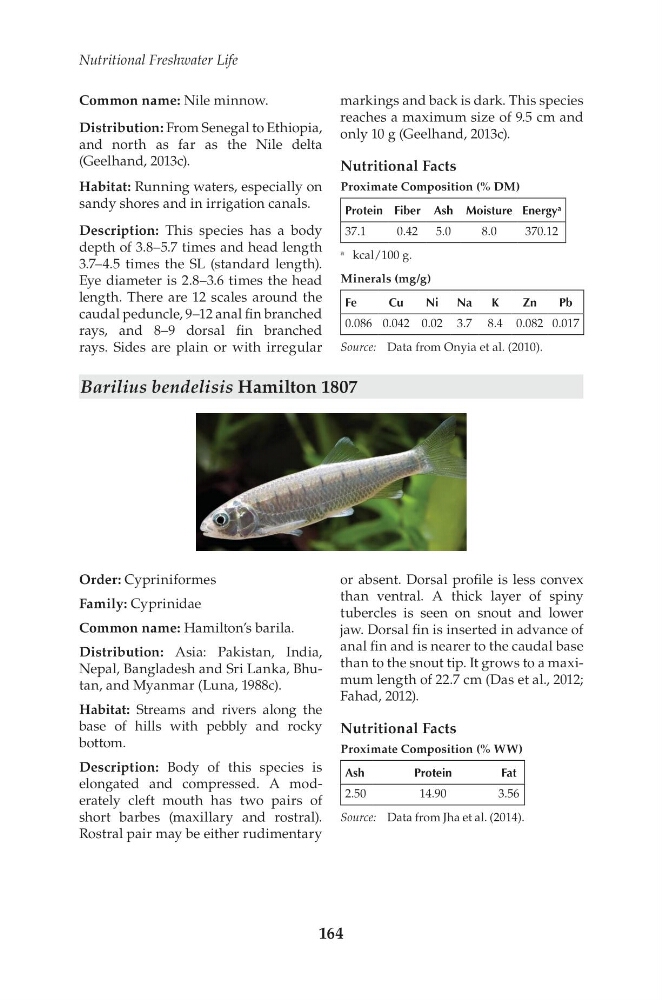
Barilius bendelisis Hamilton 1807
Order: Cypriniformes
Family: Cyprinidae
Common name: Hamilton’s barila.
Distribution: Asia: Pakistan, India,
Nepal, Bangladesh and Sri Lanka, Bhutan, and Myanmar (Luna, 1988c).
Habitat: Streams and rivers along the
base of hills with pebbly and rocky
bottom.
Description: Body of this species is
elongated and compressed. A moderately cleft mouth has two pairs of
short barbes (maxillary and rostral).
Rostral pair may be either rudimentary
or absent. Dorsal profile is less convex
than ventral. A thick layer of spiny
tubercles is seen on snout and lower
jaw. Dorsal fin is inserted in advance of
anal fin and is nearer to the caudal base
than to the snout tip. It grows to a maximum length of 22.7 cm (Das et al., 2012;
Fahad, 2012).
Nutritional Facts
Proximate Composition (% WW)
Ash
Protein
Fat
2.50
14.90
3.56
Source: Data from Jha et al. (2014).
164
Common name: Nile minnow.
Distribution: From Senegal to Ethiopia,
and north as far as the Nile delta
(Geelhand, 2013c).
Habitat: Running waters, especially on
sandy shores and in irrigation canals.
Description: This species has a body
depth of 3.8–5.7 times and head length
3.7–4.5 times the SL (standard length).
Eye diameter is 2.8–3.6 times the head
length. There are 12 scales around the
caudal peduncle, 9–12 anal fin branched
rays, and 8–9 dorsal fin branched
rays. Sides are plain or with irregular
markings and back is dark. This species
reaches a maximum size of 9.5 cm and
only 10 g (Geelhand, 2013c).
Nutritional Facts
Proximate Composition (% DM)
Protein Fiber Ash Moisture Energy a
37.1
0.42 5.0
8.0
370.12
a kcal/100 g.
Minerals (mg/g)
Fe
Cu
Ni
Na
K
Zn
Pb
0.086 0.042 0.02 3.7 8.4 0.082 0.017
Source: Data from Onyia et al. (2010).
Barilius bendelisis Hamilton 1807
Order: Cypriniformes
Family: Cyprinidae
Common name: Hamilton’s barila.
Distribution: Asia: Pakistan, India,
Nepal, Bangladesh and Sri Lanka, Bhutan, and Myanmar (Luna, 1988c).
Habitat: Streams and rivers along the
base of hills with pebbly and rocky
bottom.
Description: Body of this species is
elongated and compressed. A moderately cleft mouth has two pairs of
short barbes (maxillary and rostral).
Rostral pair may be either rudimentary
or absent. Dorsal profile is less convex
than ventral. A thick layer of spiny
tubercles is seen on snout and lower
jaw. Dorsal fin is inserted in advance of
anal fin and is nearer to the caudal base
than to the snout tip. It grows to a maximum length of 22.7 cm (Das et al., 2012;
Fahad, 2012).
Nutritional Facts
Proximate Composition (% WW)
Ash
Protein
Fat
2.50
14.90
3.56
Source: Data from Jha et al. (2014).