

Fishes
153
Tor putitora F. Hamilton 1822
Common name: Putitor mahseer, golden
mahaseer.
Distribution: Himalayan region and
elsewhere in South Asia and Southeast
Asia, ranging from Afghanistan, Pakistan, India (Darjeeling to Kashmir),
Nepal, Bangladesh, Bhutan, Sri Lanka,
Myanmar, western Iran to eastern Thailand (Jha and Rayamajhi, 2010b).
Habitat: Montane and submontane
regions, in streams and rivers.
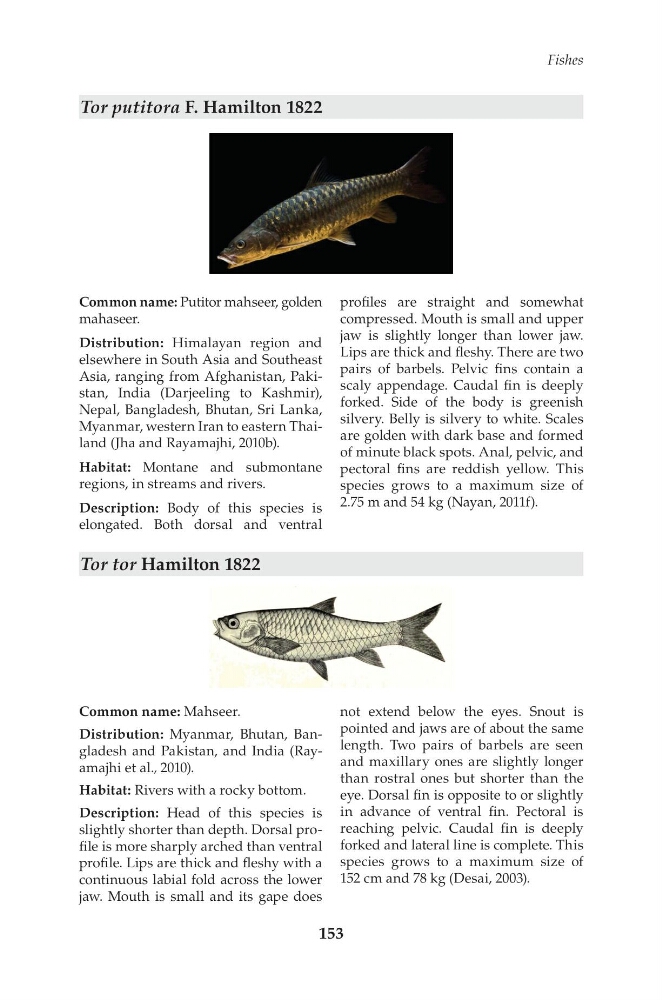
Description: Body of this species is
elongated. Both dorsal and ventral
profiles are straight and somewhat
compressed. Mouth is small and upper
jaw is slightly longer than lower jaw.
Lips are thick and fleshy. There are two
pairs of barbels. Pelvic fins contain a
scaly appendage. Caudal fin is deeply
forked. Side of the body is greenish
silvery. Belly is silvery to white. Scales
are golden with dark base and formed
of minute black spots. Anal, pelvic, and
pectoral fins are reddish yellow. This
species grows to a maximum size of
2.75 m and 54 kg (Nayan, 2011f).
Tor tor Hamilton 1822
Common name: Mahseer.
Distribution: Myanmar, Bhutan, Bangladesh and Pakistan, and India (Rayamajhi et al., 2010).
Habitat: Rivers with a rocky bottom.
Description: Head of this species is
slightly shorter than depth. Dorsal profile is more sharply arched than ventral
profile. Lips are thick and fleshy with a
continuous labial fold across the lower
jaw. Mouth is small and its gape does
not extend below the eyes. Snout is
pointed and jaws are of about the same
length. Two pairs of barbels are seen
and maxillary ones are slightly longer
than rostral ones but shorter than the
eye. Dorsal fin is opposite to or slightly
in advance of ventral fin. Pectoral is
reaching pelvic. Caudal fin is deeply
forked and lateral line is complete. This
species grows to a maximum size of
152 cm and 78 kg (Desai, 2003).
153
Tor putitora F. Hamilton 1822
Common name: Putitor mahseer, golden
mahaseer.
Distribution: Himalayan region and
elsewhere in South Asia and Southeast
Asia, ranging from Afghanistan, Pakistan, India (Darjeeling to Kashmir),
Nepal, Bangladesh, Bhutan, Sri Lanka,
Myanmar, western Iran to eastern Thailand (Jha and Rayamajhi, 2010b).
Habitat: Montane and submontane
regions, in streams and rivers.
Description: Body of this species is
elongated. Both dorsal and ventral
profiles are straight and somewhat
compressed. Mouth is small and upper
jaw is slightly longer than lower jaw.
Lips are thick and fleshy. There are two
pairs of barbels. Pelvic fins contain a
scaly appendage. Caudal fin is deeply
forked. Side of the body is greenish
silvery. Belly is silvery to white. Scales
are golden with dark base and formed
of minute black spots. Anal, pelvic, and
pectoral fins are reddish yellow. This
species grows to a maximum size of
2.75 m and 54 kg (Nayan, 2011f).
Tor tor Hamilton 1822
Common name: Mahseer.
Distribution: Myanmar, Bhutan, Bangladesh and Pakistan, and India (Rayamajhi et al., 2010).
Habitat: Rivers with a rocky bottom.
Description: Head of this species is
slightly shorter than depth. Dorsal profile is more sharply arched than ventral
profile. Lips are thick and fleshy with a
continuous labial fold across the lower
jaw. Mouth is small and its gape does
not extend below the eyes. Snout is
pointed and jaws are of about the same
length. Two pairs of barbels are seen
and maxillary ones are slightly longer
than rostral ones but shorter than the
eye. Dorsal fin is opposite to or slightly
in advance of ventral fin. Pectoral is
reaching pelvic. Caudal fin is deeply
forked and lateral line is complete. This
species grows to a maximum size of
152 cm and 78 kg (Desai, 2003).