

Nutritional Freshwater Life
146
an adipose fin. Lower lip is thick with
a median swollen pad. Tip of dorsal
is pointed and its posterior margin is
concave. Pelvic originates below dorsal
origin. It has a dark brown or gray mottled appearance and underside is light
colored. Fins have a reddish tinge. This
reaches a maximum size of 1.2 m and
12 kg (Torres, 1991a).
Nutritional Facts
Proximate Composition (g/100 g WW)
Moisture Protein Fat
Ash CHO a,b
72.39
18.61
7.78
1.33
53.12
a mg/100 g.
b Carbohydrate.
Fatty Acids (%)
SFA
MUFA PUFA PUFA/SFA
28.63
45.27 26.31
0.92
Source: Data from Ljubojevic et al.
(2013).
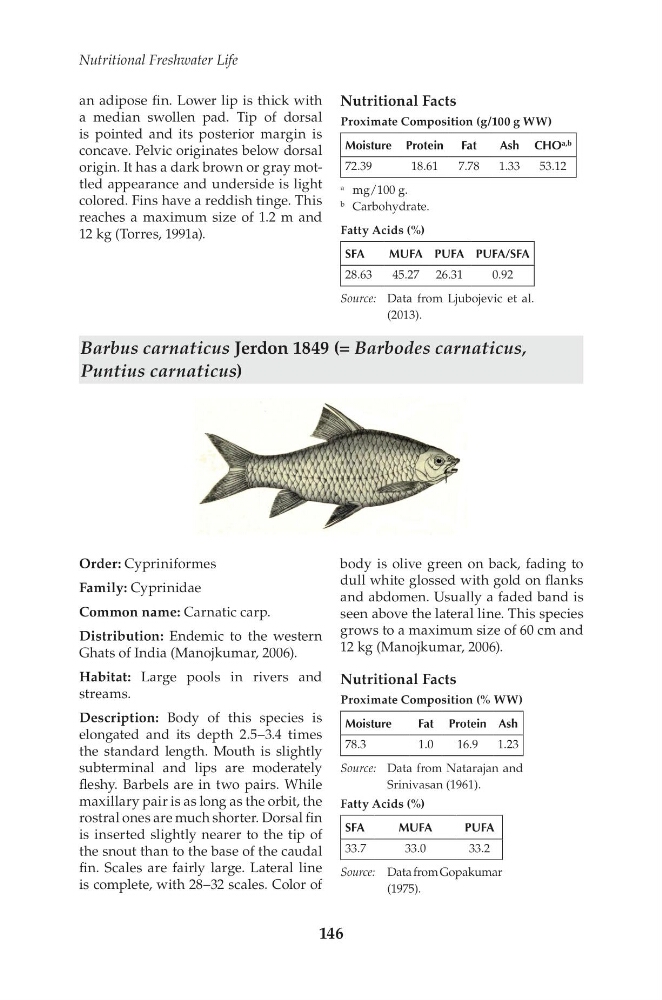
Barbus carnaticus Jerdon 1849 (= Barbodes carnaticus,
Puntius carnaticus)
Order: Cypriniformes
Family: Cyprinidae
Common name: Carnatic carp.
Distribution: Endemic to the western
Ghats of India (Manojkumar, 2006).
Habitat: Large pools in rivers and
streams.
Description: Body of this species is
elongated and its depth 2.5–3.4 times
the standard length. Mouth is slightly
subterminal and lips are moderately
fleshy. Barbels are in two pairs. While
maxillary pair is as long as the orbit, the
rostral ones are much shorter. Dorsal fin
is inserted slightly nearer to the tip of
the snout than to the base of the caudal
fin. Scales are fairly large. Lateral line
is complete, with 28–32 scales. Color of
body is olive green on back, fading to
dull white glossed with gold on flanks
and abdomen. Usually a faded band is
seen above the lateral line. This species
grows to a maximum size of 60 cm and
12 kg (Manojkumar, 2006).
Nutritional Facts
Proximate Composition (% WW)
Moisture
Fat Protein Ash
78.3
1.0
16.9
1.23
Source: Data from Natarajan and
Srinivasan (1961).
Fatty Acids (%)
SFA
MUFA
PUFA
33.7
33.0
33.2
Source: Data from Gopakumar
(1975).
146
an adipose fin. Lower lip is thick with
a median swollen pad. Tip of dorsal
is pointed and its posterior margin is
concave. Pelvic originates below dorsal
origin. It has a dark brown or gray mottled appearance and underside is light
colored. Fins have a reddish tinge. This
reaches a maximum size of 1.2 m and
12 kg (Torres, 1991a).
Nutritional Facts
Proximate Composition (g/100 g WW)
Moisture Protein Fat
Ash CHO a,b
72.39
18.61
7.78
1.33
53.12
a mg/100 g.
b Carbohydrate.
Fatty Acids (%)
SFA
MUFA PUFA PUFA/SFA
28.63
45.27 26.31
0.92
Source: Data from Ljubojevic et al.
(2013).
Barbus carnaticus Jerdon 1849 (= Barbodes carnaticus,
Puntius carnaticus)
Order: Cypriniformes
Family: Cyprinidae
Common name: Carnatic carp.
Distribution: Endemic to the western
Ghats of India (Manojkumar, 2006).
Habitat: Large pools in rivers and
streams.
Description: Body of this species is
elongated and its depth 2.5–3.4 times
the standard length. Mouth is slightly
subterminal and lips are moderately
fleshy. Barbels are in two pairs. While
maxillary pair is as long as the orbit, the
rostral ones are much shorter. Dorsal fin
is inserted slightly nearer to the tip of
the snout than to the base of the caudal
fin. Scales are fairly large. Lateral line
is complete, with 28–32 scales. Color of
body is olive green on back, fading to
dull white glossed with gold on flanks
and abdomen. Usually a faded band is
seen above the lateral line. This species
grows to a maximum size of 60 cm and
12 kg (Manojkumar, 2006).
Nutritional Facts
Proximate Composition (% WW)
Moisture
Fat Protein Ash
78.3
1.0
16.9
1.23
Source: Data from Natarajan and
Srinivasan (1961).
Fatty Acids (%)
SFA
MUFA
PUFA
33.7
33.0
33.2
Source: Data from Gopakumar
(1975).