

Nutritional Freshwater Life
144
Habitat: Freshwater and brackish
water; rivers, streams, and ponds.
Description: Body of this species is
moderately compressed. Dorsal profile
is more convex than that of the abdomen. Mouth is small and terminal
without barbels. Upper jaw is longer
than lower jaw. Pectoral fin is as long as
head excluding snout. Pelvic fin originates a little behind origin of dorsal.
Lateral line is complete. A dark spot
is seen at the tip of the tial and at the
base of dorsal fin rays. Body when alive
is silvery and back is grayish green to
brownish. Flanks are with a bluish luster and abdomen is white. It reaches an
adult size of 25 cm and a weight of 70 g
(Zakia, 2010; Froese and Pauly, 2006a).
Nutritional Facts
Proximate Composition (% WW)
Moisture Protein Fat Ash CHO a
75.60
21.50 2.70 1.90 1.55
a Carbohydrate.
Source: Data from Musa (2009).
Vitamin A and Minerals (per 100 g)
Vitamin A (RAE) Ca a
Fe b Zn b
60
1.2
3.0 3.1
RAE, retinol activity equivalent.
a g.
b mg.
Source: Data from Thilsted (2012).
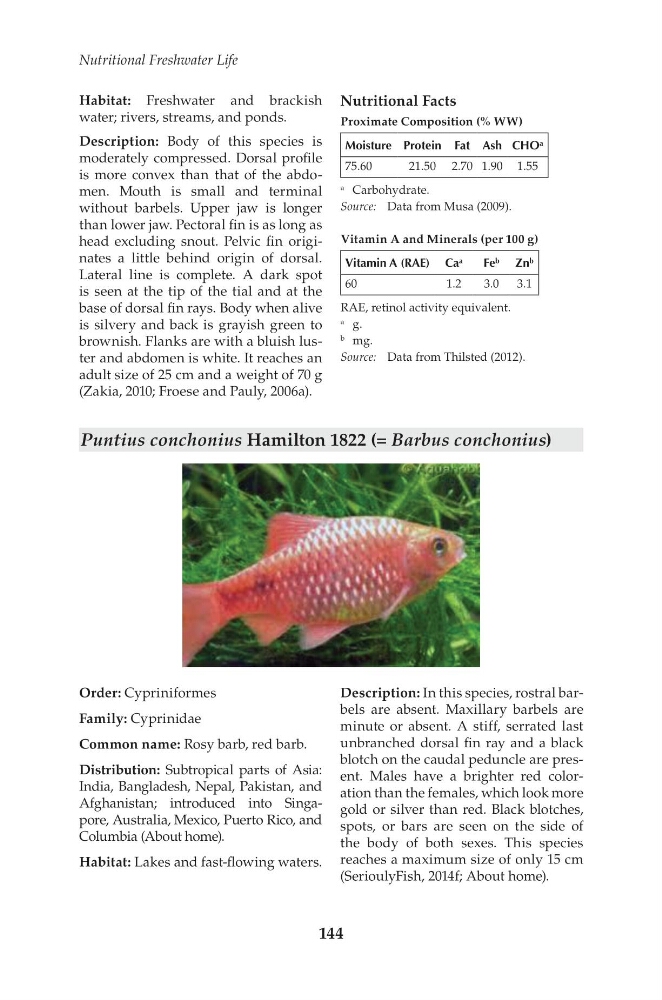
Puntius conchonius Hamilton 1822 (= Barbus conchonius)
Order: Cypriniformes
Family: Cyprinidae
Common name: Rosy barb, red barb.
Distribution: Subtropical parts of Asia:
India, Bangladesh, Nepal, Pakistan, and
Afghanistan; introduced into Singapore, Australia, Mexico, Puerto Rico, and
Columbia (About home).
Habitat: Lakes and fast-flowing waters.
Description: In this species, rostral barbels are absent. Maxillary barbels are
minute or absent. A stiff, serrated last
unbranched dorsal fin ray and a black
blotch on the caudal peduncle are present. Males have a brighter red coloration than the females, which look more
gold or silver than red. Black blotches,
spots, or bars are seen on the side of
the body of both sexes. This species
reaches a maximum size of only 15 cm
(SerioulyFish, 2014f; About home).
144
Habitat: Freshwater and brackish
water; rivers, streams, and ponds.
Description: Body of this species is
moderately compressed. Dorsal profile
is more convex than that of the abdomen. Mouth is small and terminal
without barbels. Upper jaw is longer
than lower jaw. Pectoral fin is as long as
head excluding snout. Pelvic fin originates a little behind origin of dorsal.
Lateral line is complete. A dark spot
is seen at the tip of the tial and at the
base of dorsal fin rays. Body when alive
is silvery and back is grayish green to
brownish. Flanks are with a bluish luster and abdomen is white. It reaches an
adult size of 25 cm and a weight of 70 g
(Zakia, 2010; Froese and Pauly, 2006a).
Nutritional Facts
Proximate Composition (% WW)
Moisture Protein Fat Ash CHO a
75.60
21.50 2.70 1.90 1.55
a Carbohydrate.
Source: Data from Musa (2009).
Vitamin A and Minerals (per 100 g)
Vitamin A (RAE) Ca a
Fe b Zn b
60
1.2
3.0 3.1
RAE, retinol activity equivalent.
a g.
b mg.
Source: Data from Thilsted (2012).
Puntius conchonius Hamilton 1822 (= Barbus conchonius)
Order: Cypriniformes
Family: Cyprinidae
Common name: Rosy barb, red barb.
Distribution: Subtropical parts of Asia:
India, Bangladesh, Nepal, Pakistan, and
Afghanistan; introduced into Singapore, Australia, Mexico, Puerto Rico, and
Columbia (About home).
Habitat: Lakes and fast-flowing waters.
Description: In this species, rostral barbels are absent. Maxillary barbels are
minute or absent. A stiff, serrated last
unbranched dorsal fin ray and a black
blotch on the caudal peduncle are present. Males have a brighter red coloration than the females, which look more
gold or silver than red. Black blotches,
spots, or bars are seen on the side of
the body of both sexes. This species
reaches a maximum size of only 15 cm
(SerioulyFish, 2014f; About home).