

Fishes
133
Order: Cypriniformes
Family: Cyprinidae
Common name: Pangusia labeo.
Distribution: Asia: Pakistan, India,
Nepal and Bangladesh, Afghanistan,
Bhutan, and Myanmar (Torres, 1991f).
Habitat: Rivers, lakes, and ponds; large
streams.
Description: Body of this species is
elongated and dorsal profile is more
convex than that of ventral. Mouth is
small, and it overhangs with distinct
lateral lobes. Eyes are small and lips
are thick and not fringed. Dorsal fin
is inserted to snout tip. Pectorals do
not extend up to pelvics. Caudal fin is
deeply forked. Lateral line is complete,
and there are two black spots just above
and below the lateral line. Riverine
fishes are brownish above and yellowish and white at sides and below.
Stream fishes, on the other hand, are
dark or blackish above and light yellowish below. This species reaches a
maximum size of 90 cm and 2.5 kg
(Fahad, 2011e; Practical Fishkeeping).
Nutritional Facts
Proximate Composition (% DM)
Moisture
Protein
Lipid
Ash
12.20
70.08
8.487
5.65
Macroelements (mg/100 g)
Ca
Mg
K
Na
P
9.70
56.57
234.25
58.87 322.22
Microelements (mg/100 g)
Cu
Co
Mn
Zn
Fe
Ni
Cr
0.500 3.875 0.500 3.750 5.969 1.800 0.035
Source: Data from Hei and Sarojnalini (2012).
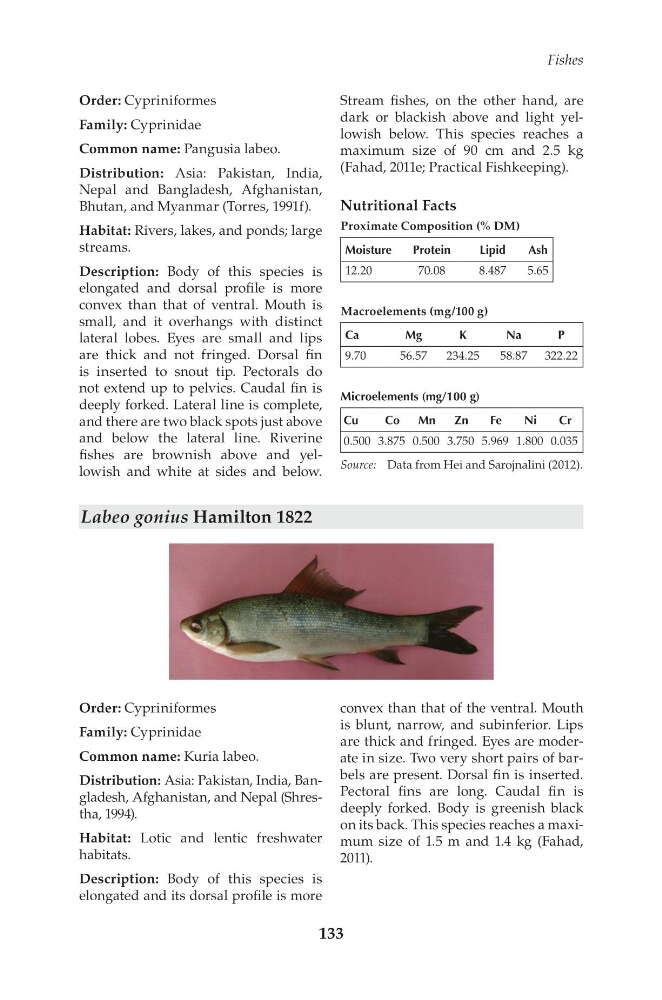
Labeo gonius Hamilton 1822
Order: Cypriniformes
Family: Cyprinidae
Common name: Kuria labeo.
Distribution: Asia: Pakistan, India, Bangladesh, Afghanistan, and Nepal (Shrestha, 1994).
Habitat: Lotic and lentic freshwater
habitats.
Description: Body of this species is
elongated and its dorsal profile is more
convex than that of the ventral. Mouth
is blunt, narrow, and subinferior. Lips
are thick and fringed. Eyes are moderate in size. Two very short pairs of barbels are present. Dorsal fin is inserted.
Pectoral fins are long. Caudal fin is
deeply forked. Body is greenish black
on its back. This species reaches a maximum size of 1.5 m and 1.4 kg (Fahad,
2011).
133
Order: Cypriniformes
Family: Cyprinidae
Common name: Pangusia labeo.
Distribution: Asia: Pakistan, India,
Nepal and Bangladesh, Afghanistan,
Bhutan, and Myanmar (Torres, 1991f).
Habitat: Rivers, lakes, and ponds; large
streams.
Description: Body of this species is
elongated and dorsal profile is more
convex than that of ventral. Mouth is
small, and it overhangs with distinct
lateral lobes. Eyes are small and lips
are thick and not fringed. Dorsal fin
is inserted to snout tip. Pectorals do
not extend up to pelvics. Caudal fin is
deeply forked. Lateral line is complete,
and there are two black spots just above
and below the lateral line. Riverine
fishes are brownish above and yellowish and white at sides and below.
Stream fishes, on the other hand, are
dark or blackish above and light yellowish below. This species reaches a
maximum size of 90 cm and 2.5 kg
(Fahad, 2011e; Practical Fishkeeping).
Nutritional Facts
Proximate Composition (% DM)
Moisture
Protein
Lipid
Ash
12.20
70.08
8.487
5.65
Macroelements (mg/100 g)
Ca
Mg
K
Na
P
9.70
56.57
234.25
58.87 322.22
Microelements (mg/100 g)
Cu
Co
Mn
Zn
Fe
Ni
Cr
0.500 3.875 0.500 3.750 5.969 1.800 0.035
Source: Data from Hei and Sarojnalini (2012).
Labeo gonius Hamilton 1822
Order: Cypriniformes
Family: Cyprinidae
Common name: Kuria labeo.
Distribution: Asia: Pakistan, India, Bangladesh, Afghanistan, and Nepal (Shrestha, 1994).
Habitat: Lotic and lentic freshwater
habitats.
Description: Body of this species is
elongated and its dorsal profile is more
convex than that of the ventral. Mouth
is blunt, narrow, and subinferior. Lips
are thick and fringed. Eyes are moderate in size. Two very short pairs of barbels are present. Dorsal fin is inserted.
Pectoral fins are long. Caudal fin is
deeply forked. Body is greenish black
on its back. This species reaches a maximum size of 1.5 m and 1.4 kg (Fahad,
2011).