

Molluscs
127
Common name: Channeled apple snail.
Distribution: Tropical and subtropical
South America.
Habitat: Freshwater habitats.
Description: Shell of this species is globose and relatively heavy (especially in
older snails). Five to six whorls are separated by a deep, indented suture. Shell
opening (aperture) is large and oval to
round. Males are known to have a rounder
aperture than females. Umbilicus is large
and deep. Maximum size of these snails
varies from 40 to 60 mm wide and 45 to
75 mm high depending on the conditions. Maximum length, however, is
150 mm. Normal coloration typically
includes bands of brown, black, and yellowish tan; color patterns are extremely
variable. Albino and gold color variations exist.
Nutritional Facts
Proximate Composition (% WW)
Protein Fat Fiber Ash
Lanistes libycus
31.66 3.57 0.09 12.21
Pomacea
canaliculata
31.38 3.26 0.11 11.38
Pomacea bridgesii 33.24 3.18 0.13 11.42
Minerals (mg/kg WW)
Na
K
Ca
P
Lanistes
libycus
0.139 0.401 0.185 0.348
Pomacea
canaliculata
0.152 0.412 0.196 0.314
Pomacea
bridgesii
0.419 0.418 0.191 0.326
Source: Data from Adebayo-Tayo et al. (2011).
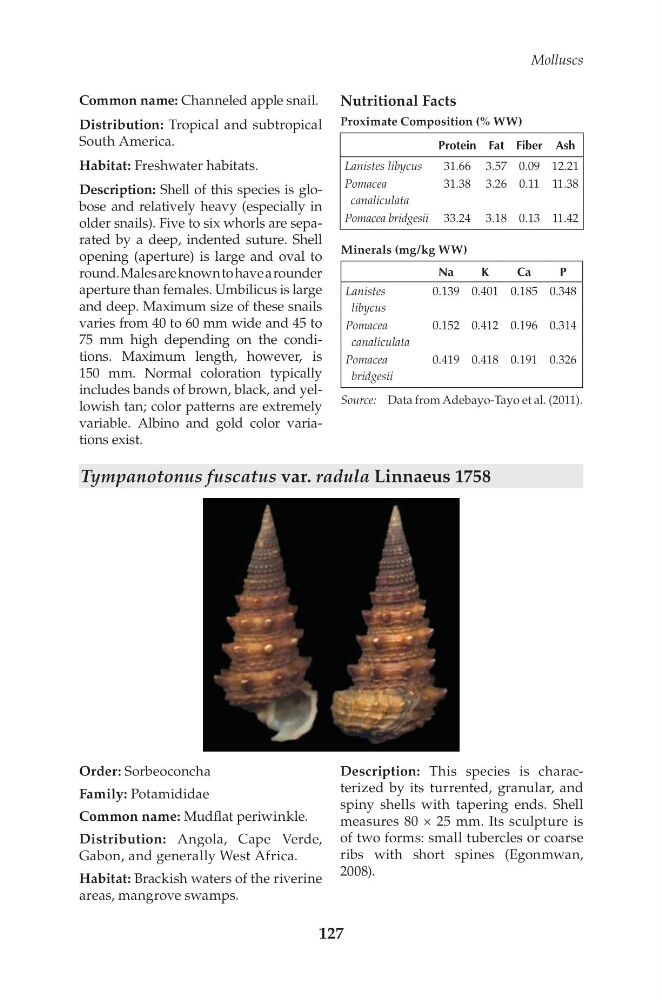
Tympanotonus fuscatus var. radula Linnaeus 1758
Order: Sorbeoconcha
Family: Potamididae
Common name: Mudflat periwinkle.
Distribution: Angola, Cape Verde,
Gabon, and generally West Africa.
Habitat: Brackish waters of the riverine
areas, mangrove swamps.
Description: This species is characterized by its turrented, granular, and
spiny shells with tapering ends. Shell
measures 80 × 25 mm. Its sculpture is
of two forms: small tubercles or coarse
ribs with short spines (Egonmwan,
2008).
127
Common name: Channeled apple snail.
Distribution: Tropical and subtropical
South America.
Habitat: Freshwater habitats.
Description: Shell of this species is globose and relatively heavy (especially in
older snails). Five to six whorls are separated by a deep, indented suture. Shell
opening (aperture) is large and oval to
round. Males are known to have a rounder
aperture than females. Umbilicus is large
and deep. Maximum size of these snails
varies from 40 to 60 mm wide and 45 to
75 mm high depending on the conditions. Maximum length, however, is
150 mm. Normal coloration typically
includes bands of brown, black, and yellowish tan; color patterns are extremely
variable. Albino and gold color variations exist.
Nutritional Facts
Proximate Composition (% WW)
Protein Fat Fiber Ash
Lanistes libycus
31.66 3.57 0.09 12.21
Pomacea
canaliculata
31.38 3.26 0.11 11.38
Pomacea bridgesii 33.24 3.18 0.13 11.42
Minerals (mg/kg WW)
Na
K
Ca
P
Lanistes
libycus
0.139 0.401 0.185 0.348
Pomacea
canaliculata
0.152 0.412 0.196 0.314
Pomacea
bridgesii
0.419 0.418 0.191 0.326
Source: Data from Adebayo-Tayo et al. (2011).
Tympanotonus fuscatus var. radula Linnaeus 1758
Order: Sorbeoconcha
Family: Potamididae
Common name: Mudflat periwinkle.
Distribution: Angola, Cape Verde,
Gabon, and generally West Africa.
Habitat: Brackish waters of the riverine
areas, mangrove swamps.
Description: This species is characterized by its turrented, granular, and
spiny shells with tapering ends. Shell
measures 80 × 25 mm. Its sculpture is
of two forms: small tubercles or coarse
ribs with short spines (Egonmwan,
2008).