

Donc c A = [H 3 O
+ ] initial =
7,5 × 10
−4
10 × 10 −3 = 0,075 mol·L
−1
4. Deux raisons :
– Le graphe sera formé de portions rectilignes
– La cellule sera facilement immergée.
5. γ exp´ erimental =
0,42 × 10
−3
0,01
= 42 mS·m
−1
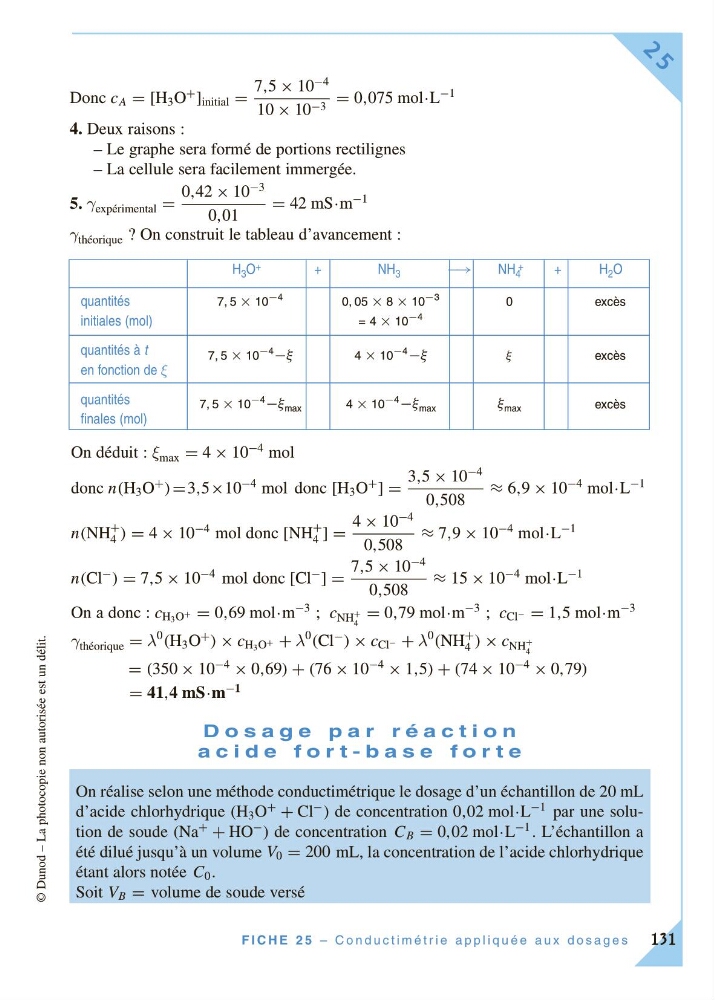
γ th´ eorique ? On construit le tableau d’avancement :
131
F I C H E 2 5 – C o n d u c t i m é t r i e a p p l i q u é e a u x d o s a g e s
© Dunod – La photocopie non autorisée est un délit.
2
5
On déduit : ξ max = 4 × 10
−4 mol
donc n(H 3 O
+
) = 3,5×10
−4 mol donc [H 3 O
+ ] =
3,5 × 10
−4
0,508
≈ 6,9 × 10
−4 mol·L
−1
n(NH
+
4 ) = 4 × 10
−4 mol donc [NH
+
4 ] =
4 × 10
−4
0,508
≈ 7,9 × 10
−4 mol·L
−1
n(Cl
−
) = 7,5 × 10
−4 mol donc [Cl
− ] =
7,5 × 10
−4
0,508
≈ 15 × 10
−4 mol·L
−1
On a donc : c H 3 O + = 0,69 mol·m
−3 ; c NH
+
4
= 0,79 mol·m
−3 ; c Cl − = 1,5 mol·m
−3
γ th´ eorique = λ
0
(H 3 O
+
) × c H 3 O + + λ
0
(Cl
−
) × c Cl − + λ
0
(NH
+
4 ) × c NH
+
4
= (350 × 10
−4
× 0,69) + (76 × 10
−4
× 1,5) + (74 × 10
−4
× 0,79)
= 41,4 mS·m
−1
D o s a g e p a r r é a c t i o n
a c i d e f o r t - b a s e f o r t e
On réalise selon une méthode conductimétrique le dosage d’un échantillon de 20 mL
d’acide chlorhydrique (H 3 O
+
+ Cl
− ) de concentration 0,02 mol·L
−1 par une solution de soude (Na
+
+ HO
− ) de concentration C B = 0,02 mol·L
−1 . L’échantillon a
été dilué jusqu’à un volume V 0 = 200 mL, la concentration de l’acide chlorhydrique
étant alors notée C 0 .
Soit V B = volume de soude versé
H 3 O +
+
NH 3
−→
NH 4
+
+
H 2 O
quantités
7, 5 × 10
−4
0, 05 × 8 × 10
−3
0
excès
initiales (mol)
= 4 × 10
−4
quantités à t
7, 5 × 10
−4
−ξ
4 × 10
−4
−ξ
ξ
excès
en fonction de ξ
quantités
7, 5 × 10
−4
−ξ max
4 × 10
−4
−ξ max
ξ max
excès
finales (mol)
+ ] initial =
7,5 × 10
−4
10 × 10 −3 = 0,075 mol·L
−1
4. Deux raisons :
– Le graphe sera formé de portions rectilignes
– La cellule sera facilement immergée.
5. γ exp´ erimental =
0,42 × 10
−3
0,01
= 42 mS·m
−1
γ th´ eorique ? On construit le tableau d’avancement :
131
F I C H E 2 5 – C o n d u c t i m é t r i e a p p l i q u é e a u x d o s a g e s
© Dunod – La photocopie non autorisée est un délit.
2
5
On déduit : ξ max = 4 × 10
−4 mol
donc n(H 3 O
+
) = 3,5×10
−4 mol donc [H 3 O
+ ] =
3,5 × 10
−4
0,508
≈ 6,9 × 10
−4 mol·L
−1
n(NH
+
4 ) = 4 × 10
−4 mol donc [NH
+
4 ] =
4 × 10
−4
0,508
≈ 7,9 × 10
−4 mol·L
−1
n(Cl
−
) = 7,5 × 10
−4 mol donc [Cl
− ] =
7,5 × 10
−4
0,508
≈ 15 × 10
−4 mol·L
−1
On a donc : c H 3 O + = 0,69 mol·m
−3 ; c NH
+
4
= 0,79 mol·m
−3 ; c Cl − = 1,5 mol·m
−3
γ th´ eorique = λ
0
(H 3 O
+
) × c H 3 O + + λ
0
(Cl
−
) × c Cl − + λ
0
(NH
+
4 ) × c NH
+
4
= (350 × 10
−4
× 0,69) + (76 × 10
−4
× 1,5) + (74 × 10
−4
× 0,79)
= 41,4 mS·m
−1
D o s a g e p a r r é a c t i o n
a c i d e f o r t - b a s e f o r t e
On réalise selon une méthode conductimétrique le dosage d’un échantillon de 20 mL
d’acide chlorhydrique (H 3 O
+
+ Cl
− ) de concentration 0,02 mol·L
−1 par une solution de soude (Na
+
+ HO
− ) de concentration C B = 0,02 mol·L
−1 . L’échantillon a
été dilué jusqu’à un volume V 0 = 200 mL, la concentration de l’acide chlorhydrique
étant alors notée C 0 .
Soit V B = volume de soude versé
H 3 O +
+
NH 3
−→
NH 4
+
+
H 2 O
quantités
7, 5 × 10
−4
0, 05 × 8 × 10
−3
0
excès
initiales (mol)
= 4 × 10
−4
quantités à t
7, 5 × 10
−4
−ξ
4 × 10
−4
−ξ
ξ
excès
en fonction de ξ
quantités
7, 5 × 10
−4
−ξ max
4 × 10
−4
−ξ max
ξ max
excès
finales (mol)