

Parameterization of Convective Boundary Layer Turbulence and Clouds
77
of order n + 1. The impossibility of establishing a closed set of turbulence equations
constitutes the “closure problem.”
This is the reason why turbulence remains an open problem in physics research.
The use of some closure is a practical necessity in any model. In the FA, one often
“forgets” about this fundamental problem by just putting the turbulent terms to zero.
That cannot be done in the boundary layer, because those terms are comparatively
large and may be even dominant. There, models use additional empirical or semiempirical equations to close the equation set. Those new equations need to be physically sound and must be thoroughly supported by observations.
There are different ways to solve the closure problem. In all cases, it amounts to
the establishment of relations between second-order (and possibly higher) statistical moments of the perturbation variables and the mean variables (the fi rst-order
moments). These relations, together with other semi-empirical relations describing
adiabatic processes, are included in the “parameterization” package of a numerical
model.
4.3.2 TURBULENCE PARAMETERIZATION AND FIRST-ORDER CLOSURES
In the CBL, there are two classic approaches for the parameterization of turbulence,
the ones based on local and nonlocal closures. The local approach consists of relating
the unknown higher-order terms in a given point of the space and time with properties of the fl ow near that point. Nonlocal closures, on the other hand, allow relations
between those unknowns and properties in other, possibly noncontiguous, regions
of the BL.
Local closures can be established at different orders, depending on the number
of statistical moments that are explicitly kept in the prognostic equations. Simplest,
fi rst-order closures keep only prognostic equations for the mean variables (fi rst-order
moments). Higher-order closures add other prognostic equations and extra variables.
Local closures have proposed up to the third order (André et al. 1978), but fi rst- and
second-order schemes are, in general, considered to be good enough (and computationally expensive enough).
First-order closures are the more frequently used in atmospheric BL modeling,
and are based on an analogy between the processes of molecular diffusion and turbulent mixing (Boussinesq 1877). Therefore, the turbulent fl ux of a property in a
point of the space is considered proportional to the local gradient of that property.
This approach is commonly known as theory of turbulent diffusion or diffusion-K,
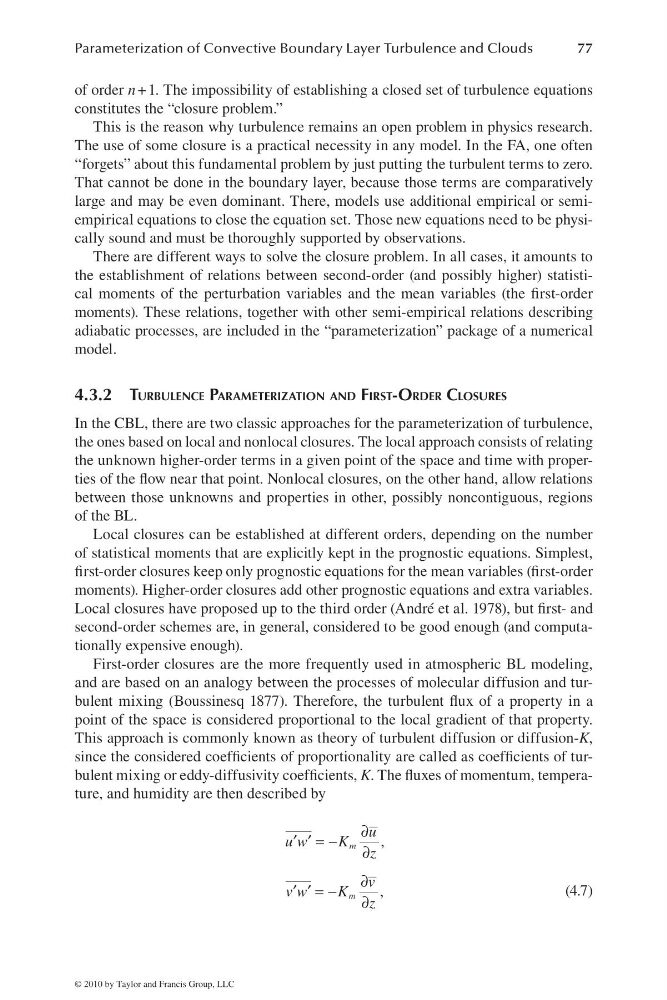
since the considered coeffi cients of proportionality are called as coeffi cients of turbulent mixing or eddy-diffusivity coeffi cients, K. The fl uxes of momentum, temperature, and humidity are then described by
,
,
m
m
u
u w
K
z
v
v w
K
z
∂
= −
′ ′
∂
∂
= −
′ ′
∂
(4.7)
© 2010 by Taylor and Francis Group, LLC
77
of order n + 1. The impossibility of establishing a closed set of turbulence equations
constitutes the “closure problem.”
This is the reason why turbulence remains an open problem in physics research.
The use of some closure is a practical necessity in any model. In the FA, one often
“forgets” about this fundamental problem by just putting the turbulent terms to zero.
That cannot be done in the boundary layer, because those terms are comparatively
large and may be even dominant. There, models use additional empirical or semiempirical equations to close the equation set. Those new equations need to be physically sound and must be thoroughly supported by observations.
There are different ways to solve the closure problem. In all cases, it amounts to
the establishment of relations between second-order (and possibly higher) statistical moments of the perturbation variables and the mean variables (the fi rst-order
moments). These relations, together with other semi-empirical relations describing
adiabatic processes, are included in the “parameterization” package of a numerical
model.
4.3.2 TURBULENCE PARAMETERIZATION AND FIRST-ORDER CLOSURES
In the CBL, there are two classic approaches for the parameterization of turbulence,
the ones based on local and nonlocal closures. The local approach consists of relating
the unknown higher-order terms in a given point of the space and time with properties of the fl ow near that point. Nonlocal closures, on the other hand, allow relations
between those unknowns and properties in other, possibly noncontiguous, regions
of the BL.
Local closures can be established at different orders, depending on the number
of statistical moments that are explicitly kept in the prognostic equations. Simplest,
fi rst-order closures keep only prognostic equations for the mean variables (fi rst-order
moments). Higher-order closures add other prognostic equations and extra variables.
Local closures have proposed up to the third order (André et al. 1978), but fi rst- and
second-order schemes are, in general, considered to be good enough (and computationally expensive enough).
First-order closures are the more frequently used in atmospheric BL modeling,
and are based on an analogy between the processes of molecular diffusion and turbulent mixing (Boussinesq 1877). Therefore, the turbulent fl ux of a property in a
point of the space is considered proportional to the local gradient of that property.
This approach is commonly known as theory of turbulent diffusion or diffusion-K,
since the considered coeffi cients of proportionality are called as coeffi cients of turbulent mixing or eddy-diffusivity coeffi cients, K. The fl uxes of momentum, temperature, and humidity are then described by
,
,
m
m
u
u w
K
z
v
v w
K
z
∂
= −
′ ′
∂
∂
= −
′ ′
∂
(4.7)
© 2010 by Taylor and Francis Group, LLC