

78
Air Pollution and Turbulence: Modeling and Applications
∂θ
′ ′
θ = −
∂
∂
′ ′ = −
∂
,
l
l
h
t
t
q
w
K
z
q
w q
K
z
(4.8)
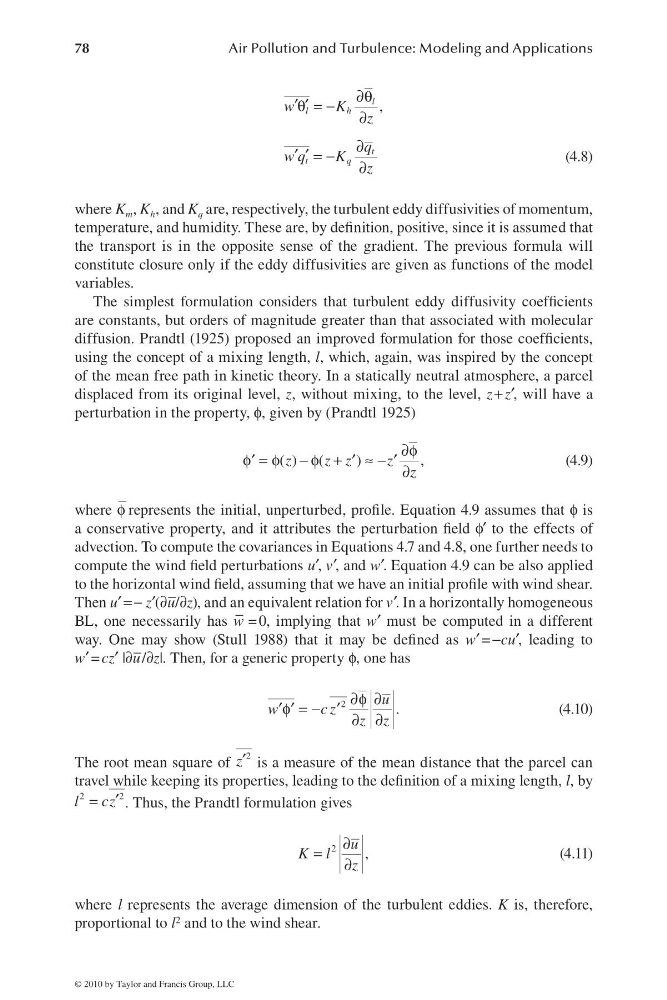
where K m , K h , and K q are, respectively, the turbulent eddy diffusivities of momentum,
temperature, and humidity. These are, by defi nition, positive, since it is assumed that
the transport is in the opposite sense of the gradient. The previous formula will
constitute closure only if the eddy diffusivities are given as functions of the model
variables.
The simplest formulation considers that turbulent eddy diffusivity coeffi cients
are constants, but orders of magnitude greater than that associated with molecular
diffusion. Prandtl (1925) proposed an improved formulation for those coeffi cients,
using the concept of a mixing length, l, which, again, was inspired by the concept
of the mean free path in kinetic theory. In a statically neutral atmosphere, a parcel
displaced from its original level, z, without mixing, to the level, z + z′, will have a
perturbation in the property, φ, given by (Prandtl 1925)
( ) (
)
,
z
z z
z
z
∂φ
φ = φ − φ + ≈ −
′
′
′ ∂
(4.9)
where φ
– represents the initial, unperturbed, profi le. Equation 4.9 assumes that φ is
a conservative property, and it attributes the perturbation fi eld φ′ to the effects of
advection. To compute the covariances in Equations 4.7 and 4.8, one further needs to
compute the wind fi eld perturbations u′, v′, and w′. Equation 4.9 can be also applied
to the horizontal wind fi eld, assuming that we have an initial profi le with wind shear.
Then u′ = − z′(∂u – /∂z), and an equivalent relation for v′. In a horizontally homogeneous
BL, one necessarily has w – = 0, implying that w′ must be computed in a different
way. One may show (Stull 1988) that it may be defi ned as w′ = −cu′, leading to
w′ = cz′ |∂u – /∂z|. Then, for a generic property φ, one has
2
.
u
w
cz
z z
∂φ ∂
φ = −
′ ′
′ ∂ ∂
(4.10)
The root mean square of
2
z′ is a measure of the mean distance that the parcel can
travel while keeping its properties, leading to the defi nition of a mixing length, l, by
2
2
l cz′
=
. Thus, the Prandtl formulation gives
2
,
u
K l
z
∂
= ∂
(4.11)
where l represents the average dimension of the turbulent eddies. K is, therefore,
proportional to l 2 and to the wind shear.
© 2010 by Taylor and Francis Group, LLC
Air Pollution and Turbulence: Modeling and Applications
∂θ
′ ′
θ = −
∂
∂
′ ′ = −
∂
,
l
l
h
t
t
q
w
K
z
q
w q
K
z
(4.8)
where K m , K h , and K q are, respectively, the turbulent eddy diffusivities of momentum,
temperature, and humidity. These are, by defi nition, positive, since it is assumed that
the transport is in the opposite sense of the gradient. The previous formula will
constitute closure only if the eddy diffusivities are given as functions of the model
variables.
The simplest formulation considers that turbulent eddy diffusivity coeffi cients
are constants, but orders of magnitude greater than that associated with molecular
diffusion. Prandtl (1925) proposed an improved formulation for those coeffi cients,
using the concept of a mixing length, l, which, again, was inspired by the concept
of the mean free path in kinetic theory. In a statically neutral atmosphere, a parcel
displaced from its original level, z, without mixing, to the level, z + z′, will have a
perturbation in the property, φ, given by (Prandtl 1925)
( ) (
)
,
z
z z
z
z
∂φ
φ = φ − φ + ≈ −
′
′
′ ∂
(4.9)
where φ
– represents the initial, unperturbed, profi le. Equation 4.9 assumes that φ is
a conservative property, and it attributes the perturbation fi eld φ′ to the effects of
advection. To compute the covariances in Equations 4.7 and 4.8, one further needs to
compute the wind fi eld perturbations u′, v′, and w′. Equation 4.9 can be also applied
to the horizontal wind fi eld, assuming that we have an initial profi le with wind shear.
Then u′ = − z′(∂u – /∂z), and an equivalent relation for v′. In a horizontally homogeneous
BL, one necessarily has w – = 0, implying that w′ must be computed in a different
way. One may show (Stull 1988) that it may be defi ned as w′ = −cu′, leading to
w′ = cz′ |∂u – /∂z|. Then, for a generic property φ, one has
2
.
u
w
cz
z z
∂φ ∂
φ = −
′ ′
′ ∂ ∂
(4.10)
The root mean square of
2
z′ is a measure of the mean distance that the parcel can
travel while keeping its properties, leading to the defi nition of a mixing length, l, by
2
2
l cz′
=
. Thus, the Prandtl formulation gives
2
,
u
K l
z
∂
= ∂
(4.11)
where l represents the average dimension of the turbulent eddies. K is, therefore,
proportional to l 2 and to the wind shear.
© 2010 by Taylor and Francis Group, LLC