

76
Air Pollution and Turbulence: Modeling and Applications
( ) may correspond to a spatial and time average in a grid:
1
d d .
T V
V t
VT
φ =
φ
∫ ∫
(4.2)
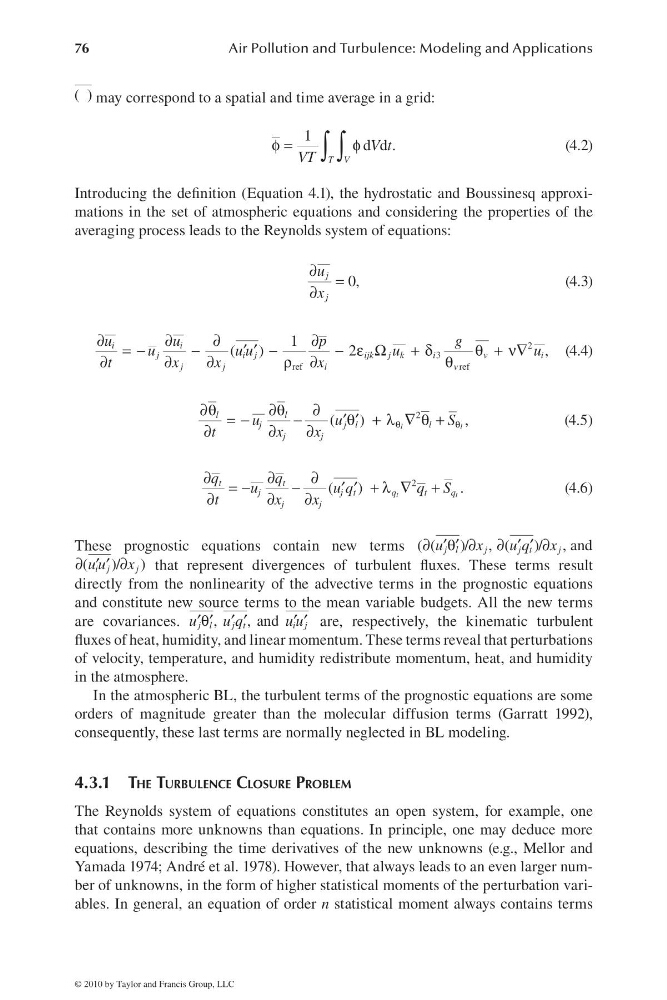
Introducing the defi nition (Equation 4.1), the hydrostatic and Boussinesq approximations in the set of atmospheric equations and considering the properties of the
averaging process leads to the Reynolds system of equations:
0,
j
j
u
x
∂ =
∂
(4.3)
2
3
ref
ref
1
(
)
2
,
i
i
j
i j
ijk
j k
i
v
i
j
j
i
v
u
u
p
g
u
u u
u
u
t
x
x
x
∂
∂
∂
∂
= −
−
−
− ε Ω
+ δ
θ + ν∇
′ ′
∂
∂
∂
ρ ∂
θ
(4.4)
2
(
)
,
l
l
l
l
j
j l
l
j
j
u
u
S
t
x
x
θ
θ
∂θ
∂θ
∂
= −
−
θ + λ ∇ θ +
′ ′
∂
∂
∂
(4.5)
2
(
)
.
t
t
t
t
j
jt
q
t
q
j
j
q
q
u
uq
q S
t
x
x
∂
∂
∂
= −
−
+ λ ∇ +
′ ′
∂
∂
∂
(4.6)
These prognostic equations contain new terms ∂ θ ∂ ∂
∂
′ ′
′ ′
( (
)/ , (
)/ , and
j l
j
j t
j
u
x
uq x
(
)/ )
i j
j
u u x
∂
∂
′ ′
that represent divergences of turbulent fl uxes. These terms result
directly from the nonlinearity of the advective terms in the prognostic equations
and constitute new source terms to the mean variable budgets. All the new terms
are covariances. θ
′ ′ ′ ′
′ ′
,
, and
j l
j t
i j
u
u q
uu are, respectively, the kinematic turbulent
fl uxes of heat, humidity, and linear momentum. These terms reveal that perturbations
of velocity, temperature, and humidity redistribute momentum, heat, and humidity
in the atmosphere.
In the atmospheric BL, the turbulent terms of the prognostic equations are some
orders of magnitude greater than the molecular diffusion terms (Garratt 1992),
consequently, these last terms are normally neglected in BL modeling.
4.3.1 THE TURBULENCE CLOSURE PROBLEM
The Reynolds system of equations constitutes an open system, for example, one
that contains more unknowns than equations. In principle, one may deduce more
equations, describing the time derivatives of the new unknowns (e.g., Mellor and
Yamada 1974; André et al. 1978). However, that always leads to an even larger number of unknowns, in the form of higher statistical moments of the perturbation variables. In general, an equation of order n statistical moment always contains terms
© 2010 by Taylor and Francis Group, LLC
Air Pollution and Turbulence: Modeling and Applications
( ) may correspond to a spatial and time average in a grid:
1
d d .
T V
V t
VT
φ =
φ
∫ ∫
(4.2)
Introducing the defi nition (Equation 4.1), the hydrostatic and Boussinesq approximations in the set of atmospheric equations and considering the properties of the
averaging process leads to the Reynolds system of equations:
0,
j
j
u
x
∂ =
∂
(4.3)
2
3
ref
ref
1
(
)
2
,
i
i
j
i j
ijk
j k
i
v
i
j
j
i
v
u
u
p
g
u
u u
u
u
t
x
x
x
∂
∂
∂
∂
= −
−
−
− ε Ω
+ δ
θ + ν∇
′ ′
∂
∂
∂
ρ ∂
θ
(4.4)
2
(
)
,
l
l
l
l
j
j l
l
j
j
u
u
S
t
x
x
θ
θ
∂θ
∂θ
∂
= −
−
θ + λ ∇ θ +
′ ′
∂
∂
∂
(4.5)
2
(
)
.
t
t
t
t
j
jt
q
t
q
j
j
q
q
u
uq
q S
t
x
x
∂
∂
∂
= −
−
+ λ ∇ +
′ ′
∂
∂
∂
(4.6)
These prognostic equations contain new terms ∂ θ ∂ ∂
∂
′ ′
′ ′
( (
)/ , (
)/ , and
j l
j
j t
j
u
x
uq x
(
)/ )
i j
j
u u x
∂
∂
′ ′
that represent divergences of turbulent fl uxes. These terms result
directly from the nonlinearity of the advective terms in the prognostic equations
and constitute new source terms to the mean variable budgets. All the new terms
are covariances. θ
′ ′ ′ ′
′ ′
,
, and
j l
j t
i j
u
u q
uu are, respectively, the kinematic turbulent
fl uxes of heat, humidity, and linear momentum. These terms reveal that perturbations
of velocity, temperature, and humidity redistribute momentum, heat, and humidity
in the atmosphere.
In the atmospheric BL, the turbulent terms of the prognostic equations are some
orders of magnitude greater than the molecular diffusion terms (Garratt 1992),
consequently, these last terms are normally neglected in BL modeling.
4.3.1 THE TURBULENCE CLOSURE PROBLEM
The Reynolds system of equations constitutes an open system, for example, one
that contains more unknowns than equations. In principle, one may deduce more
equations, describing the time derivatives of the new unknowns (e.g., Mellor and
Yamada 1974; André et al. 1978). However, that always leads to an even larger number of unknowns, in the form of higher statistical moments of the perturbation variables. In general, an equation of order n statistical moment always contains terms
© 2010 by Taylor and Francis Group, LLC