

Parameterization of Convective Boundary Layer Turbulence and Clouds
75
4.3 PARAMETERIZATION OF TURBULENCE
IN ATMOSPHERIC MODELS
The prevalence of turbulence is the main reason why fl uid mechanics is, and will
be, a diffi cult mathematical problem. Because of that, progress in this fi eld is largely
dependent on numerical simulations. These require the discretization of the system of equations, effectively reducing the number of degrees of freedom to a fi nite
value. The discretized system represents only processes that occur in time and spatial scales greater than the chosen grid mesh, and the discretization process implies
the appearance of new terms in the equations, describing the effect of the nonrepresented scales on the scales of the model. These sub-grid terms are referred to as
turbulent terms.
In fact, the discretization process is inherent to the observation of the fl ow of
a fl uid. Reynolds (1895) showed that the contributions of the sub-grid-scale terms
are responsible for the irregular (or turbulent) character of the fl ow in certain fl uid
regimes. In principle, the equations can be applied directly even to turbulent fl ows,
if the resolution is enough to explicitly represent the turbulence of different scales
down to the limit of the dissipative eddies. However, it is not, in general, possible
to draw a model with such fi ne grid. Instead, the turbulence associated with scales
smaller than the discretization limit has to be parameterized, through a turbulence
model, where the statistical average effect of the subscale on the equations for each
mean variable is represented.
The Reynolds (1895) decomposition consists in considering each atmospheric
variable, φ, as the sum of its mean value, φ
−
, and a perturbation, φ′. The mean value
describes, in a numerical model, some average value in the domain represented by
the grid point:
.
φ = φ + φ′
(4.1)
V
V g
V
Z
Z
Z
q f
Θ l
0
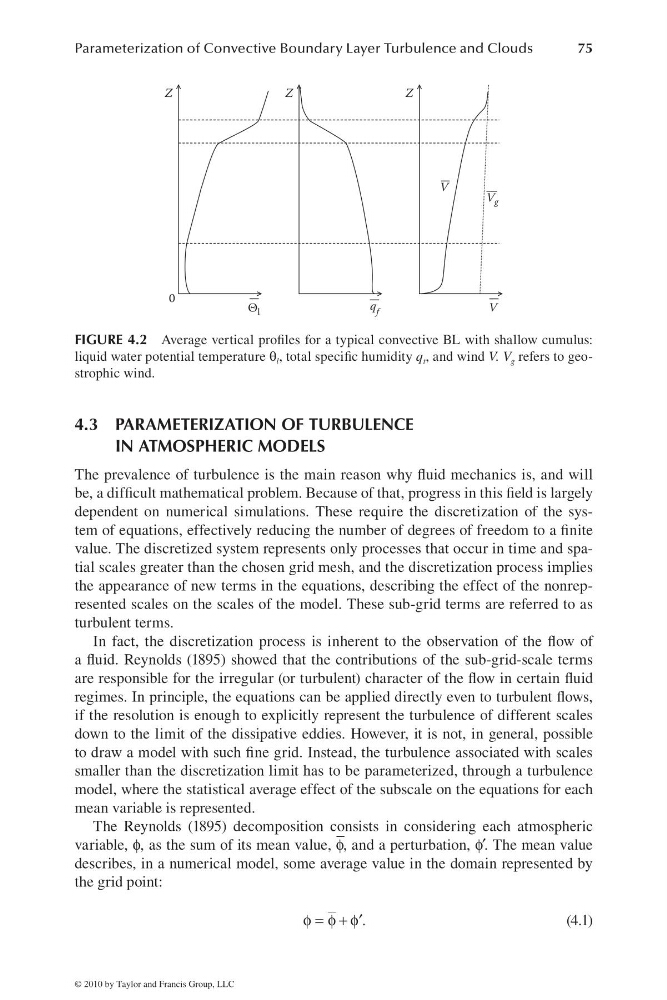
FIGURE 4.2 Average vertical profi les for a typical convective BL with shallow cumulus:
liquid water potential temperature θ l , total specifi c humidity q t , and wind V. V g refers to geostrophic wind.
© 2010 by Taylor and Francis Group, LLC
75
4.3 PARAMETERIZATION OF TURBULENCE
IN ATMOSPHERIC MODELS
The prevalence of turbulence is the main reason why fl uid mechanics is, and will
be, a diffi cult mathematical problem. Because of that, progress in this fi eld is largely
dependent on numerical simulations. These require the discretization of the system of equations, effectively reducing the number of degrees of freedom to a fi nite
value. The discretized system represents only processes that occur in time and spatial scales greater than the chosen grid mesh, and the discretization process implies
the appearance of new terms in the equations, describing the effect of the nonrepresented scales on the scales of the model. These sub-grid terms are referred to as
turbulent terms.
In fact, the discretization process is inherent to the observation of the fl ow of
a fl uid. Reynolds (1895) showed that the contributions of the sub-grid-scale terms
are responsible for the irregular (or turbulent) character of the fl ow in certain fl uid
regimes. In principle, the equations can be applied directly even to turbulent fl ows,
if the resolution is enough to explicitly represent the turbulence of different scales
down to the limit of the dissipative eddies. However, it is not, in general, possible
to draw a model with such fi ne grid. Instead, the turbulence associated with scales
smaller than the discretization limit has to be parameterized, through a turbulence
model, where the statistical average effect of the subscale on the equations for each
mean variable is represented.
The Reynolds (1895) decomposition consists in considering each atmospheric
variable, φ, as the sum of its mean value, φ
−
, and a perturbation, φ′. The mean value
describes, in a numerical model, some average value in the domain represented by
the grid point:
.
φ = φ + φ′
(4.1)
V
V g
V
Z
Z
Z
q f
Θ l
0
FIGURE 4.2 Average vertical profi les for a typical convective BL with shallow cumulus:
liquid water potential temperature θ l , total specifi c humidity q t , and wind V. V g refers to geostrophic wind.
© 2010 by Taylor and Francis Group, LLC