

74
Air Pollution and Turbulence: Modeling and Applications
4.2.1 STRUCTURE OF THE CONVECTIVE BL
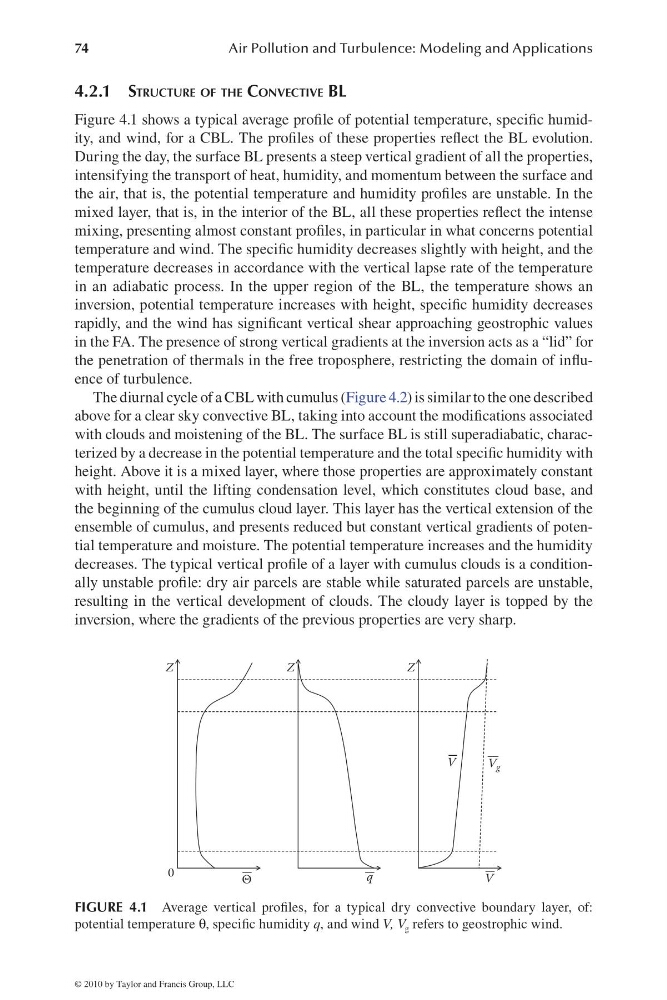
Figure 4.1 shows a typical average profi le of potential temperature, specifi c humidity, and wind, for a CBL. The profi les of these properties refl ect the BL evolution.
During the day, the surface BL presents a steep vertical gradient of all the properties,
intensifying the transport of heat, humidity, and momentum between the surface and
the air, that is, the potential temperature and humidity profi les are unstable. In the
mixed layer, that is, in the interior of the BL, all these properties refl ect the intense
mixing, presenting almost constant profi les, in particular in what concerns potential
temperature and wind. The specifi c humidity decreases slightly with height, and the
temperature decreases in accordance with the vertical lapse rate of the temperature
in an adiabatic process. In the upper region of the BL, the temperature shows an
inversion, potential temperature increases with height, specifi c humidity decreases
rapidly, and the wind has signifi cant vertical shear approaching geostrophic values
in the FA. The presence of strong vertical gradients at the inversion acts as a “lid” for
the penetration of thermals in the free troposphere, restricting the domain of infl uence of turbulence.
The diurnal cycle of a CBL with cumulus (Figure 4.2) is similar to the one described
above for a clear sky convective BL, taking into account the modifi cations associated
with clouds and moistening of the BL. The surface BL is still superadiabatic, characterized by a decrease in the potential temperature and the total specifi c humidity with
height. Above it is a mixed layer, where those properties are approximately constant
with height, until the lifting condensation level, which constitutes cloud base, and
the beginning of the cumulus cloud layer. This layer has the vertical extension of the
ensemble of cumulus, and presents reduced but constant vertical gradients of potential temperature and moisture. The potential temperature increases and the humidity
decreases. The typical vertical profi le of a layer with cumulus clouds is a conditionally unstable profi le: dry air parcels are stable while saturated parcels are unstable,
resulting in the vertical development of clouds. The cloudy layer is topped by the
inversion, where the gradients of the previous properties are very sharp.
V
V g
V
Z
Z
Z
q
Θ
0
FIGURE 4.1 Average vertical profi les, for a typical dry convective boundary layer, of:
potential temperature θ, specifi c humidity q, and wind V, V g refers to geostrophic wind.
© 2010 by Taylor and Francis Group, LLC
Air Pollution and Turbulence: Modeling and Applications
4.2.1 STRUCTURE OF THE CONVECTIVE BL
Figure 4.1 shows a typical average profi le of potential temperature, specifi c humidity, and wind, for a CBL. The profi les of these properties refl ect the BL evolution.
During the day, the surface BL presents a steep vertical gradient of all the properties,
intensifying the transport of heat, humidity, and momentum between the surface and
the air, that is, the potential temperature and humidity profi les are unstable. In the
mixed layer, that is, in the interior of the BL, all these properties refl ect the intense
mixing, presenting almost constant profi les, in particular in what concerns potential
temperature and wind. The specifi c humidity decreases slightly with height, and the
temperature decreases in accordance with the vertical lapse rate of the temperature
in an adiabatic process. In the upper region of the BL, the temperature shows an
inversion, potential temperature increases with height, specifi c humidity decreases
rapidly, and the wind has signifi cant vertical shear approaching geostrophic values
in the FA. The presence of strong vertical gradients at the inversion acts as a “lid” for
the penetration of thermals in the free troposphere, restricting the domain of infl uence of turbulence.
The diurnal cycle of a CBL with cumulus (Figure 4.2) is similar to the one described
above for a clear sky convective BL, taking into account the modifi cations associated
with clouds and moistening of the BL. The surface BL is still superadiabatic, characterized by a decrease in the potential temperature and the total specifi c humidity with
height. Above it is a mixed layer, where those properties are approximately constant
with height, until the lifting condensation level, which constitutes cloud base, and
the beginning of the cumulus cloud layer. This layer has the vertical extension of the
ensemble of cumulus, and presents reduced but constant vertical gradients of potential temperature and moisture. The potential temperature increases and the humidity
decreases. The typical vertical profi le of a layer with cumulus clouds is a conditionally unstable profi le: dry air parcels are stable while saturated parcels are unstable,
resulting in the vertical development of clouds. The cloudy layer is topped by the
inversion, where the gradients of the previous properties are very sharp.
V
V g
V
Z
Z
Z
q
Θ
0
FIGURE 4.1 Average vertical profi les, for a typical dry convective boundary layer, of:
potential temperature θ, specifi c humidity q, and wind V, V g refers to geostrophic wind.
© 2010 by Taylor and Francis Group, LLC