

Turbulence and Dispersion of Contaminants in the Planetary Boundary Layer 63
where u ˉ and v ˉ are respectively the longitudinal and lateral components of the mean
wind velocity, ρ ˉ is the air mean density, u and v are the wind velocity turbulent
fl uctuations, p ˉ is the mean pressure, and f c is the Coriolis parameter.
Since the system of Equations 3.106 and 3.107 cannot be analytically solved as
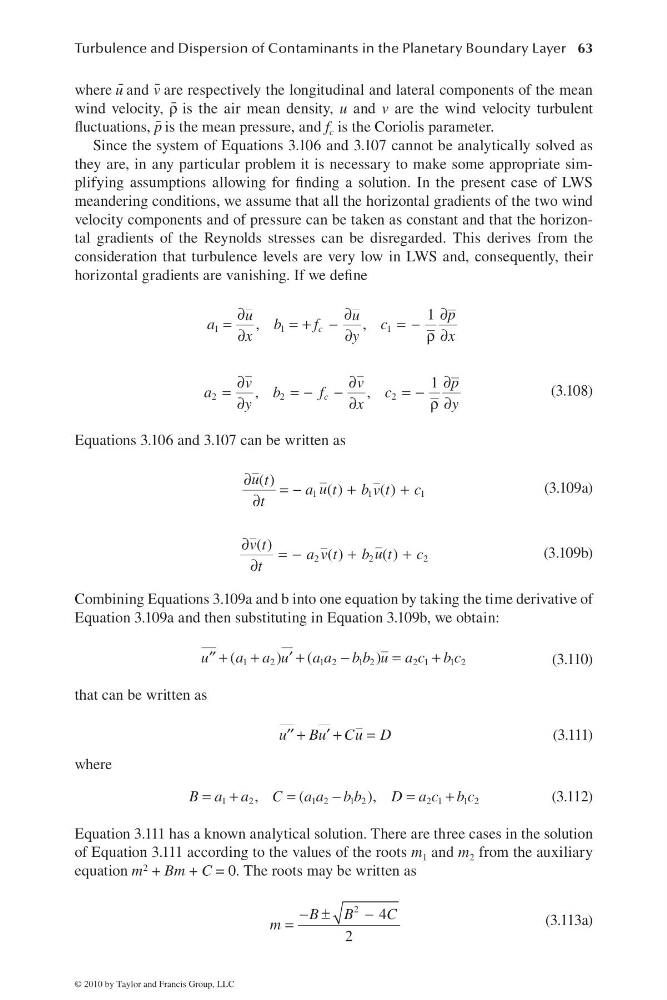
they are, in any particular problem it is necessary to make some appropriate simplifying assumptions allowing for fi nding a solution. In the present case of LWS
meandering conditions, we assume that all the horizontal gradients of the two wind
velocity components and of pressure can be taken as constant and that the horizontal gradients of the Reynolds stresses can be disregarded. This derives from the
consideration that turbulence levels are very low in LWS and, consequently, their
horizontal gradients are vanishing. If we defi ne
∂
∂
∂
=
=+ −
=−
∂
∂
ρ∂
1
1
1
1
,
,
c
p
u
u
a
b
f
c
x
y
x
2
2
2
1
,
,
c
v
v
p
a
b
f
c
y
x
y
∂
∂
∂
=
=− −
=−
∂
∂
ρ ∂
(3.108)
Equations 3.106 and 3.107 can be written as
∂
= −
+
+
∂
1
1
1
( )
( )
( )
u t
u
a t
b t
c
v
t
(3.109a)
∂
= −
+
+
∂
2
2
2
( )
( )
( )
v t
u
a v t
b t
c
t
(3.109b)
Combining Equations 3.109a and b into one equation by taking the time derivative of
Equation 3.109a and then substituting in Equation 3.109b, we obtain:
+
+
+
−
=
+
′′
′
1
2
1 2
1 2
2 1
1 2
(
)
(
)
u
a a u
aa bb u a c bc
(3.110)
that can be written as
+
+
=
′′
′
u Bu Cu D
(3.111)
where
1
2
1 2
1 2
2 1
1 2
,
(
),
B a a
C a a bb
D a c bc
= +
=
−
=
+
(3.112)
Equation 3.111 has a known analytical solution. There are three cases in the solution
of Equation 3.111 according to the values of the roots m 1 and m 2 from the auxiliary
equation m 2 + Bm + C = 0. The roots may be written as
− ±
−
=
2
4
2
B
B
C
m
(3.113a)
© 2010 by Taylor and Francis Group, LLC
where u ˉ and v ˉ are respectively the longitudinal and lateral components of the mean
wind velocity, ρ ˉ is the air mean density, u and v are the wind velocity turbulent
fl uctuations, p ˉ is the mean pressure, and f c is the Coriolis parameter.
Since the system of Equations 3.106 and 3.107 cannot be analytically solved as
they are, in any particular problem it is necessary to make some appropriate simplifying assumptions allowing for fi nding a solution. In the present case of LWS
meandering conditions, we assume that all the horizontal gradients of the two wind
velocity components and of pressure can be taken as constant and that the horizontal gradients of the Reynolds stresses can be disregarded. This derives from the
consideration that turbulence levels are very low in LWS and, consequently, their
horizontal gradients are vanishing. If we defi ne
∂
∂
∂
=
=+ −
=−
∂
∂
ρ∂
1
1
1
1
,
,
c
p
u
u
a
b
f
c
x
y
x
2
2
2
1
,
,
c
v
v
p
a
b
f
c
y
x
y
∂
∂
∂
=
=− −
=−
∂
∂
ρ ∂
(3.108)
Equations 3.106 and 3.107 can be written as
∂
= −
+
+
∂
1
1
1
( )
( )
( )
u t
u
a t
b t
c
v
t
(3.109a)
∂
= −
+
+
∂
2
2
2
( )
( )
( )
v t
u
a v t
b t
c
t
(3.109b)
Combining Equations 3.109a and b into one equation by taking the time derivative of
Equation 3.109a and then substituting in Equation 3.109b, we obtain:
+
+
+
−
=
+
′′
′
1
2
1 2
1 2
2 1
1 2
(
)
(
)
u
a a u
aa bb u a c bc
(3.110)
that can be written as
+
+
=
′′
′
u Bu Cu D
(3.111)
where
1
2
1 2
1 2
2 1
1 2
,
(
),
B a a
C a a bb
D a c bc
= +
=
−
=
+
(3.112)
Equation 3.111 has a known analytical solution. There are three cases in the solution
of Equation 3.111 according to the values of the roots m 1 and m 2 from the auxiliary
equation m 2 + Bm + C = 0. The roots may be written as
− ±
−
=
2
4
2
B
B
C
m
(3.113a)
© 2010 by Taylor and Francis Group, LLC