

64
Air Pollution and Turbulence: Modeling and Applications
We only consider the case
2
2
2
1
2
1 2
4
0 i.e., (
)
4
or
4 c
c
u
v
u
v
B
C
a a
bb
f
f
x
y
y
x
⎛
⎞
⎛
⎞
∂
∂
∂
∂
⎛
⎞
⎡
⎤
−
<
−
<−
−
<
−
+
⎜
⎟
⎜
⎟
⎜
⎟
⎣
⎦
⎝
⎠
∂
∂
∂
∂
⎝
⎠
⎝
⎠
(3.113b)
which yields oscillatory behavior. Setting
1
2
and
m p qi
m
p qi
= +
= −
(3.114)
where
−
=
=
2
4
,
2
2
B
C
B
p
q
(3.115)
the solutions of the problem are
1
2
2
2
( )
( cos( )
sin( ))
pt
D
u t e r
qt r
qt
p
q
−
=
+
+
+
(3.116a)
and
1
2
11
2
1
12
1
1
2
2
1
1
11
(
)
(
)
( )
cos( )
sin( )
pt
pr qr a r
pr qr a r
D a
c
v t e
qt
qt
b
b
p qb
b
− ⎡
⎤
− +
+
−
− +
=
+
+
−
⎢
⎥
+
⎣
⎦
(3.116b)
where
⎡
⎤
=
−
=
− − +
−
+
⎢
⎥
+
+
⎣
⎦
1
2
1
1
1
2
2
2
2
1
,
(
)
o
o
o
D
D p
r u
r
v b
p a u
c
p q
q
p q
(3.117)
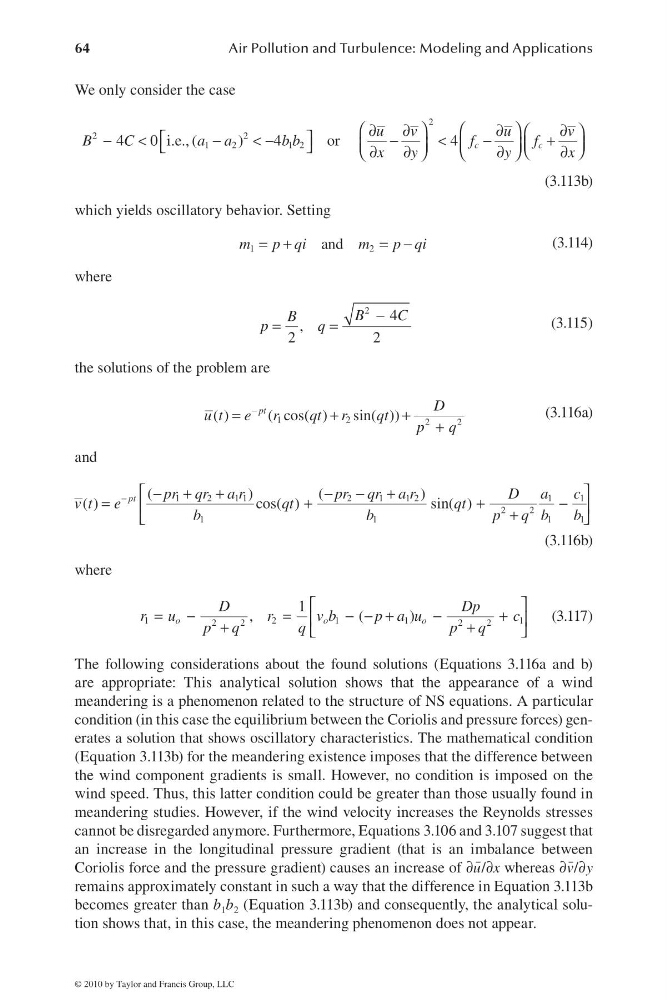
The following considerations about the found solutions (Equations 3.116a and b)
are appropriate: This analytical solution shows that the appearance of a wind
meandering is a phenomenon related to the structure of NS equations. A particular
condition (in this case the equilibrium between the Coriolis and pressure forces) generates a solution that shows oscillatory characteristics. The mathematical condition
(Equation 3.113b) for the meandering existence imposes that the difference between
the wind component gradients is small. However, no condition is imposed on the
wind speed. Thus, this latter condition could be greater than those usually found in
meandering studies. However, if the wind velocity increases the Reynolds stresses
cannot be disregarded anymore. Furthermore, Equations 3.106 and 3.107 suggest that
an increase in the longitudinal pressure gradient (that is an imbalance between
Coriolis force and the pressure gradient) causes an increase of ∂u ˉ /∂x whereas ∂v ˉ /∂y
remains approximately constant in such a way that the difference in Equation 3.113b
becomes greater than b 1 b 2 (Equation 3.113b) and consequently, the analytical solution shows that, in this case, the meandering phenomenon does not appear.
© 2010 by Taylor and Francis Group, LLC
Air Pollution and Turbulence: Modeling and Applications
We only consider the case
2
2
2
1
2
1 2
4
0 i.e., (
)
4
or
4 c
c
u
v
u
v
B
C
a a
bb
f
f
x
y
y
x
⎛
⎞
⎛
⎞
∂
∂
∂
∂
⎛
⎞
⎡
⎤
−
<
−
<−
−
<
−
+
⎜
⎟
⎜
⎟
⎜
⎟
⎣
⎦
⎝
⎠
∂
∂
∂
∂
⎝
⎠
⎝
⎠
(3.113b)
which yields oscillatory behavior. Setting
1
2
and
m p qi
m
p qi
= +
= −
(3.114)
where
−
=
=
2
4
,
2
2
B
C
B
p
q
(3.115)
the solutions of the problem are
1
2
2
2
( )
( cos( )
sin( ))
pt
D
u t e r
qt r
qt
p
q
−
=
+
+
+
(3.116a)
and
1
2
11
2
1
12
1
1
2
2
1
1
11
(
)
(
)
( )
cos( )
sin( )
pt
pr qr a r
pr qr a r
D a
c
v t e
qt
qt
b
b
p qb
b
− ⎡
⎤
− +
+
−
− +
=
+
+
−
⎢
⎥
+
⎣
⎦
(3.116b)
where
⎡
⎤
=
−
=
− − +
−
+
⎢
⎥
+
+
⎣
⎦
1
2
1
1
1
2
2
2
2
1
,
(
)
o
o
o
D
D p
r u
r
v b
p a u
c
p q
q
p q
(3.117)
The following considerations about the found solutions (Equations 3.116a and b)
are appropriate: This analytical solution shows that the appearance of a wind
meandering is a phenomenon related to the structure of NS equations. A particular
condition (in this case the equilibrium between the Coriolis and pressure forces) generates a solution that shows oscillatory characteristics. The mathematical condition
(Equation 3.113b) for the meandering existence imposes that the difference between
the wind component gradients is small. However, no condition is imposed on the
wind speed. Thus, this latter condition could be greater than those usually found in
meandering studies. However, if the wind velocity increases the Reynolds stresses
cannot be disregarded anymore. Furthermore, Equations 3.106 and 3.107 suggest that
an increase in the longitudinal pressure gradient (that is an imbalance between
Coriolis force and the pressure gradient) causes an increase of ∂u ˉ /∂x whereas ∂v ˉ /∂y
remains approximately constant in such a way that the difference in Equation 3.113b
becomes greater than b 1 b 2 (Equation 3.113b) and consequently, the analytical solution shows that, in this case, the meandering phenomenon does not appear.
© 2010 by Taylor and Francis Group, LLC