

62
Air Pollution and Turbulence: Modeling and Applications
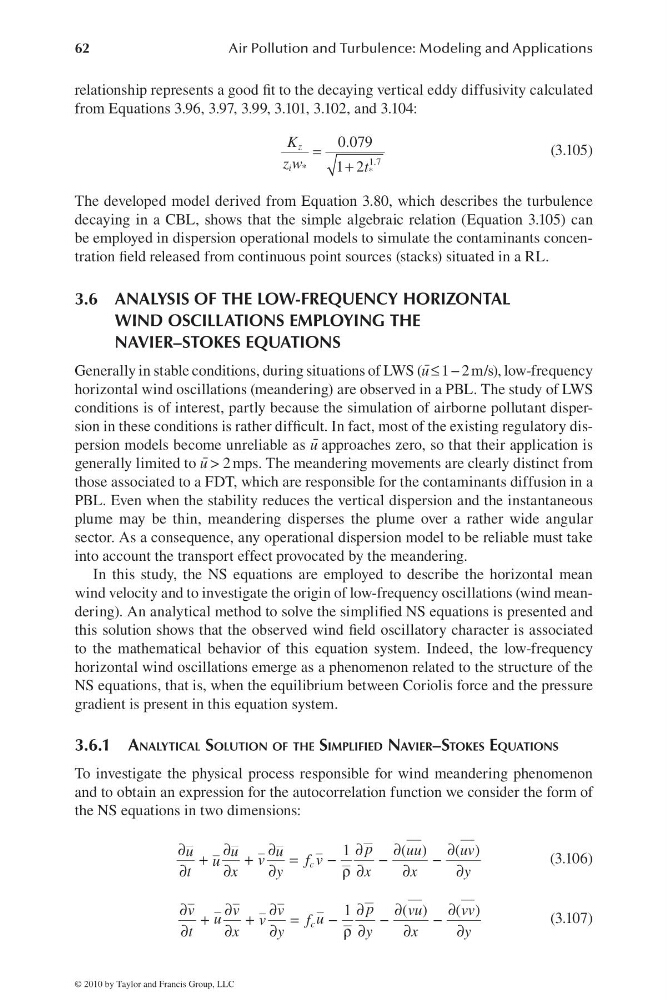
relationship represents a good fi t to the decaying vertical eddy diffusivity calculated
from Equations 3.96, 3.97, 3.99, 3.101, 3.102, and 3.104:
1.7
*
*
0.079
1 2
z
i
K
z w
t
=
+
(3.105)
The developed model derived from Equation 3.80, which describes the turbulence
decaying in a CBL, shows that the simple algebraic relation (Equation 3.105) can
be employed in dispersion operational models to simulate the contaminants concentration fi eld released from continuous point sources (stacks) situated in a RL.
3.6 ANALYSIS OF THE LOW-FREQUENCY HORIZONTAL
WIND OSCILLATIONS EMPLOYING THE
NAVIER–STOKES EQUATIONS
Generally in stable conditions, during situations of LWS (u ˉ ≤ 1 − 2 m/s), low-frequency
horizontal wind oscillations (meandering) are observed in a PBL. The study of LWS
conditions is of interest, partly because the simulation of airborne pollutant dispersion in these conditions is rather diffi cult. In fact, most of the existing regulatory dispersion models become unreliable as u ˉ approaches zero, so that their application is
generally limited to u ˉ > 2 mps. The meandering movements are clearly distinct from
those associated to a FDT, which are responsible for the contaminants diffusion in a
PBL. Even when the stability reduces the vertical dispersion and the instantaneous
plume may be thin, meandering disperses the plume over a rather wide angular
sector. As a consequence, any operational dispersion model to be reliable must take
into account the transport effect provocated by the meandering.
In this study, the NS equations are employed to describe the horizontal mean
wind velocity and to investigate the origin of low-frequency oscillations (wind meandering). An analytical method to solve the simplifi ed NS equations is presented and
this solution shows that the observed wind fi eld oscillatory character is associated
to the mathematical behavior of this equation system. Indeed, the low-frequency
horizontal wind oscillations emerge as a phenomenon related to the structure of the
NS equations, that is, when the equilibrium between Coriolis force and the pressure
gradient is present in this equation system.
3.6.1 ANALYTICAL SOLUTION OF THE SIMPLIFIED NAVIER–STOKES EQUATIONS
To investigate the physical process responsible for wind meandering phenomenon
and to obtain an expression for the autocorrelation function we consider the form of
the NS equations in two dimensions:
1
( )
( )
c
p
uu
uv
u
u
u
v
f v
u
t
x
y
x
x
y
∂
∂
∂
∂
∂
∂
+
+
=
−
−
−
∂
∂
∂
ρ ∂
∂
∂
(3.106)
1
( )
( )
c
p
v
v
v
vu
vv
u
u
v
f
t
x
y
y
x
y
∂
∂
∂
∂
∂
∂
+
+
=
−
−
−
∂
∂
∂
ρ ∂
∂
∂
(3.107)
© 2010 by Taylor and Francis Group, LLC
Air Pollution and Turbulence: Modeling and Applications
relationship represents a good fi t to the decaying vertical eddy diffusivity calculated
from Equations 3.96, 3.97, 3.99, 3.101, 3.102, and 3.104:
1.7
*
*
0.079
1 2
z
i
K
z w
t
=
+
(3.105)
The developed model derived from Equation 3.80, which describes the turbulence
decaying in a CBL, shows that the simple algebraic relation (Equation 3.105) can
be employed in dispersion operational models to simulate the contaminants concentration fi eld released from continuous point sources (stacks) situated in a RL.
3.6 ANALYSIS OF THE LOW-FREQUENCY HORIZONTAL
WIND OSCILLATIONS EMPLOYING THE
NAVIER–STOKES EQUATIONS
Generally in stable conditions, during situations of LWS (u ˉ ≤ 1 − 2 m/s), low-frequency
horizontal wind oscillations (meandering) are observed in a PBL. The study of LWS
conditions is of interest, partly because the simulation of airborne pollutant dispersion in these conditions is rather diffi cult. In fact, most of the existing regulatory dispersion models become unreliable as u ˉ approaches zero, so that their application is
generally limited to u ˉ > 2 mps. The meandering movements are clearly distinct from
those associated to a FDT, which are responsible for the contaminants diffusion in a
PBL. Even when the stability reduces the vertical dispersion and the instantaneous
plume may be thin, meandering disperses the plume over a rather wide angular
sector. As a consequence, any operational dispersion model to be reliable must take
into account the transport effect provocated by the meandering.
In this study, the NS equations are employed to describe the horizontal mean
wind velocity and to investigate the origin of low-frequency oscillations (wind meandering). An analytical method to solve the simplifi ed NS equations is presented and
this solution shows that the observed wind fi eld oscillatory character is associated
to the mathematical behavior of this equation system. Indeed, the low-frequency
horizontal wind oscillations emerge as a phenomenon related to the structure of the
NS equations, that is, when the equilibrium between Coriolis force and the pressure
gradient is present in this equation system.
3.6.1 ANALYTICAL SOLUTION OF THE SIMPLIFIED NAVIER–STOKES EQUATIONS
To investigate the physical process responsible for wind meandering phenomenon
and to obtain an expression for the autocorrelation function we consider the form of
the NS equations in two dimensions:
1
( )
( )
c
p
uu
uv
u
u
u
v
f v
u
t
x
y
x
x
y
∂
∂
∂
∂
∂
∂
+
+
=
−
−
−
∂
∂
∂
ρ ∂
∂
∂
(3.106)
1
( )
( )
c
p
v
v
v
vu
vv
u
u
v
f
t
x
y
y
x
y
∂
∂
∂
∂
∂
∂
+
+
=
−
−
−
∂
∂
∂
ρ ∂
∂
∂
(3.107)
© 2010 by Taylor and Francis Group, LLC