

28
Air Pollution and Turbulence: Modeling and Applications
2.4 CASE STUDY: AMAZONIA
In Sections 2.2 and 2.3, the principal concepts of the ABL have been described.
Understanding the behavior of the ABL is thus a critical prerequisite to know how
changes in the land surface will translate into changes in the dynamics and thermodynamics of the large-scale circulation and vice versa. The Amazon region is
suffering a high rate of deforestation and tropical forest is being replaced by agricultural landscape, mainly for cattle activities. Field measurements are being conducted
under the LBA Program (http://lba.cptec.inpe.br/lba/site/) over tropical and pasture
areas in Amazonia in order to identify this land use, land change, and its effect on
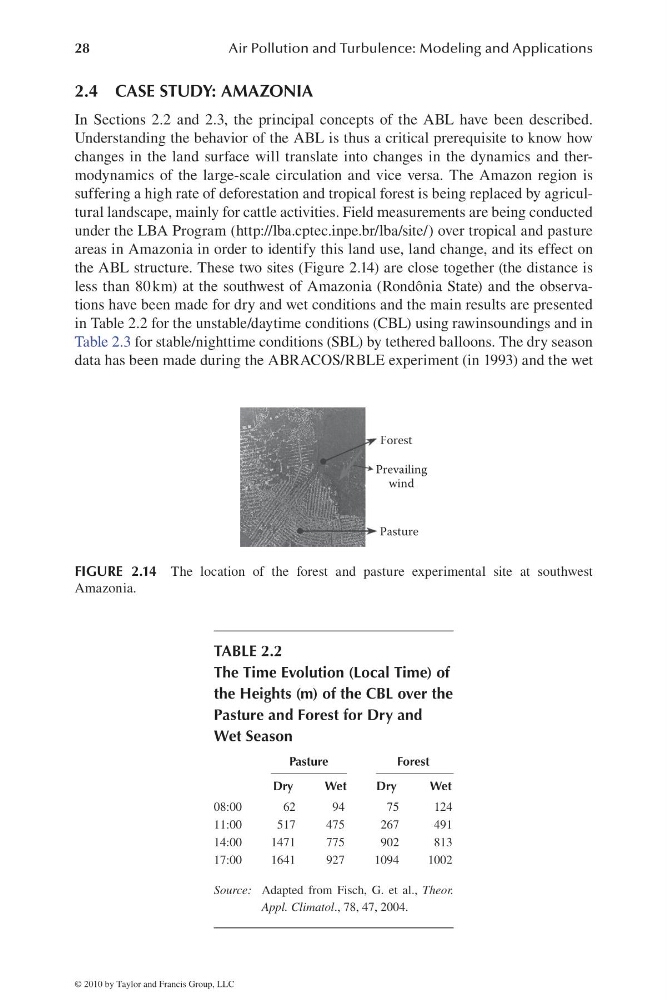
the ABL structure. These two sites (Figure 2.14) are close together (the distance is
less than 80 km) at the southwest of Amazonia (Rondônia State) and the observations have been made for dry and wet conditions and the main results are presented
in Table 2.2 for the unstable/daytime conditions (CBL) using rawinsoundings and in
Table 2.3 for stable/nighttime conditions (SBL) by tethered balloons. The dry season
data has been made during the ABRACOS/RBLE experiment (in 1993) and the wet
Forest
Prevailing
wind
Pasture
FIGURE 2.14 The location of the forest and pasture experimental site at southwest
Amazonia.
TABLE 2.2
The Time Evolution (Local Time) of
the Heights (m) of the CBL over the
Pasture and Forest for Dry and
Wet Season
Pasture
Forest
Dry
Wet
Dry
Wet
08:00
62
94
75
124
11:00
517
475
267
491
14:00
1471
775
902
813
17:00
1641
927
1094
1002
Source: Adapted from Fisch, G. et al., Theor.
Appl. Climatol., 78, 47, 2004.
© 2010 by Taylor and Francis Group, LLC
Air Pollution and Turbulence: Modeling and Applications
2.4 CASE STUDY: AMAZONIA
In Sections 2.2 and 2.3, the principal concepts of the ABL have been described.
Understanding the behavior of the ABL is thus a critical prerequisite to know how
changes in the land surface will translate into changes in the dynamics and thermodynamics of the large-scale circulation and vice versa. The Amazon region is
suffering a high rate of deforestation and tropical forest is being replaced by agricultural landscape, mainly for cattle activities. Field measurements are being conducted
under the LBA Program (http://lba.cptec.inpe.br/lba/site/) over tropical and pasture
areas in Amazonia in order to identify this land use, land change, and its effect on
the ABL structure. These two sites (Figure 2.14) are close together (the distance is
less than 80 km) at the southwest of Amazonia (Rondônia State) and the observations have been made for dry and wet conditions and the main results are presented
in Table 2.2 for the unstable/daytime conditions (CBL) using rawinsoundings and in
Table 2.3 for stable/nighttime conditions (SBL) by tethered balloons. The dry season
data has been made during the ABRACOS/RBLE experiment (in 1993) and the wet
Forest
Prevailing
wind
Pasture
FIGURE 2.14 The location of the forest and pasture experimental site at southwest
Amazonia.
TABLE 2.2
The Time Evolution (Local Time) of
the Heights (m) of the CBL over the
Pasture and Forest for Dry and
Wet Season
Pasture
Forest
Dry
Wet
Dry
Wet
08:00
62
94
75
124
11:00
517
475
267
491
14:00
1471
775
902
813
17:00
1641
927
1094
1002
Source: Adapted from Fisch, G. et al., Theor.
Appl. Climatol., 78, 47, 2004.
© 2010 by Taylor and Francis Group, LLC