

26
Air Pollution and Turbulence: Modeling and Applications
are parameterized and estimated by models), especially as there are few (or none)
traditional data of mean/fl uctuations. This technique has been used successfully in
the last two to three decades, and has given insights into the turbulent processes by
estimating the pressure fi eld (very diffi cult to measure) and/or isolating physical processes for developing new (or even improving) parameterization schemes. It is also
used to improve the knowledge of the entrainment zone, which data is very hard to
get. Nowadays, the use of LES has become the best source of data for ABL modeling.
A good review of the use of this technique can be found in Moeng (1998).
The wind tunnel measurements are used to study the fl ow inside a chamber. The
fl ow inside it is originally laminar and the turbulent pattern is achieved by the use of
spires and/or a rough carpet. One of the weaknesses of the use of wind tunnels is the low
Reynolds number achieved (usually 10 4 or 10 5 while at the atmosphere it is between 10 6
and 10 7 ) as well as the neutral conditions. For situations where the windspeed is very
high (say higher than 8.0–9.0 m/s), the atmosphere can be considered as neutral (LoredoSouza et al., 2004). This is the case of Alcantara Space Center, where the winds are
very strong (usually higher than 6–7 m/s) due to the coupling between the trade winds
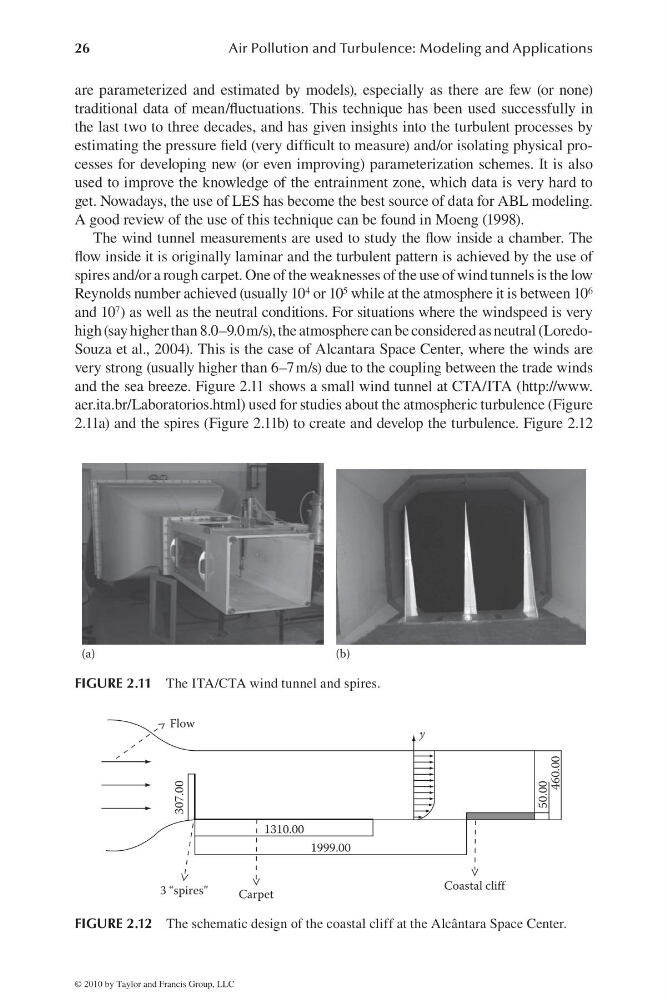
and the sea breeze. Figure 2.11 shows a small wind tunnel at CTA/ITA (http://www.
aer.ita.br/Laboratorios.html) used for studies about the atmospheric turbulence (Figure
2.11a) and the spires (Figure 2.11b) to create and develop the turbulence. Figure 2.12
(a)
(b)
FIGURE 2.11 The ITA/CTA wind tunnel and spires.
Flow
y
Coastal cliff
1999.00
1310.00
307.00
50.00
460.00
Carpet
3 “spires”
FIGURE 2.12 The schematic design of the coastal cliff at the Alcântara Space Center.
© 2010 by Taylor and Francis Group, LLC
Air Pollution and Turbulence: Modeling and Applications
are parameterized and estimated by models), especially as there are few (or none)
traditional data of mean/fl uctuations. This technique has been used successfully in
the last two to three decades, and has given insights into the turbulent processes by
estimating the pressure fi eld (very diffi cult to measure) and/or isolating physical processes for developing new (or even improving) parameterization schemes. It is also
used to improve the knowledge of the entrainment zone, which data is very hard to
get. Nowadays, the use of LES has become the best source of data for ABL modeling.
A good review of the use of this technique can be found in Moeng (1998).
The wind tunnel measurements are used to study the fl ow inside a chamber. The
fl ow inside it is originally laminar and the turbulent pattern is achieved by the use of
spires and/or a rough carpet. One of the weaknesses of the use of wind tunnels is the low
Reynolds number achieved (usually 10 4 or 10 5 while at the atmosphere it is between 10 6
and 10 7 ) as well as the neutral conditions. For situations where the windspeed is very
high (say higher than 8.0–9.0 m/s), the atmosphere can be considered as neutral (LoredoSouza et al., 2004). This is the case of Alcantara Space Center, where the winds are
very strong (usually higher than 6–7 m/s) due to the coupling between the trade winds
and the sea breeze. Figure 2.11 shows a small wind tunnel at CTA/ITA (http://www.
aer.ita.br/Laboratorios.html) used for studies about the atmospheric turbulence (Figure
2.11a) and the spires (Figure 2.11b) to create and develop the turbulence. Figure 2.12
(a)
(b)
FIGURE 2.11 The ITA/CTA wind tunnel and spires.
Flow
y
Coastal cliff
1999.00
1310.00
307.00
50.00
460.00
Carpet
3 “spires”
FIGURE 2.12 The schematic design of the coastal cliff at the Alcântara Space Center.
© 2010 by Taylor and Francis Group, LLC