

Atmospheric Dispersion with a Large-Eddy Simulation
261
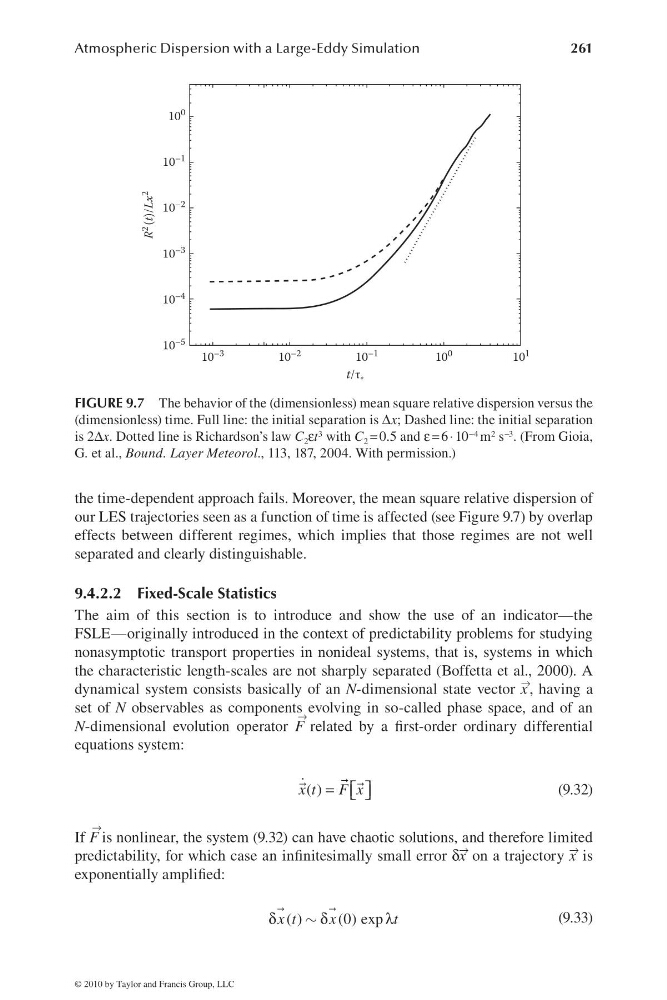
the time-dependent approach fails. Moreover, the mean square relative dispersion of
our LES trajectories seen as a function of time is affected (see Figure 9.7) by overlap
effects between different regimes, which implies that those regimes are not well
separated and clearly distinguishable.
9.4.2.2 Fixed-Scale Statistics
The aim of this section is to introduce and show the use of an indicator—the
FSLE—originally introduced in the context of predictability problems for studying
nonasymptotic transport properties in nonideal systems, that is, systems in which
the characteristic length-scales are not sharply separated (Boffetta et al., 2000). A
dynamical system consists basically of an N-dimensional state vector x
→
, having a
set of N observables as components evolving in so-called phase space, and of an
N-dimensional evolution operator F
→
related by a fi rst-order ordinary differential
equations system:
( )
x t F x
= ⎡ ⎤
⎣ ⎦
(9.32)
If F
→
is nonlinear, the system (9.32) can have chaotic solutions, and therefore limited
predictability, for which case an infi nitesimally small error δx
→ on a trajectory x
→ is
exponentially amplifi ed:
δ
δ
λ
( )
(0) exp
x t
x
t
∼
(9.33)
10
0
10 –1
10
–2
10
–3
10
–4
10
–5
10
–3
10
–2
10
–1
t/τ *
R
2
(t)/Lx
2
10
0
10
1
FIGURE 9.7 The behavior of the (dimensionless) mean square relative dispersion versus the
(dimensionless) time. Full line: the initial separation is Δx; Dashed line: the initial separation
is 2Δx. Dotted line is Richardson’s law C 2 εt 3 with C 2 = 0.5 and ε = 6 ⋅ 10 −4 m 2 s −3 . (From Gioia,
G. et al., Bound. Layer Meteorol., 113, 187, 2004. With permission.)
© 2010 by Taylor and Francis Group, LLC
261
the time-dependent approach fails. Moreover, the mean square relative dispersion of
our LES trajectories seen as a function of time is affected (see Figure 9.7) by overlap
effects between different regimes, which implies that those regimes are not well
separated and clearly distinguishable.
9.4.2.2 Fixed-Scale Statistics
The aim of this section is to introduce and show the use of an indicator—the
FSLE—originally introduced in the context of predictability problems for studying
nonasymptotic transport properties in nonideal systems, that is, systems in which
the characteristic length-scales are not sharply separated (Boffetta et al., 2000). A
dynamical system consists basically of an N-dimensional state vector x
→
, having a
set of N observables as components evolving in so-called phase space, and of an
N-dimensional evolution operator F
→
related by a fi rst-order ordinary differential
equations system:
( )
x t F x
= ⎡ ⎤
⎣ ⎦
(9.32)
If F
→
is nonlinear, the system (9.32) can have chaotic solutions, and therefore limited
predictability, for which case an infi nitesimally small error δx
→ on a trajectory x
→ is
exponentially amplifi ed:
δ
δ
λ
( )
(0) exp
x t
x
t
∼
(9.33)
10
0
10 –1
10
–2
10
–3
10
–4
10
–5
10
–3
10
–2
10
–1
t/τ *
R
2
(t)/Lx
2
10
0
10
1
FIGURE 9.7 The behavior of the (dimensionless) mean square relative dispersion versus the
(dimensionless) time. Full line: the initial separation is Δx; Dashed line: the initial separation
is 2Δx. Dotted line is Richardson’s law C 2 εt 3 with C 2 = 0.5 and ε = 6 ⋅ 10 −4 m 2 s −3 . (From Gioia,
G. et al., Bound. Layer Meteorol., 113, 187, 2004. With permission.)
© 2010 by Taylor and Francis Group, LLC