

Atmospheric Dispersion with a Large-Eddy Simulation
241
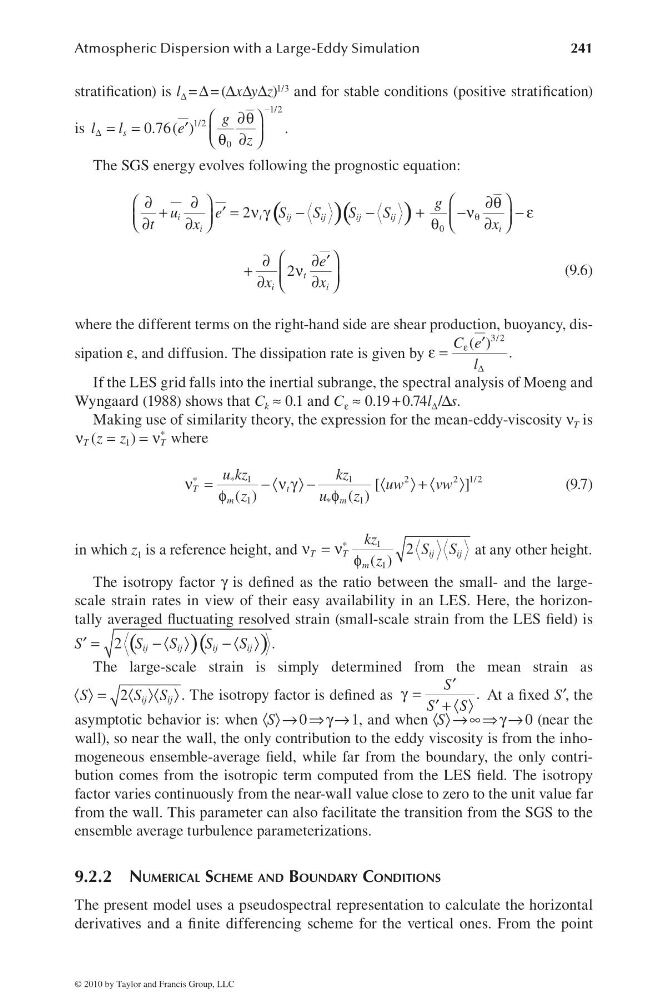
stratifi cation) is l Δ = Δ = (ΔxΔyΔz) 1/3 and for stable conditions (positive stratifi cation)
is
1/2
1/2
0
0.76( )
.
s
g
l
l
e
z
−
Δ
⎛
⎞
∂θ
= =
′ ⎜
⎟
θ ∂
⎝
⎠
The SGS energy evolves following the prognostic equation:
(
)(
)
θ
⎛
⎞
⎛
⎞
∂
∂
∂θ
+
= νγ
−
−
+
− ν
−ε
′
⎜
⎟
⎜
⎟
⎝
⎠
∂
∂
θ
∂
⎝
⎠
⎛
⎞
∂
∂ ′
+
ν
⎜
⎟
∂
∂
⎝
⎠
0
2
2
i
t
ij
ij
ij
ij
i
i
t
i
i
g
u
e
S
S
S
S
t
x
x
e
x
x
(9.6)
where the different terms on the right-hand side are shear production, buoyancy, dissipation ε, and diffusion. The dissipation rate is given by
ε
Δ
′
ε =
3/2
( ) .
C e
l
If the LES grid falls into the inertial subrange, the spectral analysis of Moeng and
Wyngaard (1988) shows that C k ≈ 0.1 and C ε ≈ 0.19 + 0.74l Δ /Δs.
Making use of similarity theory, the expression for the mean-eddy-viscosity ν T is
1
(
)
T
T
z z
∗
ν
=
= ν where
1
1
2
2 1 / 2
1
1
[
]
( )
( )
T
t
m
m
u kz
kz
uw
vw
z
u
z
∗
∗
∗
ν =
− 〈ν γ〉 −
〈
〉 + 〈
〉
φ
φ
(9.7)
in which z 1 is a reference height, and
∗
ν = ν φ
1
1
2
( )
T
T
ij
ij
m
kz
S S
z
at any other height.
The isotropy factor γ is defi ned as the ratio between the small- and the largescale strain rates in view of their easy availability in an LES. Here, the horizontally averaged fl uctuating resolved strain (small-scale strain from the LES fi eld) is
(
)(
)
=
−〈 〉
−〈 〉
′
2
.
ij
ij
ij
ij
S
S
S
S
S
The large-scale strain is simply determined from the mean strain as
2 ij ij
S
S S
〈 〉 = 〈 〉〈 〉. The isotropy factor is defi ned as
′
γ = + 〈 〉
′
.
S
S
S
At a fi xed S′, the
asymptotic behavior is: when 〈S〉 → 0 ⇒ γ → 1, and when 〈S〉 → ∞ ⇒ γ → 0 (near the
wall), so near the wall, the only contribution to the eddy viscosity is from the inhomogeneous ensemble-average fi eld, while far from the boundary, the only contribution comes from the isotropic term computed from the LES fi eld. The isotropy
factor varies continuously from the near-wall value close to zero to the unit value far
from the wall. This parameter can also facilitate the transition from the SGS to the
ensemble average turbulence parameterizations.
9.2.2 NUMERICAL SCHEME AND BOUNDARY CONDITIONS
The present model uses a pseudospectral representation to calculate the horizontal
derivatives and a fi nite differencing scheme for the vertical ones. From the point
© 2010 by Taylor and Francis Group, LLC
241
stratifi cation) is l Δ = Δ = (ΔxΔyΔz) 1/3 and for stable conditions (positive stratifi cation)
is
1/2
1/2
0
0.76( )
.
s
g
l
l
e
z
−
Δ
⎛
⎞
∂θ
= =
′ ⎜
⎟
θ ∂
⎝
⎠
The SGS energy evolves following the prognostic equation:
(
)(
)
θ
⎛
⎞
⎛
⎞
∂
∂
∂θ
+
= νγ
−
−
+
− ν
−ε
′
⎜
⎟
⎜
⎟
⎝
⎠
∂
∂
θ
∂
⎝
⎠
⎛
⎞
∂
∂ ′
+
ν
⎜
⎟
∂
∂
⎝
⎠
0
2
2
i
t
ij
ij
ij
ij
i
i
t
i
i
g
u
e
S
S
S
S
t
x
x
e
x
x
(9.6)
where the different terms on the right-hand side are shear production, buoyancy, dissipation ε, and diffusion. The dissipation rate is given by
ε
Δ
′
ε =
3/2
( ) .
C e
l
If the LES grid falls into the inertial subrange, the spectral analysis of Moeng and
Wyngaard (1988) shows that C k ≈ 0.1 and C ε ≈ 0.19 + 0.74l Δ /Δs.
Making use of similarity theory, the expression for the mean-eddy-viscosity ν T is
1
(
)
T
T
z z
∗
ν
=
= ν where
1
1
2
2 1 / 2
1
1
[
]
( )
( )
T
t
m
m
u kz
kz
uw
vw
z
u
z
∗
∗
∗
ν =
− 〈ν γ〉 −
〈
〉 + 〈
〉
φ
φ
(9.7)
in which z 1 is a reference height, and
∗
ν = ν φ
1
1
2
( )
T
T
ij
ij
m
kz
S S
z
at any other height.
The isotropy factor γ is defi ned as the ratio between the small- and the largescale strain rates in view of their easy availability in an LES. Here, the horizontally averaged fl uctuating resolved strain (small-scale strain from the LES fi eld) is
(
)(
)
=
−〈 〉
−〈 〉
′
2
.
ij
ij
ij
ij
S
S
S
S
S
The large-scale strain is simply determined from the mean strain as
2 ij ij
S
S S
〈 〉 = 〈 〉〈 〉. The isotropy factor is defi ned as
′
γ = + 〈 〉
′
.
S
S
S
At a fi xed S′, the
asymptotic behavior is: when 〈S〉 → 0 ⇒ γ → 1, and when 〈S〉 → ∞ ⇒ γ → 0 (near the
wall), so near the wall, the only contribution to the eddy viscosity is from the inhomogeneous ensemble-average fi eld, while far from the boundary, the only contribution comes from the isotropic term computed from the LES fi eld. The isotropy
factor varies continuously from the near-wall value close to zero to the unit value far
from the wall. This parameter can also facilitate the transition from the SGS to the
ensemble average turbulence parameterizations.
9.2.2 NUMERICAL SCHEME AND BOUNDARY CONDITIONS
The present model uses a pseudospectral representation to calculate the horizontal
derivatives and a fi nite differencing scheme for the vertical ones. From the point
© 2010 by Taylor and Francis Group, LLC