

240
Air Pollution and Turbulence: Modeling and Applications
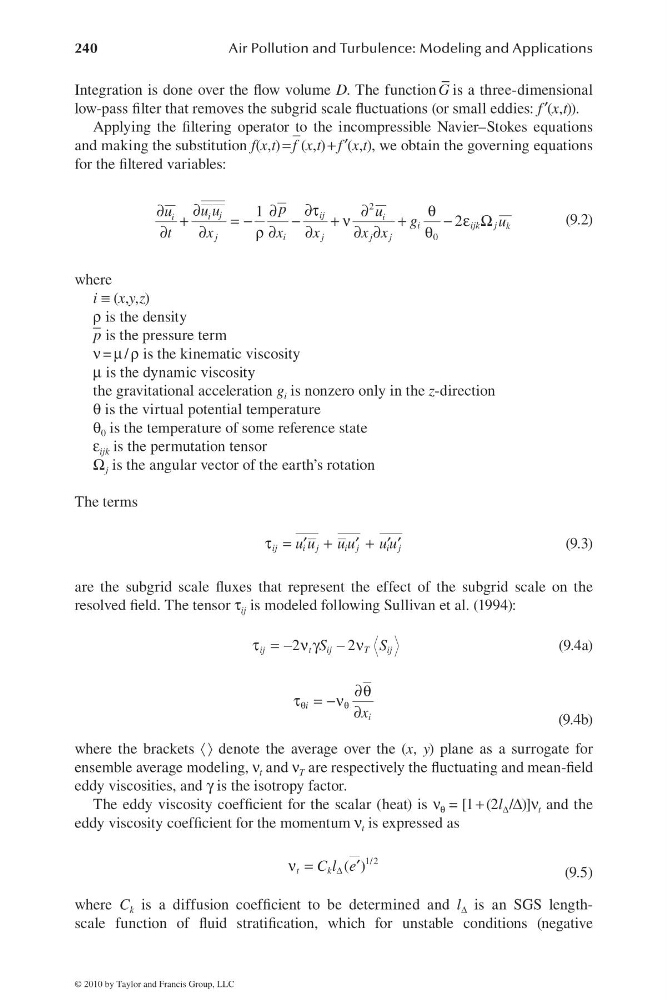
Integration is done over the fl ow volume D. The function
−
G is a three-dimensional
low-pass fi lter that removes the subgrid scale fl uctuations (or small eddies: f ′(x,t)).
Applying the fi ltering operator to the incompressible Navier–Stokes equations
and making the substitution f(x,t) =
–
f (x,t) + f ′(x,t), we obtain the governing equations
for the fi ltered variables:
∂
∂ τ
∂
∂
∂
θ
+
=−
−
+ν
+
− ε Ω
∂
∂
ρ∂
∂
∂ ∂
θ
2
0
1
2
j
i j
i
i
i
i
ijk
j k
j
i
j
j
j
p
u u
u
u
g
u
t
x
x
x
x x
(9.2)
where
i ≡ (x,y,z)
ρ is the density
–
p is the pressure term
ν = μ / ρ is the kinematic viscosity
μ is the dynamic viscosity
the gravitational acceleration g i is nonzero only in the z-direction
θ is the virtual potential temperature
θ 0 is the temperature of some reference state
ε ijk is the permutation tensor
Ω j is the angular vector of the earth’s rotation
The terms
τ =
+
+
′
′
′ ′
ij
i j
i j
i j
u u u u
u u
(9.3)
are the subgrid scale fl uxes that represent the effect of the subgrid scale on the
resolved fi eld. The tensor τ ij is modeled following Sullivan et al. (1994):
τ = − ν γ − ν
2
2
ij
t
ij
T
ij
S
S
(9.4a)
i
i
x
θ
θ
∂θ
τ = −ν ∂
(9.4b)
where the brackets á ñ denote the average over the (x, y) plane as a surrogate for
ensemble average modeling, ν t and ν T are respectively the fl uctuating and mean-fi eld
eddy viscosities, and γ is the isotropy factor.
The eddy viscosity coeffi cient for the scalar (heat) is ν θ = [1 + (2l Δ /Δ)]ν t and the
eddy viscosity coeffi cient for the momentum ν t is expressed as
Δ
ν =
′
1/2
( )
t
k
C l e
(9.5)
where C k is a diffusion coeffi cient to be determined and l Δ is an SGS lengthscale function of fl uid stratifi cation, which for unstable conditions (negative
© 2010 by Taylor and Francis Group, LLC
Air Pollution and Turbulence: Modeling and Applications
Integration is done over the fl ow volume D. The function
−
G is a three-dimensional
low-pass fi lter that removes the subgrid scale fl uctuations (or small eddies: f ′(x,t)).
Applying the fi ltering operator to the incompressible Navier–Stokes equations
and making the substitution f(x,t) =
–
f (x,t) + f ′(x,t), we obtain the governing equations
for the fi ltered variables:
∂
∂ τ
∂
∂
∂
θ
+
=−
−
+ν
+
− ε Ω
∂
∂
ρ∂
∂
∂ ∂
θ
2
0
1
2
j
i j
i
i
i
i
ijk
j k
j
i
j
j
j
p
u u
u
u
g
u
t
x
x
x
x x
(9.2)
where
i ≡ (x,y,z)
ρ is the density
–
p is the pressure term
ν = μ / ρ is the kinematic viscosity
μ is the dynamic viscosity
the gravitational acceleration g i is nonzero only in the z-direction
θ is the virtual potential temperature
θ 0 is the temperature of some reference state
ε ijk is the permutation tensor
Ω j is the angular vector of the earth’s rotation
The terms
τ =
+
+
′
′
′ ′
ij
i j
i j
i j
u u u u
u u
(9.3)
are the subgrid scale fl uxes that represent the effect of the subgrid scale on the
resolved fi eld. The tensor τ ij is modeled following Sullivan et al. (1994):
τ = − ν γ − ν
2
2
ij
t
ij
T
ij
S
S
(9.4a)
i
i
x
θ
θ
∂θ
τ = −ν ∂
(9.4b)
where the brackets á ñ denote the average over the (x, y) plane as a surrogate for
ensemble average modeling, ν t and ν T are respectively the fl uctuating and mean-fi eld
eddy viscosities, and γ is the isotropy factor.
The eddy viscosity coeffi cient for the scalar (heat) is ν θ = [1 + (2l Δ /Δ)]ν t and the
eddy viscosity coeffi cient for the momentum ν t is expressed as
Δ
ν =
′
1/2
( )
t
k
C l e
(9.5)
where C k is a diffusion coeffi cient to be determined and l Δ is an SGS lengthscale function of fl uid stratifi cation, which for unstable conditions (negative
© 2010 by Taylor and Francis Group, LLC