

Deposition, Transformation, and Remobilization of Soot and Diesel
5
correlated with these insoluble materials. Nevertheless, they correlate well among
themselves, so chloride and formate concentrations are related because they are both
soluble and removed from the crust in similar ways by rainfall. There is also evidence of biological transformations within the crust such as the production of oxalate
or even acetate (Bonazza et al., 2007).
1.6 DARKENING OF BUILDINGS
Declining concentrations of corrosive components in air has made the accumulation
of black particles more important and raised the relevance of aesthetic considerations. Today diesel soot has become the major source of elemental carbon in urban
air. Nevertheless, in some locations decreasing atmospheric soot concentrations have
meant that in recent years there has been less darkening and in some cases rainfall
removal has made buildings much cleaner (Davidson et al., 2000). Biological activity, perhaps supported by an ongoing increase in organic pollution, may increasingly
contribute to stone blackening (Viles and Gorbushina, 2003).
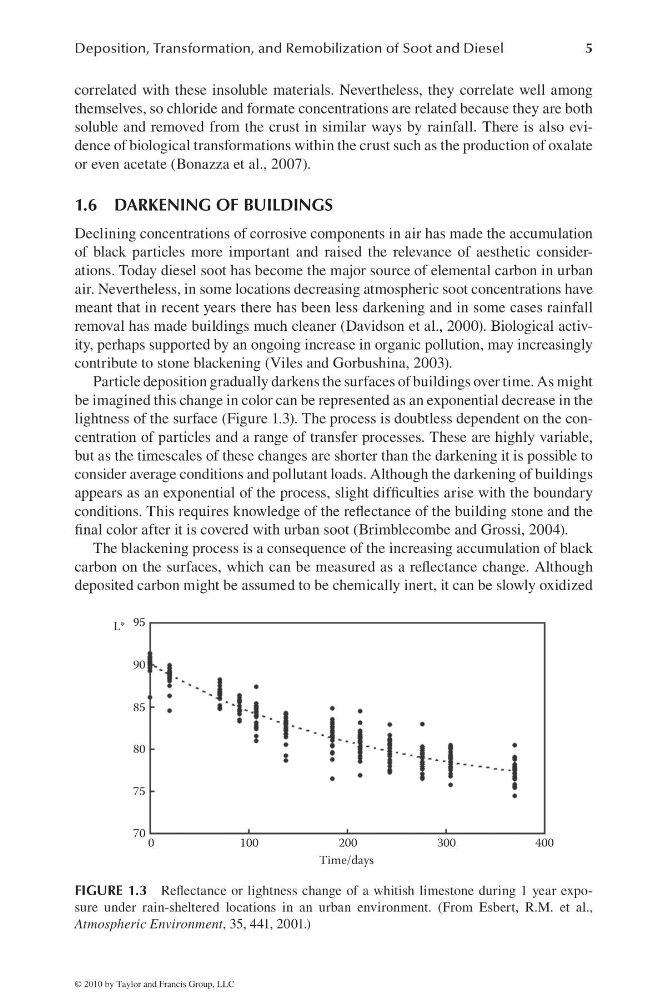
Particle deposition gradually darkens the surfaces of buildings over time. As might
be imagined this change in color can be represented as an exponential decrease in the
lightness of the surface (Figure 1.3). The process is doubtless dependent on the concentration of particles and a range of transfer processes. These are highly variable,
but as the timescales of these changes are shorter than the darkening it is possible to
consider average conditions and pollutant loads. Although the darkening of buildings
appears as an exponential of the process, slight diffi culties arise with the boundary
conditions. This requires knowledge of the refl ectance of the building stone and the
fi nal color after it is covered with urban soot (Brimblecombe and Grossi, 2004).
The blackening process is a consequence of the increasing accumulation of black
carbon on the surfaces, which can be measured as a refl ectance change. Although
deposited carbon might be assumed to be chemically inert, it can be slowly oxidized
70
0
100
200
300
400
Time/days
75
80
85
90
L* 95
FIGURE 1.3 Refl ectance or lightness change of a whitish limestone during 1 year exposure under rain-sheltered locations in an urban environment. (From Esbert, R.M. et al.,
Atmospheric Environment, 35, 441, 2001.)
© 2010 by Taylor and Francis Group, LLC
5
correlated with these insoluble materials. Nevertheless, they correlate well among
themselves, so chloride and formate concentrations are related because they are both
soluble and removed from the crust in similar ways by rainfall. There is also evidence of biological transformations within the crust such as the production of oxalate
or even acetate (Bonazza et al., 2007).
1.6 DARKENING OF BUILDINGS
Declining concentrations of corrosive components in air has made the accumulation
of black particles more important and raised the relevance of aesthetic considerations. Today diesel soot has become the major source of elemental carbon in urban
air. Nevertheless, in some locations decreasing atmospheric soot concentrations have
meant that in recent years there has been less darkening and in some cases rainfall
removal has made buildings much cleaner (Davidson et al., 2000). Biological activity, perhaps supported by an ongoing increase in organic pollution, may increasingly
contribute to stone blackening (Viles and Gorbushina, 2003).
Particle deposition gradually darkens the surfaces of buildings over time. As might
be imagined this change in color can be represented as an exponential decrease in the
lightness of the surface (Figure 1.3). The process is doubtless dependent on the concentration of particles and a range of transfer processes. These are highly variable,
but as the timescales of these changes are shorter than the darkening it is possible to
consider average conditions and pollutant loads. Although the darkening of buildings
appears as an exponential of the process, slight diffi culties arise with the boundary
conditions. This requires knowledge of the refl ectance of the building stone and the
fi nal color after it is covered with urban soot (Brimblecombe and Grossi, 2004).
The blackening process is a consequence of the increasing accumulation of black
carbon on the surfaces, which can be measured as a refl ectance change. Although
deposited carbon might be assumed to be chemically inert, it can be slowly oxidized
70
0
100
200
300
400
Time/days
75
80
85
90
L* 95
FIGURE 1.3 Refl ectance or lightness change of a whitish limestone during 1 year exposure under rain-sheltered locations in an urban environment. (From Esbert, R.M. et al.,
Atmospheric Environment, 35, 441, 2001.)
© 2010 by Taylor and Francis Group, LLC