

4
Air Pollution and Turbulence: Modeling and Applications
are accompanied by associated organic compounds (Hermosin et al., 2004), such as
polycyclic aromatic molecules or organic acids. These organic compounds can act
as photosensitizers inducing oxidation processes or polymerization. The polymers
formed may create a kind of adhesive, and thus replace the calcareous cements that
have characterized the outer layers of buildings in the past.
1.4 OLDER CRUSTS
If we look at the thick deposits found on monuments such as the Tower of London,
we fi nd layered structures that refl ect both the change in deposition with time and
the changes brought about by physical, chemical, and biological processes. Deeper
in the deposits there are traces from wood and coal burning in the past (Del Monte
et al., 2001). Older crusts also tend to be thicker with dendritic aluminosilicate and
iron-containing particles. At the Tower, younger crusts are thinner and tabular. Their
structure is clear under microscopy (Sabbioni et al., 2004), with the presence of coal
and wood smoke in oldest layers.
These changes seem to relate to changes in the nature of urban pollution. This
may also be true of the type of carbon present. Particulate carbon in the modern
atmosphere tends to be associated with signifi cant fractions of organic matter. In
the past there was a smaller amount of organic material. Today those cities with a
large amount of pollution generated from two-stroke motor vehicles (motor cycles
especially) have large amounts; this leads to contemporary thin crusts observed with
high organic carbon/elemental carbon ratios (OC/EC). In Florence, it varies between
1.5 and 2.2, while in older crusts the OC/EC ratio is smaller, such as those of the
cathedral of Milan varying from 0.1 to 0.7 (Bonazza et al., 2005).
1.5 TRANSFORMATIONS
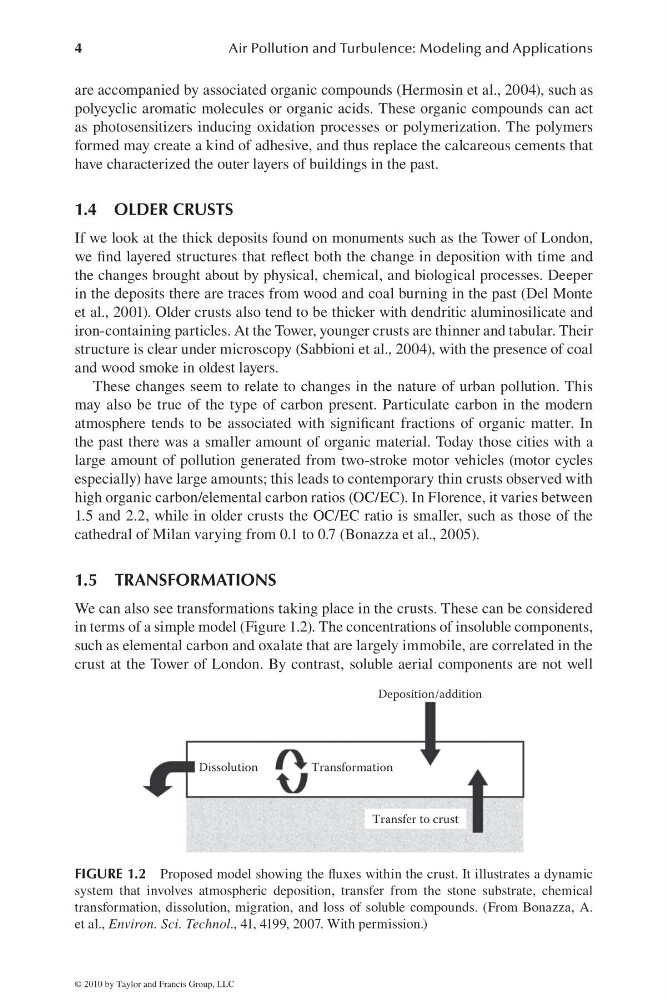
We can also see transformations taking place in the crusts. These can be considered
in terms of a simple model (Figure 1.2). The concentrations of insoluble components,
such as elemental carbon and oxalate that are largely immobile, are correlated in the
crust at the Tower of London. By contrast, soluble aerial components are not well
Dissolution
Transformation
Transfer to crust
Deposition/addition
FIGURE 1.2 Proposed model showing the fl uxes within the crust. It illustrates a dynamic
system that involves atmospheric deposition, transfer from the stone substrate, chemical
transformation, dissolution, migration, and loss of soluble compounds. (From Bonazza, A.
et al., Environ. Sci. Technol., 41, 4199, 2007. With permission.)
© 2010 by Taylor and Francis Group, LLC
Air Pollution and Turbulence: Modeling and Applications
are accompanied by associated organic compounds (Hermosin et al., 2004), such as
polycyclic aromatic molecules or organic acids. These organic compounds can act
as photosensitizers inducing oxidation processes or polymerization. The polymers
formed may create a kind of adhesive, and thus replace the calcareous cements that
have characterized the outer layers of buildings in the past.
1.4 OLDER CRUSTS
If we look at the thick deposits found on monuments such as the Tower of London,
we fi nd layered structures that refl ect both the change in deposition with time and
the changes brought about by physical, chemical, and biological processes. Deeper
in the deposits there are traces from wood and coal burning in the past (Del Monte
et al., 2001). Older crusts also tend to be thicker with dendritic aluminosilicate and
iron-containing particles. At the Tower, younger crusts are thinner and tabular. Their
structure is clear under microscopy (Sabbioni et al., 2004), with the presence of coal
and wood smoke in oldest layers.
These changes seem to relate to changes in the nature of urban pollution. This
may also be true of the type of carbon present. Particulate carbon in the modern
atmosphere tends to be associated with signifi cant fractions of organic matter. In
the past there was a smaller amount of organic material. Today those cities with a
large amount of pollution generated from two-stroke motor vehicles (motor cycles
especially) have large amounts; this leads to contemporary thin crusts observed with
high organic carbon/elemental carbon ratios (OC/EC). In Florence, it varies between
1.5 and 2.2, while in older crusts the OC/EC ratio is smaller, such as those of the
cathedral of Milan varying from 0.1 to 0.7 (Bonazza et al., 2005).
1.5 TRANSFORMATIONS
We can also see transformations taking place in the crusts. These can be considered
in terms of a simple model (Figure 1.2). The concentrations of insoluble components,
such as elemental carbon and oxalate that are largely immobile, are correlated in the
crust at the Tower of London. By contrast, soluble aerial components are not well
Dissolution
Transformation
Transfer to crust
Deposition/addition
FIGURE 1.2 Proposed model showing the fl uxes within the crust. It illustrates a dynamic
system that involves atmospheric deposition, transfer from the stone substrate, chemical
transformation, dissolution, migration, and loss of soluble compounds. (From Bonazza, A.
et al., Environ. Sci. Technol., 41, 4199, 2007. With permission.)
© 2010 by Taylor and Francis Group, LLC