

6
Air Pollution and Turbulence: Modeling and Applications
in modern crusts. It is increasingly recognized that carbon can be converted to
humic-like substances (HULIS) in the atmosphere (Graber and Rudich, 2005).
Such oxidative processes on soot is likely to be promoted by traces of the organic
compounds associated with the diesels. The products exhibit yellowish or brownish
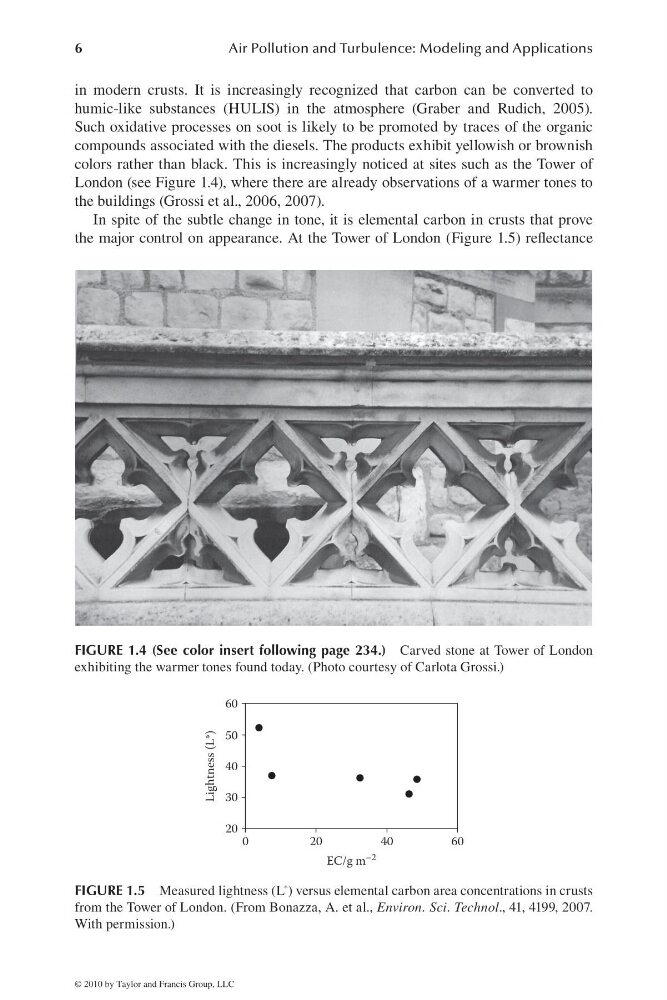
colors rather than black. This is increasingly noticed at sites such as the Tower of
London (see Figure 1.4), where there are already observations of a warmer tones to
the buildings (Grossi et al., 2006, 2007).
In spite of the subtle change in tone, it is elemental carbon in crusts that prove
the major control on appearance. At the Tower of London (Figure 1.5) refl ectance
FIGURE 1.4 (See color insert following page 234.) Carved stone at Tower of London
exhibiting the warmer tones found today. (Photo courtesy of Carlota Grossi.)
20
0
2 0
Lightness (L*)
EC/g m
–2
40
60
30
40
50
60
FIGURE 1.5 Measured lightness (L * ) versus elemental carbon area concentrations in crusts
from the Tower of London. (From Bonazza, A. et al., Environ. Sci. Technol., 41, 4199, 2007.
With permission.)
© 2010 by Taylor and Francis Group, LLC
Air Pollution and Turbulence: Modeling and Applications
in modern crusts. It is increasingly recognized that carbon can be converted to
humic-like substances (HULIS) in the atmosphere (Graber and Rudich, 2005).
Such oxidative processes on soot is likely to be promoted by traces of the organic
compounds associated with the diesels. The products exhibit yellowish or brownish
colors rather than black. This is increasingly noticed at sites such as the Tower of
London (see Figure 1.4), where there are already observations of a warmer tones to
the buildings (Grossi et al., 2006, 2007).
In spite of the subtle change in tone, it is elemental carbon in crusts that prove
the major control on appearance. At the Tower of London (Figure 1.5) refl ectance
FIGURE 1.4 (See color insert following page 234.) Carved stone at Tower of London
exhibiting the warmer tones found today. (Photo courtesy of Carlota Grossi.)
20
0
2 0
Lightness (L*)
EC/g m
–2
40
60
30
40
50
60
FIGURE 1.5 Measured lightness (L * ) versus elemental carbon area concentrations in crusts
from the Tower of London. (From Bonazza, A. et al., Environ. Sci. Technol., 41, 4199, 2007.
With permission.)
© 2010 by Taylor and Francis Group, LLC