

212
Air Pollution and Turbulence: Modeling and Applications
where
(
)
2
3
4
5
1
3
4
3
4
3
4
3
15
1 6
10
T
C x C
C x
C x C x C x
= −
−
+ +
+
−
−
(
)
2
3
4
5
6
2
4
4
3
4
3
4
1
1
2
5
T
C x
C
C x
C x C x C x
= − +
+
−
−
+
+
(8.31)
2
3
4
3
4
3
4
3
4
1 3
3
6
T
C
C x
C x C x C x
= +
−
−
+
+
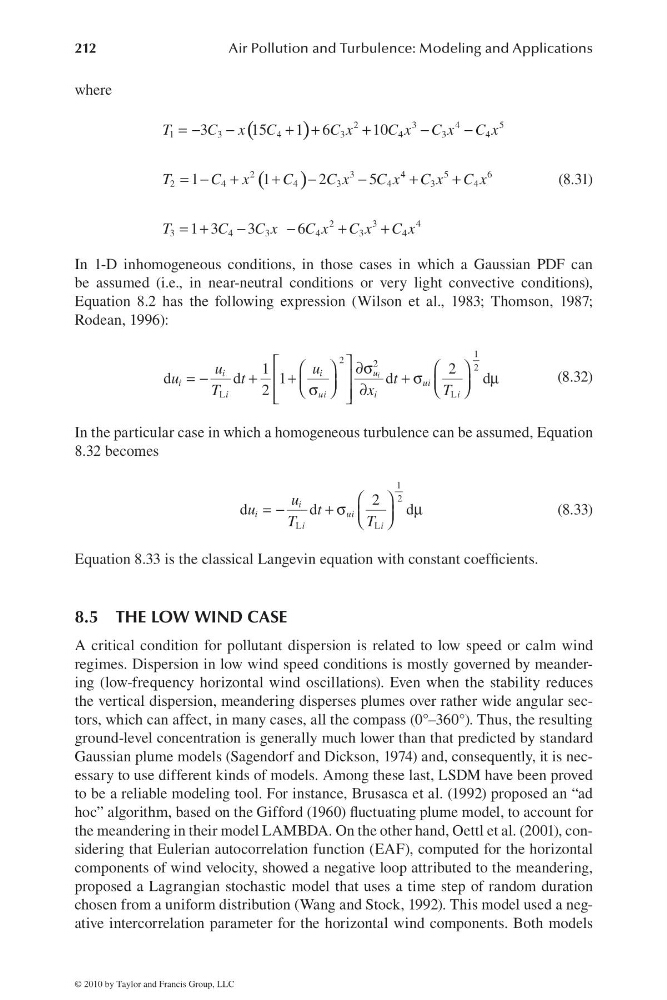
In 1-D inhomogeneous conditions, in those cases in which a Gaussian PDF can
be assumed (i.e., in near-neutral conditions or very light convective conditions),
Equation 8.2 has the following expression (Wilson et al., 1983; Thomson, 1987;
Rodean, 1996):
⎡
⎤
⎛
⎞ ∂σ
⎛ ⎞
= −
+
+
+ σ
μ
⎢
⎥
⎜
⎟
⎜ ⎟
⎝
⎠
⎝ ⎠
σ
∂
⎢
⎥
⎣
⎦
1
2
2
2
L
L
1
2
d
d
1
d
d
2
i
u
i
i
i
u i
i
u i
i
i
u
u
u
t
t
T
x
T
(8.32)
In the particular case in which a homogeneous turbulence can be assumed, Equation
8.32 becomes
⎛ ⎞
= −
+ σ
μ
⎜ ⎟
⎝ ⎠
1
2
L
L
2
d
d
d
i
i
u i
i
i
u
u
t
T
T
(8.33)
Equation 8.33 is the classical Langevin equation with constant coeffi cients.
8.5 THE LOW WIND CASE
A critical condition for pollutant dispersion is related to low speed or calm wind
regimes. Dispersion in low wind speed conditions is mostly governed by meandering (low-frequency horizontal wind oscillations). Even when the stability reduces
the vertical dispersion, meandering disperses plumes over rather wide angular sectors, which can affect, in many cases, all the compass (0°–360°). Thus, the resulting
ground-level concentration is generally much lower than that predicted by standard
Gaussian plume models (Sagendorf and Dickson, 1974) and, consequently, it is necessary to use different kinds of models. Among these last, LSDM have been proved
to be a reliable modeling tool. For instance, Brusasca et al. (1992) proposed an “ad
hoc” algorithm, based on the Gifford (1960) fl uctuating plume model, to account for
the meandering in their model LAMBDA. On the other hand, Oettl et al. (2001), considering that Eulerian autocorrelation function (EAF), computed for the horizontal
components of wind velocity, showed a negative loop attributed to the meandering,
proposed a Lagrangian stochastic model that uses a time step of random duration
chosen from a uniform distribution (Wang and Stock, 1992). This model used a negative intercorrelation parameter for the horizontal wind components. Both models
© 2010 by Taylor and Francis Group, LLC
Air Pollution and Turbulence: Modeling and Applications
where
(
)
2
3
4
5
1
3
4
3
4
3
4
3
15
1 6
10
T
C x C
C x
C x C x C x
= −
−
+ +
+
−
−
(
)
2
3
4
5
6
2
4
4
3
4
3
4
1
1
2
5
T
C x
C
C x
C x C x C x
= − +
+
−
−
+
+
(8.31)
2
3
4
3
4
3
4
3
4
1 3
3
6
T
C
C x
C x C x C x
= +
−
−
+
+
In 1-D inhomogeneous conditions, in those cases in which a Gaussian PDF can
be assumed (i.e., in near-neutral conditions or very light convective conditions),
Equation 8.2 has the following expression (Wilson et al., 1983; Thomson, 1987;
Rodean, 1996):
⎡
⎤
⎛
⎞ ∂σ
⎛ ⎞
= −
+
+
+ σ
μ
⎢
⎥
⎜
⎟
⎜ ⎟
⎝
⎠
⎝ ⎠
σ
∂
⎢
⎥
⎣
⎦
1
2
2
2
L
L
1
2
d
d
1
d
d
2
i
u
i
i
i
u i
i
u i
i
i
u
u
u
t
t
T
x
T
(8.32)
In the particular case in which a homogeneous turbulence can be assumed, Equation
8.32 becomes
⎛ ⎞
= −
+ σ
μ
⎜ ⎟
⎝ ⎠
1
2
L
L
2
d
d
d
i
i
u i
i
i
u
u
t
T
T
(8.33)
Equation 8.33 is the classical Langevin equation with constant coeffi cients.
8.5 THE LOW WIND CASE
A critical condition for pollutant dispersion is related to low speed or calm wind
regimes. Dispersion in low wind speed conditions is mostly governed by meandering (low-frequency horizontal wind oscillations). Even when the stability reduces
the vertical dispersion, meandering disperses plumes over rather wide angular sectors, which can affect, in many cases, all the compass (0°–360°). Thus, the resulting
ground-level concentration is generally much lower than that predicted by standard
Gaussian plume models (Sagendorf and Dickson, 1974) and, consequently, it is necessary to use different kinds of models. Among these last, LSDM have been proved
to be a reliable modeling tool. For instance, Brusasca et al. (1992) proposed an “ad
hoc” algorithm, based on the Gifford (1960) fl uctuating plume model, to account for
the meandering in their model LAMBDA. On the other hand, Oettl et al. (2001), considering that Eulerian autocorrelation function (EAF), computed for the horizontal
components of wind velocity, showed a negative loop attributed to the meandering,
proposed a Lagrangian stochastic model that uses a time step of random duration
chosen from a uniform distribution (Wang and Stock, 1992). This model used a negative intercorrelation parameter for the horizontal wind components. Both models
© 2010 by Taylor and Francis Group, LLC