

Analytical Models for the Dispersion of Pollutants in Low Wind Conditions 171
They solved the integral Equation 6.31 by assuming that σ i ’s (i = x, y, z)
depends only on the downwind distance x from the source to receptor. This
assumption on σ i ’s is unimportant when U is not too low (Slade, 1968).
Bianconi and Tamponi (1993) presented an extension of the above model
(Palazzi et al. 1982), for the calculation of the time evolution of the concentration fi eld and the duration of the exposure to emissions in order to cover
the case of substance that may be subject to chemical–physical decay in
fi nite mixing layer.
b. For short-time releases, Arya (1995) made an attempt for modeling and
parameterization of near-source diffusion in weak wind, including the calm
conditions. From Taylor’s theory, for small diffusion or travel times, the
dispersion parameters (σ i ’s) vary linearly with time. But at large travel or
diffusion times, these dispersion parameters are predicted to grow more
slowly and are proportional to square root of time. Using the mixed-layer
similarity theory, Arya (1995) interpolated the dispersion parameters from
the above two parameterizations for different timescales, as continuous
function of time t. These new interpolated parameters cover the whole wide
range of small, intermediate, and large diffusion times in convective mixed
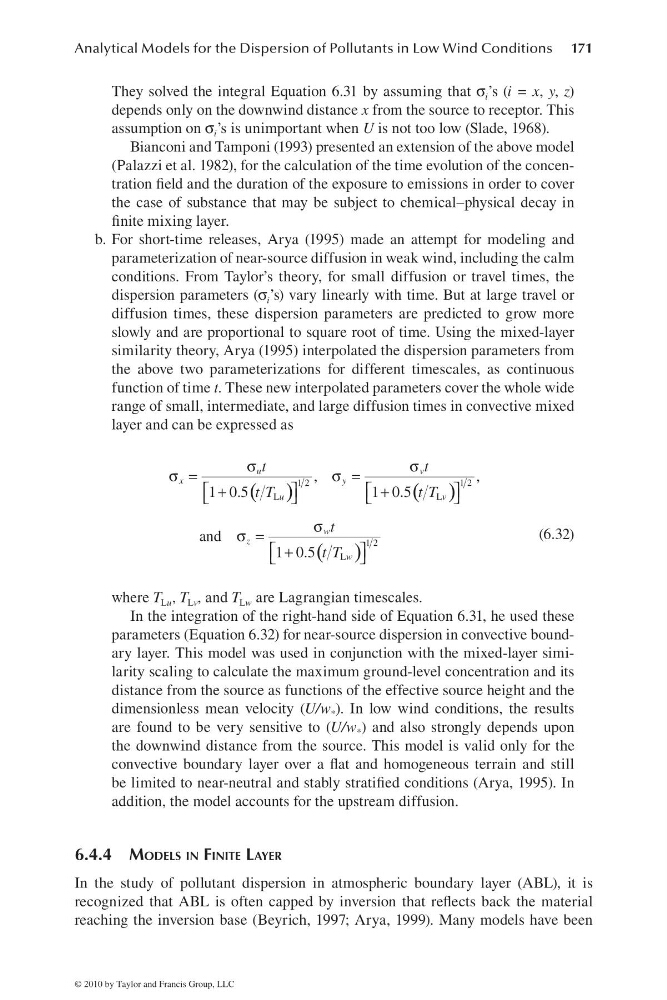
layer and can be expressed as
( )
( )
( )
σ
σ
σ =
σ =
⎡
⎤
⎡
⎤
+
+
⎣
⎦
⎣
⎦
σ
σ = ⎡
⎤
+
⎣
⎦
1 2
1 2
L
L
1 2
L
,
,
1 0.5
1 0.5
and
1 0.5
u
v
x
y
u
v
w
z
w
t
t
t T
t T
t
t T
(6.32)
where T Lu , T Lv , and T Lw are Lagrangian timescales.
In the integration of the right-hand side of Equation 6.31, he used these
parameters (Equation 6.32) for near-source dispersion in convective boundary layer. This model was used in conjunction with the mixed-layer similarity scaling to calculate the maximum ground-level concentration and its
distance from the source as functions of the effective source height and the
dimensionless mean velocity (U/w * ). In low wind conditions, the results
are found to be very sensitive to (U/w * ) and also strongly depends upon
the downwind distance from the source. This model is valid only for the
convective boundary layer over a fl at and homogeneous terrain and still
be limited to near-neutral and stably stratifi ed conditions (Arya, 1995). In
addition, the model accounts for the upstream diffusion.
6.4.4 MODELS IN FINITE LAYER
In the study of pollutant dispersion in atmospheric boundary layer (ABL), it is
recognized that ABL is often capped by inversion that refl ects back the material
reaching the inversion base (Beyrich, 1997; Arya, 1999). Many models have been
© 2010 by Taylor and Francis Group, LLC
They solved the integral Equation 6.31 by assuming that σ i ’s (i = x, y, z)
depends only on the downwind distance x from the source to receptor. This
assumption on σ i ’s is unimportant when U is not too low (Slade, 1968).
Bianconi and Tamponi (1993) presented an extension of the above model
(Palazzi et al. 1982), for the calculation of the time evolution of the concentration fi eld and the duration of the exposure to emissions in order to cover
the case of substance that may be subject to chemical–physical decay in
fi nite mixing layer.
b. For short-time releases, Arya (1995) made an attempt for modeling and
parameterization of near-source diffusion in weak wind, including the calm
conditions. From Taylor’s theory, for small diffusion or travel times, the
dispersion parameters (σ i ’s) vary linearly with time. But at large travel or
diffusion times, these dispersion parameters are predicted to grow more
slowly and are proportional to square root of time. Using the mixed-layer
similarity theory, Arya (1995) interpolated the dispersion parameters from
the above two parameterizations for different timescales, as continuous
function of time t. These new interpolated parameters cover the whole wide
range of small, intermediate, and large diffusion times in convective mixed
layer and can be expressed as
( )
( )
( )
σ
σ
σ =
σ =
⎡
⎤
⎡
⎤
+
+
⎣
⎦
⎣
⎦
σ
σ = ⎡
⎤
+
⎣
⎦
1 2
1 2
L
L
1 2
L
,
,
1 0.5
1 0.5
and
1 0.5
u
v
x
y
u
v
w
z
w
t
t
t T
t T
t
t T
(6.32)
where T Lu , T Lv , and T Lw are Lagrangian timescales.
In the integration of the right-hand side of Equation 6.31, he used these
parameters (Equation 6.32) for near-source dispersion in convective boundary layer. This model was used in conjunction with the mixed-layer similarity scaling to calculate the maximum ground-level concentration and its
distance from the source as functions of the effective source height and the
dimensionless mean velocity (U/w * ). In low wind conditions, the results
are found to be very sensitive to (U/w * ) and also strongly depends upon
the downwind distance from the source. This model is valid only for the
convective boundary layer over a fl at and homogeneous terrain and still
be limited to near-neutral and stably stratifi ed conditions (Arya, 1995). In
addition, the model accounts for the upstream diffusion.
6.4.4 MODELS IN FINITE LAYER
In the study of pollutant dispersion in atmospheric boundary layer (ABL), it is
recognized that ABL is often capped by inversion that refl ects back the material
reaching the inversion base (Beyrich, 1997; Arya, 1999). Many models have been
© 2010 by Taylor and Francis Group, LLC