

170
Air Pollution and Turbulence: Modeling and Applications
To compute the concentration close to the plume centerline, the analytical solution (Equation 6.30) can be easily converted into slender plume approximation by
taking α → 0 in Equation 6.30 (Yadav, 1995). During the evaluation, Sharan and
Yadav (1998) have found similar results for the models (Equations 6.27 and 6.30),
though they are based on different approaches. The reason for the similar results is
attributed to the similar type of parameterizations used in both the approaches.
Turbulent intensities in Equation 6.28 can be calculated directly from the measurements. In the absence of such measurements, turbulent intensities may be parameterized in terms of friction velocity (u * ) in stable conditions (Sharan and Yadav, 1998)
and convective velocity (w * ) in unstable conditions (Sharan et al., 1996a). The use of
parameterization of turbulent intensities in terms of w * provides an under-prediction
(Sharan et al., 1996a) of the concentration observed in IIT diffusion experiment (Singh
et al., 1991) in unstable conditions. However, the parameterization based on u * provides
a signifi cant improvement (Sharan et al., 2002). The eddy diffusivities in Equation
6.28 tend to vanish as downwind distance x from the source or the wind speed U
approaches to zero. Vanishing U will introduce a singularity in the solution (Equation
6.30). In addition, this parameterization does not account for upstream diffusion. To
overcome these shortcomings, there is a need to explore other alternative parameterizations of eddy diffusivities in terms of travel time, turbulent kinetic energy in order
to develop the realistic variable-K models for describing low wind dispersion.
6.4.3 MODELS FOR STEADY SOURCE OF SHORT DURATION
There are many diffusion models for the dispersion of pollutants in atmosphere for
continuous and instantaneous source releases. However, dispersion of short-term
releases of pollutants from industrial plants, potential consequences of leakage such
as fi re and explosion, is a matter of great concern of research because of the lack
of reliability of most of the dispersion models, mainly in terms of actual duration
time of releases, as well as in terms of exposure time for human beings in environments. Thus, some models to realize the dispersion from steady-state source of short
duration are described as follows:
a. Palazzi et al. (1982) presented a useful mathematical technique to fi ll the gap
between the instantaneous and continuous point sources diffusions models.
The mean concentration fi eld due to continuous point source in an infi nite
medium is obtained by superimposing the concentrations in sequentially
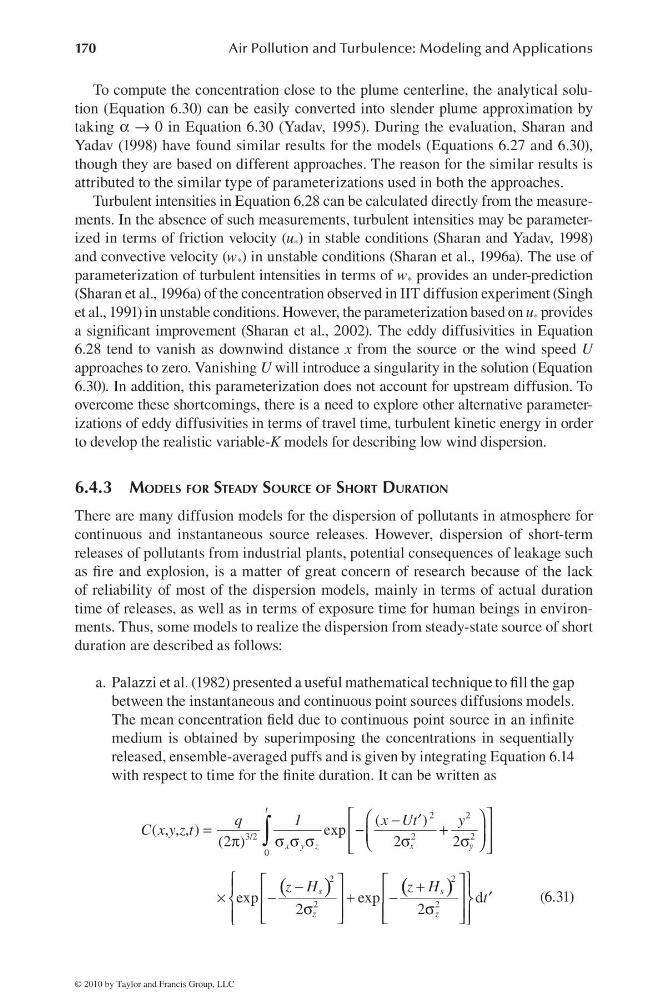
released, ensemble-averaged puffs and is given by integrating Equation 6.14
with respect to time for the fi nite duration. It can be written as
(
)
(
)
⎡
⎤
⎛
⎞
− ′
=
−
+
⎢
⎥
⎜
⎟
π
σ σ σ
σ
σ
⎝
⎠
⎢
⎥
⎣
⎦
⎧
⎫
⎡
⎤
⎡
⎤
−
+
⎪
⎪
⎢
⎥
⎢
⎥
×
−
+
−
′
⎨
⎬
σ
σ
⎢
⎥
⎢
⎥
⎪
⎪
⎣
⎦
⎣
⎦
⎩
⎭
∫
2
2
3/2
2
2
0
2
2
2
2
(
)
( , , , )
exp
(2 )
2
2
exp
exp
d
2
2
t
x y z
x
y
s
s
z
z
q
1
x U t
y
C x y z t
z H
z H
t
(6.31)
© 2010 by Taylor and Francis Group, LLC
Air Pollution and Turbulence: Modeling and Applications
To compute the concentration close to the plume centerline, the analytical solution (Equation 6.30) can be easily converted into slender plume approximation by
taking α → 0 in Equation 6.30 (Yadav, 1995). During the evaluation, Sharan and
Yadav (1998) have found similar results for the models (Equations 6.27 and 6.30),
though they are based on different approaches. The reason for the similar results is
attributed to the similar type of parameterizations used in both the approaches.
Turbulent intensities in Equation 6.28 can be calculated directly from the measurements. In the absence of such measurements, turbulent intensities may be parameterized in terms of friction velocity (u * ) in stable conditions (Sharan and Yadav, 1998)
and convective velocity (w * ) in unstable conditions (Sharan et al., 1996a). The use of
parameterization of turbulent intensities in terms of w * provides an under-prediction
(Sharan et al., 1996a) of the concentration observed in IIT diffusion experiment (Singh
et al., 1991) in unstable conditions. However, the parameterization based on u * provides
a signifi cant improvement (Sharan et al., 2002). The eddy diffusivities in Equation
6.28 tend to vanish as downwind distance x from the source or the wind speed U
approaches to zero. Vanishing U will introduce a singularity in the solution (Equation
6.30). In addition, this parameterization does not account for upstream diffusion. To
overcome these shortcomings, there is a need to explore other alternative parameterizations of eddy diffusivities in terms of travel time, turbulent kinetic energy in order
to develop the realistic variable-K models for describing low wind dispersion.
6.4.3 MODELS FOR STEADY SOURCE OF SHORT DURATION
There are many diffusion models for the dispersion of pollutants in atmosphere for
continuous and instantaneous source releases. However, dispersion of short-term
releases of pollutants from industrial plants, potential consequences of leakage such
as fi re and explosion, is a matter of great concern of research because of the lack
of reliability of most of the dispersion models, mainly in terms of actual duration
time of releases, as well as in terms of exposure time for human beings in environments. Thus, some models to realize the dispersion from steady-state source of short
duration are described as follows:
a. Palazzi et al. (1982) presented a useful mathematical technique to fi ll the gap
between the instantaneous and continuous point sources diffusions models.
The mean concentration fi eld due to continuous point source in an infi nite
medium is obtained by superimposing the concentrations in sequentially
released, ensemble-averaged puffs and is given by integrating Equation 6.14
with respect to time for the fi nite duration. It can be written as
(
)
(
)
⎡
⎤
⎛
⎞
− ′
=
−
+
⎢
⎥
⎜
⎟
π
σ σ σ
σ
σ
⎝
⎠
⎢
⎥
⎣
⎦
⎧
⎫
⎡
⎤
⎡
⎤
−
+
⎪
⎪
⎢
⎥
⎢
⎥
×
−
+
−
′
⎨
⎬
σ
σ
⎢
⎥
⎢
⎥
⎪
⎪
⎣
⎦
⎣
⎦
⎩
⎭
∫
2
2
3/2
2
2
0
2
2
2
2
(
)
( , , , )
exp
(2 )
2
2
exp
exp
d
2
2
t
x y z
x
y
s
s
z
z
q
1
x U t
y
C x y z t
z H
z H
t
(6.31)
© 2010 by Taylor and Francis Group, LLC