

142
Air Pollution and Turbulence: Modeling and Applications
especially important in the evaluation of violations of air pollution standards, which
are often expressed in high percentiles.
Conversely, Gaussian models are fast, simple, do not require complex meteorological input, and describe the diffusive transport in an Eulerian framework, making
the use of the Eulerian nature of measurements easy.
For these reasons, they are still widely employed for regulatory applications by
environmental agencies all over the world. Nonetheless, because of their well-known
intrinsic limits, the reliability of a Gaussian model strongly depends on the way the
dispersion parameters are determined on the basis of the turbulence structure of the
PBL and the model’s ability to reproduce experimental diffusion data. A great variety of formulations exist (Hanna et al., 1977; Briggs, 1985; Berkowicz et al., 1986;
Hanna, 1986; Bowen, 1994; Erbrink, 1995; Mohan and Siddiqui, 1997).
The Gaussian solution in a system of coordinates where x is along the direction of
the wind, y is transversal to wind, z is the height, and source of intensity Q is located
at (0, 0, H), can be written as
=
π σ σ
−
σ
−
σ +
+
σ
2
2
2
2
2
2
( , , )
/(2
) exp(
/(2 ))[exp((
) /(2 )) exp((
) /(2 ))]
y z
y
z
z
C x y z Q
u
y
z H
z H
(5.16)
where σ y and σ z are functions of the distance from the source and turbulent intensity,
and are determined experimentally.
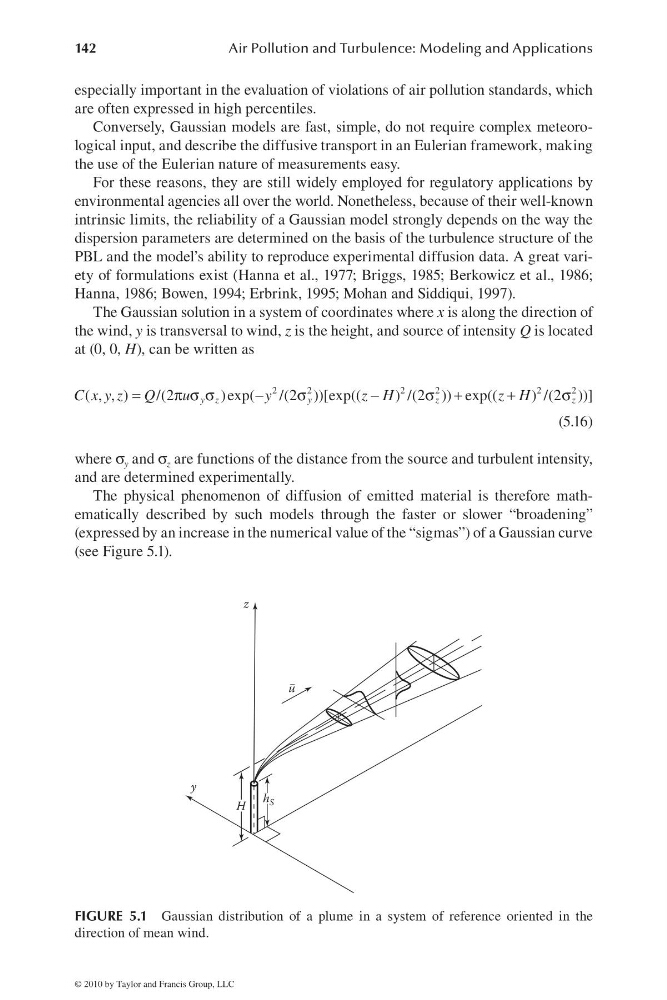
The physical phenomenon of diffusion of emitted material is therefore mathematically described by such models through the faster or slower “broadening”
(expressed by an increase in the numerical value of the “sigmas”) of a Gaussian curve
(see Figure 5.1).
z
y
H
h S
u
FIGURE 5.1 Gaussian distribution of a plume in a system of reference oriented in the
direction of mean wind.
© 2010 by Taylor and Francis Group, LLC
Air Pollution and Turbulence: Modeling and Applications
especially important in the evaluation of violations of air pollution standards, which
are often expressed in high percentiles.
Conversely, Gaussian models are fast, simple, do not require complex meteorological input, and describe the diffusive transport in an Eulerian framework, making
the use of the Eulerian nature of measurements easy.
For these reasons, they are still widely employed for regulatory applications by
environmental agencies all over the world. Nonetheless, because of their well-known
intrinsic limits, the reliability of a Gaussian model strongly depends on the way the
dispersion parameters are determined on the basis of the turbulence structure of the
PBL and the model’s ability to reproduce experimental diffusion data. A great variety of formulations exist (Hanna et al., 1977; Briggs, 1985; Berkowicz et al., 1986;
Hanna, 1986; Bowen, 1994; Erbrink, 1995; Mohan and Siddiqui, 1997).
The Gaussian solution in a system of coordinates where x is along the direction of
the wind, y is transversal to wind, z is the height, and source of intensity Q is located
at (0, 0, H), can be written as
=
π σ σ
−
σ
−
σ +
+
σ
2
2
2
2
2
2
( , , )
/(2
) exp(
/(2 ))[exp((
) /(2 )) exp((
) /(2 ))]
y z
y
z
z
C x y z Q
u
y
z H
z H
(5.16)
where σ y and σ z are functions of the distance from the source and turbulent intensity,
and are determined experimentally.
The physical phenomenon of diffusion of emitted material is therefore mathematically described by such models through the faster or slower “broadening”
(expressed by an increase in the numerical value of the “sigmas”) of a Gaussian curve
(see Figure 5.1).
z
y
H
h S
u
FIGURE 5.1 Gaussian distribution of a plume in a system of reference oriented in the
direction of mean wind.
© 2010 by Taylor and Francis Group, LLC